
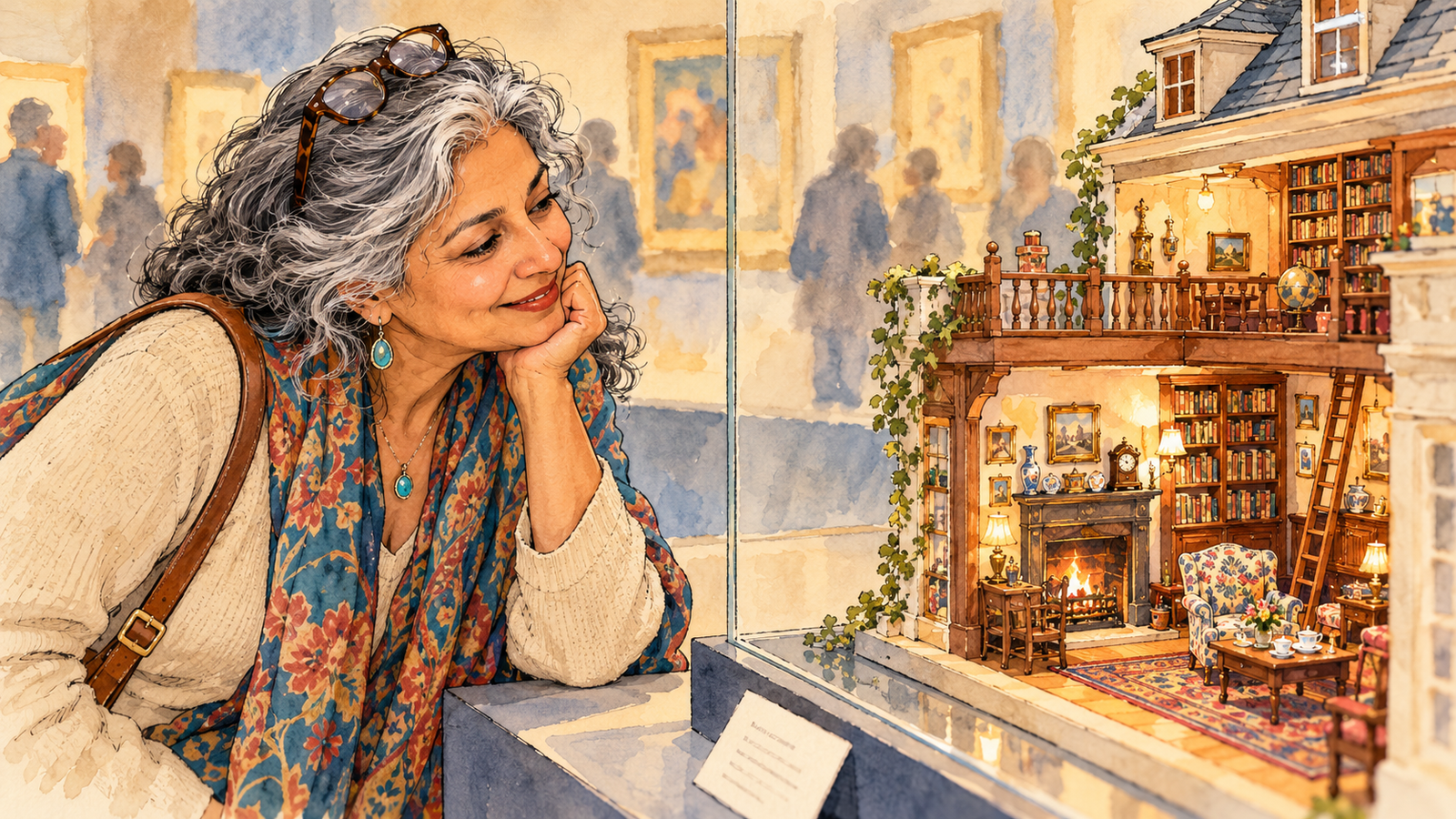
Somewhere, a grown adult is making a chandelier smaller than your thumbnail. I would like to meet this person.
I have reached an age where I refuse to explain why I spent twenty minutes examining a dollhouse bathroom. The sink had taps. The toilet had a lid. There was a folded towel on a rack no bigger than a paper clip. Meanwhile, in my own bathroom, the drawer sticks, the faucet drips, and the towels have apparently formed a union. Naturally, I wanted to see more of the dollhouse.
The trouble begins innocently. Someone shows you a miniature bakery, and you admire the window display. Then you notice six croissants on a tray. Are they individually shaped? Is that flour on the counter? Before long you’re enlarging the photograph, looking for the cash register, and wondering whether the tiny proprietor has passed a health inspection. You had intended to check the weather. Instead, you’ve become emotionally invested in a shop that cannot sell you a doughnut.
A Small House With Ridiculously High Standards
Queen Mary’s Dolls’ House, built between 1921 and 1924, may be the finest example of adults behaving magnificently over something no adult could possibly use. Made at one-twelfth scale, it has running water, electric lighting, working lifts, and a library of miniature books. More than 1,500 artists, craftspeople, and manufacturers contributed to it. I have seen family committees struggle to coordinate a potluck. These people organized functioning plumbing for royalty who would never be small enough to turn on the tap.
The books are especially outrageous. Some contain original writing by well-known authors, made for the little library. Imagine receiving a request to write a book, then discovering the intended reader would need a magnifying glass. Yet somebody made the shelves, somebody bound the pages, and somebody thought to arrange everything as though a very small person had just stepped out for tea. That last touch gets me every time. A room becomes interesting when it looks as if life has happened inside it.
Hermes Has Questions for the Sculptor
Aesop’s lesser-known The Sculptor and Hermes (Perry 307) tells of an artist selling a marble statue of Hermes. Two buyers appear. One wants the statue for his son’s tomb; the other wants to dedicate it to the god. They postpone the purchase until morning, leaving the sculptor to sleep on the decision.
That night Hermes visits him in a dream and points out that the sculptor now gets to decide whether he will become a dead man or a god. I suspect the artist had been hoping only to settle on a fair price. Ancient customer service could be demanding.
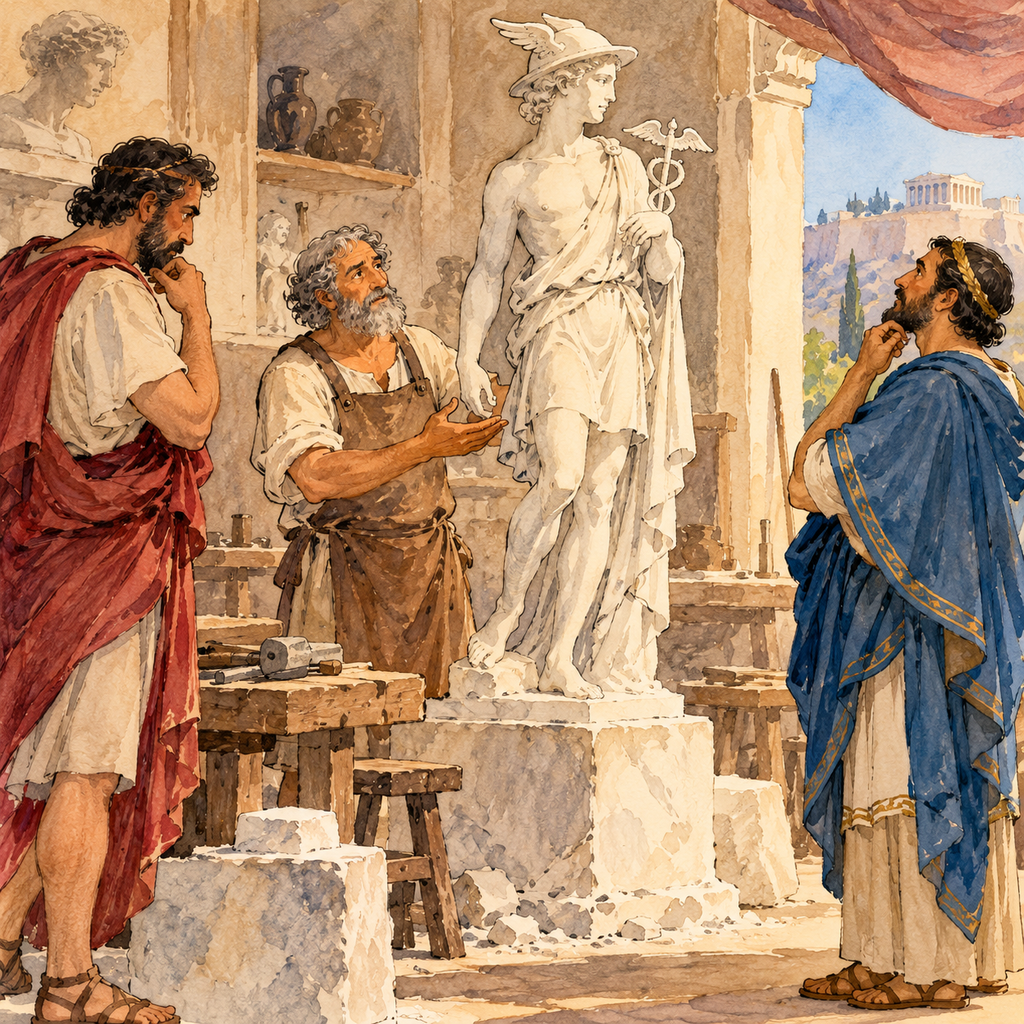
The fable is not about miniatures, and I won’t pretend it is. But it catches something funny about the objects people make: the same workmanship can send two viewers in entirely different directions. Put a miniature chair before me and I admire its carving. Put it before someone else and she starts imagining the person who lives in that tiny room. Put it before a third person and she asks whether the upholstery comes in blue. We bring our own worlds to the object.
Why We Have to Open the Tiny Cupboard
Psychologist George Loewenstein described curiosity partly as the feeling that appears when we notice a gap in what we know. A miniature gives us gaps by the dozen. We can see the little staircase, but where does it go? We can see a letter on a desk, but what’s in it? A partly open cupboard might as well have a sign reading, You know you want to look.
Scale supplies another surprise. We know what a grandfather clock looks like. Shrink one until it is smaller than a postage stamp, give it a swinging pendulum, and suddenly its familiar details become astonishing. We start thinking about the maker’s hands. How did anyone cut those pieces? How did they hold them? Did they sneeze halfway through and lose an entire dining room?
This is a plausible explanation for some of our fascination, not a claim that scientists have isolated a miniature-house gene. Smallness, detail, curiosity, and imagination can work together. The marvelous thing is how little encouragement the imagination needs. One dollhouse chair pulled away from its table, and I am already wondering who left in a hurry and whether the biscuits are burning.
Looking Is a Perfectly Good Activity
If you want a pleasant expedition, explore photographs of Queen Mary’s Dolls’ House on the Royal Collection Trust website. Choose one room and look slowly. Find three details you missed at first. Then look for the tiny books, or watch a miniature artist turn scraps of wood, paper, or clay into something absurdly convincing.
Search for miniature kitchens, historical model rooms, tiny pottery, or illuminated book nooks. Watch a maker assemble a chandelier with tweezers. It’s especially entertaining to see an artist calmly paint a flower on a plate smaller than a fingernail. I cannot always paint my own toenails without getting some on the furniture, so my admiration is considerable.
You may decide to make something small yourself. Or not. No kit is required, and nobody will ask you to demonstrate a newly acquired skill. This is not a twelve-week program in personal growth disguised as a dollhouse tour. You’re here to be impressed. That’s the entire itinerary.
No Practical Purpose Whatsoever
We have developed a tiresome habit of demanding that every interest earn its keep. Reading should improve us. Walking should count as exercise. A hobby ought to become a side business, preferably with its own logo. I object. Some pleasures are wonderfully, extravagantly unnecessary, and I would like them left alone.
Somewhere, someone has made a grandfather clock smaller than a postage stamp. It may never hang on a wall, support a family, or solve a single problem. But it has made somebody stop, lean closer, and say, “How on earth did they do that?” I consider that an excellent afternoon. The clock probably keeps better time than half the people I know.
🧺 A Question for the Road…What tiny, wonderfully unnecessary creation has ever made you stop and look twice?
🌿 You Might Also Enjoy
The Five-Minute Version Still Counts. Who decided that a little pleasure doesn’t count? Sometimes five minutes with a favorite book, a garden, or something that makes you smile is an experience worth enjoying in its own right.
Do I Really Have to Decide This Again? When ordinary life starts feeling like an endless committee meeting, perhaps it’s time to stop reopening every little decision. A humorous look at giving your brain fewer things to negotiate.
🌿 More Stories for the Life You’re Living
Life changes, sometimes dramatically and sometimes one bewildering little inconvenience at a time.
Join From The Fables for a monthly letter filled with timeless stories, practical wisdom, and a little humor about navigating life’s changes.
And there’s a welcome gift! You’ll receive a free copy of Best I Can Do Is a Mustache, our illustrated, irreverent look at menopause and its many surprises.