

Why doing less doesn’t have to mean enjoying life less.
There was a time when you could accomplish more before lunch than you sometimes manage in an entire day now. You kept a home, raised children, entertained friends, managed responsibilities, and somehow found time for the things you enjoyed. You didn’t think much about how you did it. You simply did.
Then life changed. Perhaps your health changed, your energy became less predictable, or the responsibilities that once organized your days disappeared. Activities that used to feel effortless began requiring negotiations with your body, your concentration, or your circumstances. You adjusted, because what else could you do? But somewhere along the way, you began treating the smaller things you could still manage as though they hardly counted.
You once maintained a beautiful garden. Now you have three pots on the patio, and one of them is considering legal action. You used to entertain a dozen people for dinner. Now you enjoy a friend stopping by for coffee, provided she doesn’t expect matching cups. You once read for hours. Today, three pages may be enough before your attention wanders off without leaving a forwarding address.
The activities have become smaller. Unfortunately, so has the credit you’re willing to give yourself.
When Enough Stopped Being Enough
One of the more frustrating habits we develop is measuring today’s accomplishments against yesterday’s abilities. We don’t simply notice that something has changed. We turn the comparison into a judgment.
Five minutes in the garden becomes “I barely did anything.” A short visit becomes “I can’t entertain anymore.” Three pages of a good book become “I used to be such a reader.”
Notice what happened. The experience itself may have been pleasant, satisfying, or meaningful. But instead of enjoying what happened, we immediately compared it with what might have happened twenty years ago. Naturally, the younger version of ourselves wins. She has an unfair advantage: we remember her best performances and conveniently forget the days she accomplished absolutely nothing except finding her car keys.
This is where all-or-nothing thinking quietly takes over. If we cannot do something the way we once did, we begin questioning whether the smaller version is worth doing at all.
And that’s a rather expensive way to live, because the price is paid in pleasures we could still be enjoying.
What a Little Fish Knew About Value
An old Aesop fable, The Fisherman and the Little Fish, tells of a fisherman who spends the day trying to catch something worth taking home. Eventually, he catches a very small fish.
The fish begs to be released, arguing that it is too tiny to be useful. If the fisherman waits until it grows, the fish promises, he will have a much better meal. But the fisherman refuses. A small catch he has today is worth more to him than the possibility of a larger one he might never catch.
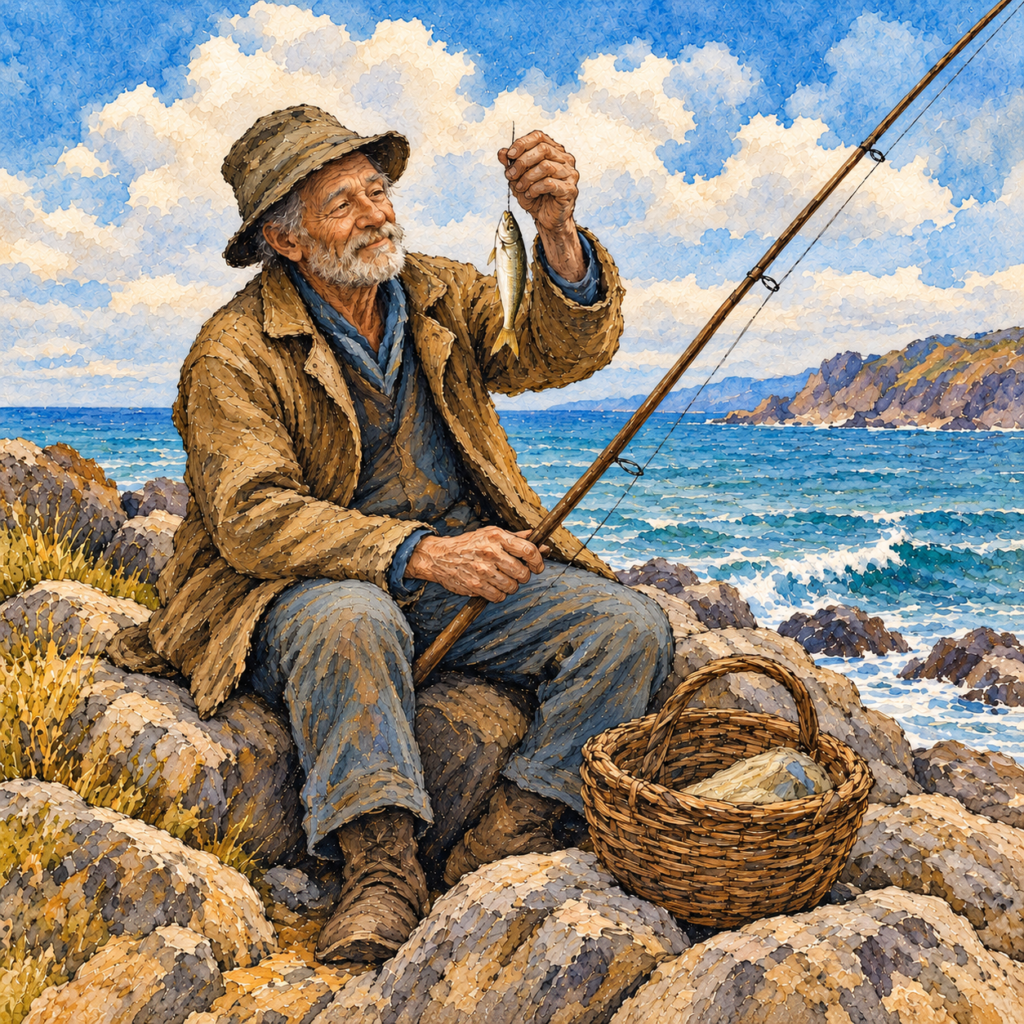
The original lesson concerns the wisdom of valuing something certain over a greater but uncertain reward. Yet there’s another useful thought hiding in that fishing basket.
The fisherman recognizes that something doesn’t become worthless simply because it is small.
We often do precisely the opposite. We throw away the value of what we can experience today because we’re comparing it with something larger that belongs to another time in our lives.
Of course, a visit with a friend isn’t a fish dinner, and meaningful experiences aren’t measured by what we can collect. But the comparison invites a useful question: Why do we insist that something must be bigger before we’re willing to appreciate it?
Your Brain Doesn’t Require the Deluxe Package
Psychology offers some useful support for this idea. One evidence-based approach called behavioral activation helps people reconnect with activities that provide pleasure, satisfaction, and a sense of meaning. It is commonly used in treating depression, but the underlying principle is relevant to everyday life: engaging in personally rewarding activities matters, even when those activities are modest.
The important distinction is that meaningful activity isn’t necessarily the same as impressive activity. Research into behavioral activation has examined the roles of enjoyment and accomplishment, finding that activities people expect to be rewarding can contribute to improvement in mood. The findings don’t establish that any particular five-minute activity will make someone happier. They do suggest that the personal value of an experience deserves more attention than its size.
All-or-nothing thinking interferes with that process. When we insist that an activity must be completed perfectly or not attempted at all, we create an unnecessary barrier between ourselves and experiences we might enjoy.
A woman who loves gardening may still enjoy the scent of damp soil and the sight of new growth while caring for one plant. Someone who treasures friendship may experience genuine connection during a brief conversation. A lifelong reader may still find delight in a single beautifully written passage.
The experience doesn’t have to reproduce its former size to retain its essential pleasure.
Commercial Clean Up
When my children were young, we invented something called Commercial Clean Up.
Back when television programs were interrupted by commercials, those interruptions became opportunities to straighten the house. We’d jump up, pick up whatever we could, and return to the program when it resumed.
Nobody expected the entire house to be spotless before the next scene. We weren’t launching a household improvement campaign or holding performance reviews. We were simply making use of a few available minutes.
And those minutes counted.
I’ve thought about that little family invention because it contains a surprisingly useful lesson for later life. We don’t always need a large block of time, perfect circumstances, or the ability to finish everything before something is worthwhile.
Sometimes five minutes is all the time available. Sometimes it’s all the interest we have. Sometimes the activity itself only needs five minutes. The mistake is assuming those minutes are merely a poor substitute for the longer version.
Commercial Clean Up worked because we accepted the available time instead of arguing with it. We didn’t stand in the living room mourning the fact that we couldn’t clean the entire house before the commercials ended. We picked something up.
Then we went back to enjoying our program.
Keep the Part That Matters
There’s a practical way to apply this idea without turning your life into another collection of assignments.
First, identify what you actually loved about an activity rather than concentrating on everything it once involved. If you enjoyed hosting dinners because you loved conversation and laughter, perhaps the elaborate meal was never the most important part. Coffee with one friend might preserve exactly what mattered.
Next, remove the unnecessary requirements. Reading doesn’t demand an hour, gardening doesn’t require a yard, and friendship doesn’t require a perfectly clean house. These are conditions we often attach to activities out of habit, not because the pleasure depends on them.
Finally, give yourself permission to stop without declaring the experience unfinished. If you enjoy ten minutes of painting, you don’t owe the canvas another fifty. If you take a short walk and notice something beautiful, the walk has already given you something. You don’t need to turn around and do another mile to earn it.
This isn’t an argument for filling every spare moment with miniature accomplishments. Some days, the nicest thing you can do with five minutes is sit outside and enjoy your coffee while it’s still hot. There is no requirement to improve yourself during the process.
The goal is to preserve access to the things that make your life feel like yours.
The Life You Have Still Belongs to You
There is genuine grief in recognizing that parts of our former lives may not return. We don’t need to pretend that a potted geranium is identical to the garden we once cultivated, or that a short visit replaces every pleasure of a house full of guests.
But recognizing a loss doesn’t require us to dismiss what remains.
We can miss the larger version while still appreciating the smaller one. We can acknowledge how much has changed without allowing the past to become the judge of every present experience.
Perhaps that’s the most important adjustment of all. Instead of asking whether today’s activity measures up to what we once managed, we can ask whether it gave us something worth having.
A little beauty. A little laughter. A little connection. A few moments of being absorbed in something we love.
Five minutes isn’t always the beginning of something bigger. Sometimes five minutes is the whole experience, complete exactly as it is. A smaller version of something you love is not necessarily a lesser version of your life.
🐟 And here’s something worth considering: What is one pleasure you’ve been dismissing because you can no longer enjoy it the way you once did—and what would happen if you let the smaller version count?
🌿 You Might Also Enjoy
Maybe Today Is a 60 Percent Day. When your energy doesn’t stretch as far as your plans, doing what you can still counts. Adjusting expectations can make room for accomplishment without exhausting yourself.
How to Accept Your Limits Without Disappearing. Changing how you do things doesn’t mean abandoning what matters. Sometimes a smaller, more manageable approach allows you to keep meaningful parts of your life.
🌿 More Stories for the Life You’re Living
Life changes, sometimes dramatically and sometimes one bewildering little inconvenience at a time.
Join From The Fables for a monthly letter filled with timeless stories, practical wisdom, and a little humor about navigating life’s changes.
And there’s a welcome gift! You’ll receive a free copy of Best I Can Do Is a Mustache, our illustrated, irreverent look at menopause and its many surprises.
GET MY FREE BOOK & MONTHLY LETTER