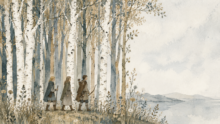

The Heart Remembers Every Mile
A hunter owned a hound who had served him faithfully for many years.
In his youth, the dog was everything a hunter could hope for. He was swift through the forest, fearless in the chase, and strong enough to bring down even the finest stag. His master depended on him for every hunt, and together they spent season after season crossing the same familiar woods.
But time is patient. Without asking permission, it leaves its mark on every living thing. The hound’s muzzle turned gray. His stride became slower. His teeth, once strong enough to hold any quarry, had grown worn with age.
Still, he answered the hunter’s call.
One day they chased a magnificent stag through the forest. After a long pursuit, the old hound caught the animal by its ear. For one hopeful moment, it seemed the hunt was won.
Then his grip failed. The stag broke free and disappeared among the trees. The hunter, angry at losing such a prize, turned on the old dog with harsh words, calling him useless.
The hound lowered his head and quietly replied, “My spirit is as strong as ever. My body is simply no longer what it was. Blame the years—not my heart.”
The story ends there. No miracle restores the hound’s strength. No one comes to defend him.
Only those few words remain, carrying a kindness that reaches far beyond the forest.
When The Body Begins Speaking Differently
There comes a day when your body quietly tells you something new. Not with a dramatic announcement. Not with a warning. Just a small moment when something you once did without thinking suddenly asks for more effort than before.
You pause. You notice. And a question quietly appears. Who am I if I cannot do what I used to do?
For many of us living with fibromyalgia or chronic illness, that question doesn’t arrive all at once. It unfolds through ordinary moments. The grocery trip that suddenly requires recovery. The afternoon that disappears into an unexpected nap. The walk that once felt refreshing but now asks for careful pacing.
What surprises us isn’t simply the change itself. It’s that inside, we still feel like the same person. Our determination hasn’t disappeared. Our willingness hasn’t faded.
Yet the body has begun negotiating different terms. Like the old hound, our spirit often arrives before our strength does.
The Part No One Else Can See
One of the hardest parts of chronic illness isn’t always the pain. It’s being misunderstood.
The hunter looked at a single failed moment and forgot an entire lifetime of faithfulness. We sometimes do the same thing to ourselves. We compare today’s body with yesterday’s expectations. We judge ourselves for needing rest. We apologize for cancelling plans. We measure our worth by how much we accomplish instead of how faithfully we care for ourselves.
Modern life quietly teaches us that productivity equals value. Move faster. Do more. Keep going. So when illness changes our capacity, it can feel as though our value has changed too.
But capacity and character are not the same thing. The old hound hadn’t lost his loyalty. Only his strength had changed.
What Your Nervous System Is Trying To Protect
There is a reason this feels so personal.
Our nervous systems are designed to notice anything that might threaten our sense of safety or belonging. For thousands of years, contributing to the group helped people survive. Although life looks very different today, our brains still carry some of that ancient wiring.
When illness changes what we can do, the nervous system can quietly interpret it as a threat. Not because we have become less valuable. But because our brains are trying to understand a body that no longer follows yesterday’s rules.
That is why chronic illness often affects identity as much as it affects muscles or joints. The struggle isn’t imagined. It’s deeply human.
Strength Has More Than One Language
Living with limits has taught me something I couldn’t have learned while rushing through life.
Strength doesn’t disappear. Sometimes it simply changes shape. It becomes pacing instead of pushing. Listening instead of proving. Resting before exhaustion instead of recovering afterward.
It becomes the courage to say, “This is what my body can offer today,” without believing that today’s limits define tomorrow’s worth.
The world may celebrate endless productivity. Our bodies often teach a quieter wisdom. That gentleness is not giving up.
It is learning how to continue.
What The Old Hound Still Knew
The older I get, the more I think the hunter misunderstood the wrong thing. The old hound wasn’t grieving because he had grown older.
He was grieving because his faithfulness had been mistaken for failure. There is a difference.
Our bodies may ask us to live differently than we once imagined. They may ask for slower mornings, lighter schedules, more rest, and greater compassion.
But none of those things diminish the heart that still wants to love well, contribute where it can, and remain faithful to the life it has been given.
Perhaps that is the quiet wisdom Aesop left for us. The years may loosen our grip. They never have to loosen our heart.
