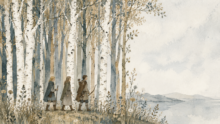

One day, the pair spotted a traveler making his way along a country road. He wore a heavy cloak against the chill, his head bowed against the weather. The North Wind saw an opportunity.
“Let’s settle this,” he said. “Whoever can make that traveler remove his cloak is the stronger.” The Sun agreed. The North Wind went first. He blew across the fields with all his might. He whipped leaves into the air and sent dust swirling along the road. He howled through the trees and pushed against the traveler with increasing force.
The traveler responded by pulling his cloak tighter. The harder the wind blew, the more firmly he wrapped himself in it. So the North Wind blew harder still. And the traveler held on tighter still. Eventually the wind exhausted itself.
Then the Sun took its turn. It did not argue. It did not push. It simply warmed the air. Slowly the chill began to leave the day. The traveler loosened his grip. His shoulders relaxed. Before long, he opened his cloak and carried it over one arm as he continued down the road. The Sun had succeeded where force had failed.
The old moral is simple enough: gentleness often accomplishes what pressure cannot. But lately I’ve been thinking about the traveler. Because some days, I am that traveler.
When Everything Feels Like Too Much
A few days ago I found myself saying something that sounded almost ridiculous: “I do not want to go anywhere for two weeks until these stupid holidays are done.”
It wasn’t anger. It wasn’t depression. It wasn’t even antisocial behavior, despite how tempting that diagnosis might sound to anyone who enjoys holiday potlucks. It was exhaustion.
The holidays have a way of piling noise upon noise. There are gatherings, expectations, schedule changes, extra errands, crowded stores, emotional memories, family dynamics, and a hundred tiny disruptions that don’t seem like much individually. Together, they become a storm.
For people living with fibromyalgia, chronic fatigue, grief, sensory sensitivity, or simply a nervous system that has been carrying too much for too long, the holidays are not always restorative. Sometimes they’re destabilizing. And when the world starts blowing harder, many of us do exactly what the traveler did. We pull our cloaks tighter.
The Curious Thing About Overload
From the outside, withdrawal can look like avoidance. Someone says no to invitations. They stay home. They cancel plans. They stop answering messages as quickly. To observers, it may seem as though they are shrinking from life. But often something very different is happening.
The body is trying to create safety. The traveler wasn’t resisting the wind because he was stubborn. He was responding to force. The more pressure he felt, the more tightly he protected himself. Many of us do the same thing.
The harder we push ourselves to keep up, the more depleted we become. The more demands we face, the less capacity we have to meet them. The more we insist that we should be fine, the less fine we often feel. It’s one of life’s more annoying paradoxes.
The body does not negotiate with “should.” I’ve checked. Repeatedly.
What The Nervous System Knows
Modern neuroscience gives us language that Aesop never had. When the nervous system perceives overload, it shifts toward protection. Energy is redirected. Attention narrows. The body becomes more vigilant. Recovery becomes more difficult.
This is especially true for people living with chronic pain conditions like fibromyalgia, where the nervous system is already working harder than average. In that state, adding more pressure rarely creates more resilience. It usually creates more bracing.
The North Wind strategy sounds like this: “Push through.” “Try harder.” “Don’t be lazy.” “Everyone else is doing it.”
The Sun strategy sounds very different: “Rest first.” “Recover.” “Let’s make this easier.” “You’re allowed to have limits.”
One approach tightens the cloak. The other allows it to loosen.
Perhaps The Cloak Isn’t The Problem
For years, many of us learn to blame ourselves for our responses. We criticize our fatigue. We judge our need for recovery. We compare ourselves to people whose bodies are playing by entirely different rules.
What if the problem isn’t that you’re holding the cloak too tightly? What if you’re simply cold? What if your nervous system has been standing in a storm for longer than anyone realizes? What if your desire for a quiet week, a slower schedule, or fewer obligations isn’t weakness at all? What if it’s wisdom?
Letting Gentleness Lead
I suspect that’s what these past few weeks have been teaching me. Not every season requires expansion. Not every opportunity requires a yes. Not every invitation deserves the last ounce of energy I have available.
Sometimes the bravest thing we can do is stop fighting our own limits long enough to listen to them. The traveler eventually loosened his cloak. Not because someone forced him. Because the conditions changed. Because warmth arrived. Because safety returned.
And perhaps that’s the deeper wisdom hidden inside this old fable. This is an old story—older than we remember—about what happens when gentleness is finally allowed to lead.
