
The Crossing Was Easy. The Return Wasn’t.
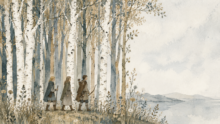
On a hillside above the Scottish village of Aberfoyle stood a minister named Robert Kirk.
He wasn’t known for chasing ghost stories or frightening tales. He was an educated man, a scholar, and a careful observer of the world around him. But alongside his work as a minister, he became fascinated by something many of his neighbors quietly accepted as part of Highland life: the Hidden People.
They were said to live in the same places as everyone else—just not in the same layer of the world.
Most people knew better than to seek them out. Kirk did something different. He listened.
He collected stories. He wrote about old beliefs with unusual respect, treating them as part of the landscape rather than dismissing them as superstition. He tried to understand what others simply accepted.
Then, according to Scottish tradition, something curious happened.
One evening, while walking the hills he knew so well, Robert Kirk collapsed and died.
Or perhaps he didn’t.
The story says he crossed too close to the Hidden People’s world and never fully returned. Some believed they had taken him. Others claimed he could still be seen, just beyond ordinary sight. A few even whispered that he appeared briefly after his death, unable to remain in either place.
Whether anyone believed the tale mattered less than what it captured.
It imagined a man who stepped across a boundary so subtle that no one noticed until he could no longer find his way completely home.
When the Familiar Feels Strange
That’s the part of the story that lingers. Not the disappearance. The return.
Many of us know what it feels like to come back… and still not feel entirely here.
There are mornings with fibromyalgia when I wake up and everything appears perfectly ordinary. The bedroom is the same. The sunlight falls across the floor exactly where it always has. Nothing has happened overnight that anyone else could point to.
Yet something feels slightly misaligned. You’re awake—but not fully settled. Present—but not quite connected. Like the space between dreaming and being fully here.
It’s difficult to explain because nothing looks wrong from the outside.
You simply don’t feel like you’ve landed yet.
The Invisible Crossing
People often expect illness to announce itself loudly. Pain. Swelling. A fever. Something obvious that explains why today feels different.
Fibromyalgia doesn’t always work that way.
Sometimes the hardest symptoms are the invisible ones—the quiet changes in attention, memory, balance, and emotional steadiness that leave you feeling half a step away from yourself.
You can still make breakfast. You can still answer the phone. You can still smile when someone asks how you’re doing.
Meanwhile, inside, you’re trying to find your footing. Not because you’ve become someone else.
But because your body hasn’t quite found its rhythm today.
What the Nervous System Is Doing
Researchers now understand that fibromyalgia changes the way the nervous system processes information.
Instead of filtering sensations efficiently, the brain may amplify signals that would normally fade into the background.
Pain is only part of that picture. Fatigue. Brain fog. Sensory overload.
Even emotional disorientation can arise from a nervous system working much harder than anyone else can see.
Imagine trying to listen to one quiet conversation while dozens of radios are playing around you.
Eventually everything begins to feel overwhelming—not because you’re weak, but because your brain is sorting through far more information than it was designed to manage.
When that happens, it’s understandable that the world can feel slightly out of focus.
Learning Not to Force the Return
For years, I assumed those days meant I wasn’t trying hard enough.
If I planned better…
Rested more…
Pushed a little harder…
Surely I’d return to the person I remembered.
But chronic illness has taught me something Robert Kirk’s story quietly understands. Not every crossing can be uncrossed. Illness changes us. Grief changes us. Long seasons of stress change us.
We don’t become different people. We become people carrying different information.
Different limits. Different ways of paying attention. There’s sadness in that.
There’s wisdom too. Perhaps healing isn’t about becoming who we were before the crossing. Perhaps it’s about learning the shape of the person who came back.
A Quieter Kind of Homecoming
Robert Kirk’s story has survived for centuries because it gives shape to something people have always known.
There are crossings that leave no footprints. Journeys no one else can see. Returns that never feel quite complete. Maybe that’s why the story still speaks to us.
Not because it’s about disappearing into another world. But because, sooner or later, most of us discover that we don’t come through every season exactly the same.
And perhaps we were never meant to.
Sometimes the kindest thing we can do is stop trying to become the person who crossed the threshold…
…and begin caring for the one who quietly came back.
.jpg)