Slow living gets considerably more interesting when your body has its own opinions about the schedule.
The Summer Felt Endless
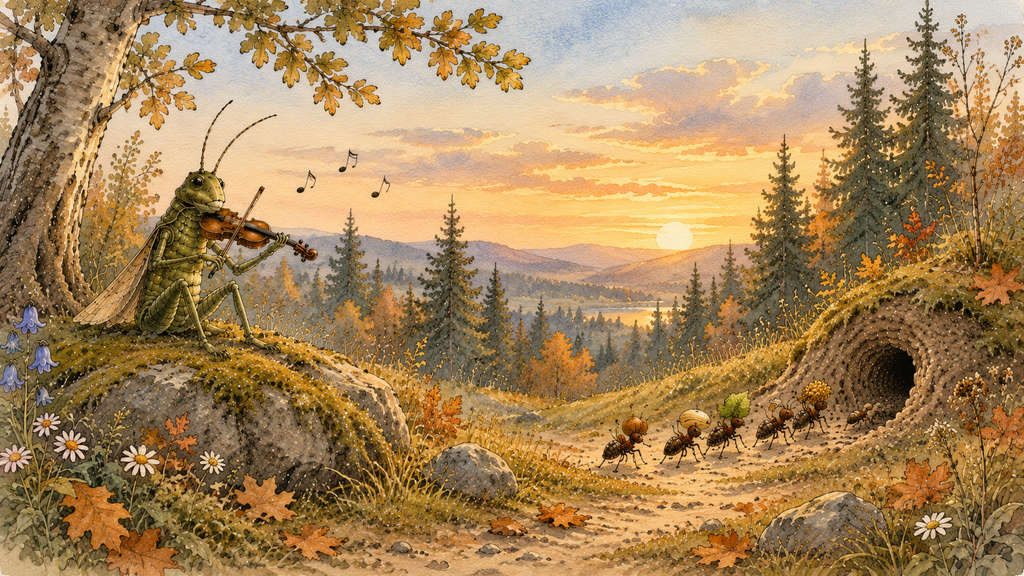
All summer long, the grasshopper played his fiddle.
He played beneath the trees when the mornings were cool and beside the meadow when the afternoons grew warm. There were flowers everywhere, food was easy to find, and winter seemed like the sort of problem sensible creatures could postpone until winter actually bothered to show up.
Nearby, the ants went about their business.
They carried seeds. They carried bits of grain. One hauled a leaf considerably larger than seemed reasonable for an animal that size. Another disappeared into the nest and came back out again. Nobody appeared frantic. There was no ant supervisor standing on a pebble shouting about fourth-quarter productivity. They simply kept going, a little at a time, while summer was generous.
The grasshopper watched them and wondered why anyone would spend such lovely days preparing for miserable ones.
Then the light began to change. The flowers faded. The grasses browned. Cool mornings became cold mornings, and eventually the ground hardened beneath the first frost.
The grasshopper put down his fiddle. Inside their nest, the ants had food. They had not defeated winter. They had simply remembered it was coming.
I Think We May Have Misjudged the Ants
I grew up hearing this as a story about hard work and laziness. The ants were industrious. The grasshopper was irresponsible. Work now or suffer later. Very efficient. Possibly designed by someone who thought sitting down before sunset was a character defect.
But the older I get—and the more years I spend living in a body with fibromyalgia—the less interested I am in that interpretation.
What catches my attention now is that the ants weren’t rushing. They worked steadily while conditions allowed it. They responded to the season they were in while remembering that another season would follow. That sounds less like hustle to me and more like slow living.
Slow living is sometimes presented as linen dresses, homemade bread, and drinking tea beside a window while rain falls decoratively outside. I have no objection to any of these things. I would happily accept the cottage as well.
But slow living is really about intention. It means paying enough attention to your life that you stop automatically moving at whatever speed the world has chosen for you.
For those of us with chronic illness, that becomes something more than an aesthetic preference. Sometimes it becomes survival.
When a Good Day Starts Making Promises
Fibromyalgia has an irritating little trick. You wake up one morning and feel surprisingly decent. Naturally, this means you should wash the sheets, clean the kitchen, answer six emails, reorganize the closet, make soup, walk farther than usual, and possibly begin restoring a Victorian farmhouse.
Because apparently feeling 20 percent better means we have been granted immortality.
Then tomorrow arrives. This is where the ants have something useful to say. A better day doesn’t have to become a catch-up day. It can become a preparation day.
Maybe I cook enough food for tomorrow. Maybe I do one load of laundry instead of declaring war on the entire hamper. Maybe I refill the things I know I’ll need, make the phone call I’ve been postponing, or stop while I still have something left.
That last one is difficult. Stopping before exhaustion can feel almost unnatural when you’ve spent years measuring a successful day by how much you squeezed out of yourself.
The Body Keeps Its Own Calendar
There is a physical reason pacing matters with chronic illness. Pain, fatigue, sleep disruption, stress, sensory overload, and exertion all draw from overlapping systems in the body. With fibromyalgia, the nervous system can become unusually sensitive to incoming signals, and activities that seem ordinary on paper can cost more energy than expected.
The bill doesn’t always arrive immediately. That’s the particularly charming part. You can feel capable while you’re doing something and discover hours later—or the next day—that your body had been keeping receipts.
Pacing tries to interrupt that boom-and-bust cycle. Instead of using every bit of available energy because it happens to be there, we leave some margin. Not because we’re pessimistic. Because we’ve met Tuesday before.
Slow living fits beautifully here because it asks a different question. Not How much can I accomplish while I feel good? but What pace can my life actually sustain?
Those are very different lives.
Preparing Is Not the Same as Worrying
I also think there is an important distinction between preparing for harder days and living in fear of them. The ants weren’t sitting underground all summer fretting about snow. They were outside. Summer was still summer.
The grasshopper’s mistake wasn’t enjoying himself. Frankly, I think the ants could probably have benefited from a little fiddle music while they worked. The trouble was behaving as though today’s abundance guaranteed tomorrow’s.
Chronic illness teaches this rather efficiently.
I don’t want to spend my better days afraid of the next flare. I want to enjoy them. Go outside. Write something. Laugh with somebody. Notice the light. Do something wonderfully unnecessary.
But I can enjoy today without borrowing energy from tomorrow. That may be one of the gentlest forms of preparation there is.
Carry One Small Thing
Perhaps that’s what I like most about the ants now. They didn’t carry winter. They carried one seed. Then another.
Slow living with chronic illness can look exactly that ordinary. Keep easy food available. Rest before the crash. Leave space between appointments. Put something back where your foggy future self can actually find it. Say no before resentment has to say it for you. Let a good day remain a good day instead of turning it into unpaid overtime.
None of this is particularly glamorous. Neither is carrying a seed. But enough small acts of care begin to create something larger: a life that doesn’t require you to start from empty quite so often.
The old moral says it is best to prepare for the days of necessity. I think I would soften it a little. Take care of tomorrow while today is still kind.
Reflection Question: 🐜 What is one small thing you can do today to make tomorrow a little easier?