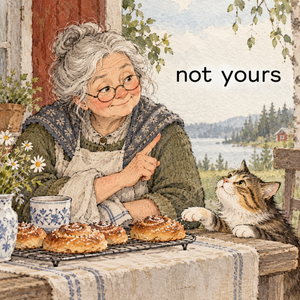
Not every better thing belongs to you.
The Axe That Knew His Hand
A carpenter once went into the woods to work beside a stream. He carried the same axe he had used for years, the kind of tool that had stopped looking like an object and started feeling like part of his hand. The handle was worn smooth where his fingers had held it. The blade had nicks and small scars from honest use. No one would have called it beautiful, unless they had a sentimental attachment to practical objects and possibly needed to get out more.
Still, it was his axe. It knew the rhythm of his work. It had helped him earn his bread. It had weight, history, and usefulness, which are three qualities that rarely look impressive until they are gone.
That morning, as he worked near the water, the axe slipped. One moment it was in his hand. The next, it had flashed downward and vanished into the stream. The carpenter stood frozen on the bank, staring at the place where the water had closed over it as though nothing important had happened.
But something important had happened. Without his axe, he could not work. Without work, he could not earn. Without earning, the day ahead suddenly grew teeth.
He searched along the bank, but the water was too deep and dark. At last, he sat down beside the stream, helpless and heartsick over the plain tool that had been enough until the moment he lost it.
The Shining Mistake
As he sat grieving, Mercury appeared and asked what troubled him.
The carpenter told the truth. His axe had fallen into the stream. It was not fine. It was not rare. It was not the sort of axe anyone would lock in a chest or pass around at dinner parties as a conversation piece. It was simply his, and he needed it.
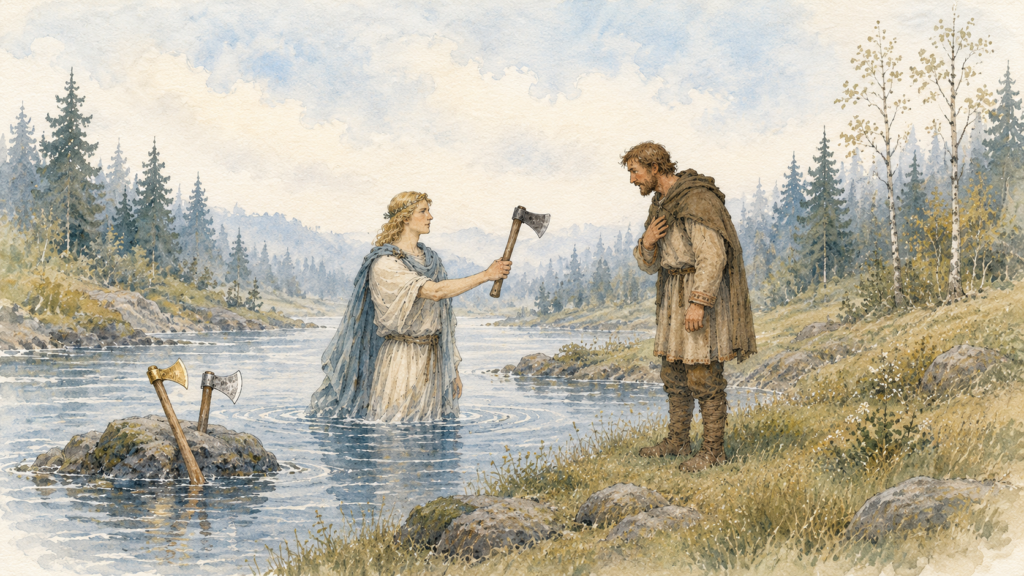
Mercury listened, then went down to the water. When he returned, he held up an axe made of gold.
“Is this yours?” Mercury asked.
The carpenter looked at it. Anyone would have looked at it. It shone in the pale morning light with the kind of beauty that makes a poor man briefly wonder whether honesty might be overrated. That one axe was worth more than he owned. It could have changed his life in an afternoon.
But he shook his head.
“No,” he said. “That is not mine.”
Mercury went again and returned with an axe made of silver.
This one was not as dazzling as the gold, but it was still far finer than anything the carpenter had ever carried. It gleamed with possibility. It was elegant, valuable, and entirely unsuitable for the actual work waiting in the trees.
Again, the carpenter shook his head.
“No,” he said. “That is not mine either.”
The Plain Thing Returned
A third time, Mercury reached into the water.
This time, he brought up the old axe: the worn wooden handle, the marked blade, the familiar shape of an ordinary life.
The carpenter stood.
“That one is mine,” he said.
Mercury, pleased by the carpenter’s honesty, gave him all three axes. The old story calls this a reward for truthfulness, and that is certainly there. But before the reward ever arrived, something quieter had already happened.
The carpenter recognized what belonged to him.
He was offered something richer, shinier, easier to admire. He was handed a version of his life that would have looked better to everyone watching. And still, he did not claim what was not his.
He knew the difference between a beautiful thing and a true thing.
The Better Body Everyone Offers
This still happens.
Usually there is no Mercury, which is probably good, because most of us have enough appointments without adding woodland gods to the calendar. But the offer still comes. Life is always holding up shinier versions of ourselves and asking, “Is this yours?”
Here is the gold axe: the energetic body. The one that can show up, stay late, answer messages, cook the meal, attend the gathering, laugh at the right places, and recover by morning like some sort of mythical housekeeping appliance.
Here is the silver axe: the agreeable body. The one that says, “I’m fine.” The one that softens every limit so no one else has to feel awkward. The one that makes the visit work, stretches the conversation, and keeps smiling while the nervous system is already packing a suitcase and leaving town.
Then there is the plain axe.
The real body. The actual capacity. The truth of today.
This one may come with fibromyalgia, pain, fatigue, food sensitivities, dizziness, brain fog, early exits, quiet rooms, canceled plans, and the humiliating need to rest after something other people call “just a quick errand.” It does not sparkle. It does not photograph well. It has absolutely no interest in your plans.
Still, it is yours.
When The Handle Is Worn
Living with chronic illness often means being surrounded by axes that are not yours.
People may remember an older version of you and offer her back as if you simply misplaced her. They may say, “You used to be able to,” or “Maybe if you just,” or “Come on, it will be good for you,” as though the gold axe will fit if everyone is cheerful enough.
And sometimes you want to reach for it. Of course you do.
You may want to be easy again. You may want to prove that love, faith, usefulness, friendship, intelligence, and humor still live inside you. You may want to be the person who can do the thing without calculating the cost like a tired clerk in sensible shoes.
But a body with fibromyalgia is often working with a sensitized nervous system. Pain can be amplified. Sleep may not restore. Stress, noise, weather, exertion, strong emotion, social effort, and food triggers may all draw from the same small account. What looks like “not much” from the outside may be a full day’s labor inside the body.
That does not mean you are weak.
It means the tool in your hand is real.
Enough For This Day
The carpenter’s wisdom was not that he rejected beauty. It was that he did not betray reality to gain it.
That is a tender kind of courage.
When you say, “I can’t do that today,” you are not refusing love. You are naming the axe you actually have. When you say, “I need to leave early,” you are not being difficult. You are protecting tomorrow’s body from today’s overreach. When you say, “I want to be there, but I cannot spend that much energy,” you are not making excuses. You are refusing to claim a gold axe that will not fit your hand.
There is grief in that. The plain axe may not be the one you would have chosen. It may feel smaller than the life you planned. It may make you miss the old ease, the old pace, the old way of moving through the world without negotiating with your own nervous system before noon.
But honesty is not defeat.
Honesty is how you keep working with the life you actually have.
The gold axe may impress people. The silver axe may please people. But the plain axe is the one your hand can hold.
And sometimes healing begins there: not in becoming shinier, stronger, easier, or more acceptable, but in telling the truth without apology.
This is mine.
This is what I can carry.
This is enough for today.
Reflective Question: 🪓 Where have you been trying to carry a shinier version of yourself, when the plain truth may be the only tool your body can actually hold?