Sometimes protection becomes a cage long before anyone admits the door is locked.
The Palace Had Everything Except Freedom
There are cages made of iron, and then there are cages with comfortable chairs. Those are harder to recognize.
A king had one beloved son. Then came a dream: the young prince would someday be killed by a lion. The king, understandably unwilling to file this under Things We’ll Just See How They Go, decided to remove the danger entirely.
He built his son a magnificent palace and kept him safely inside.
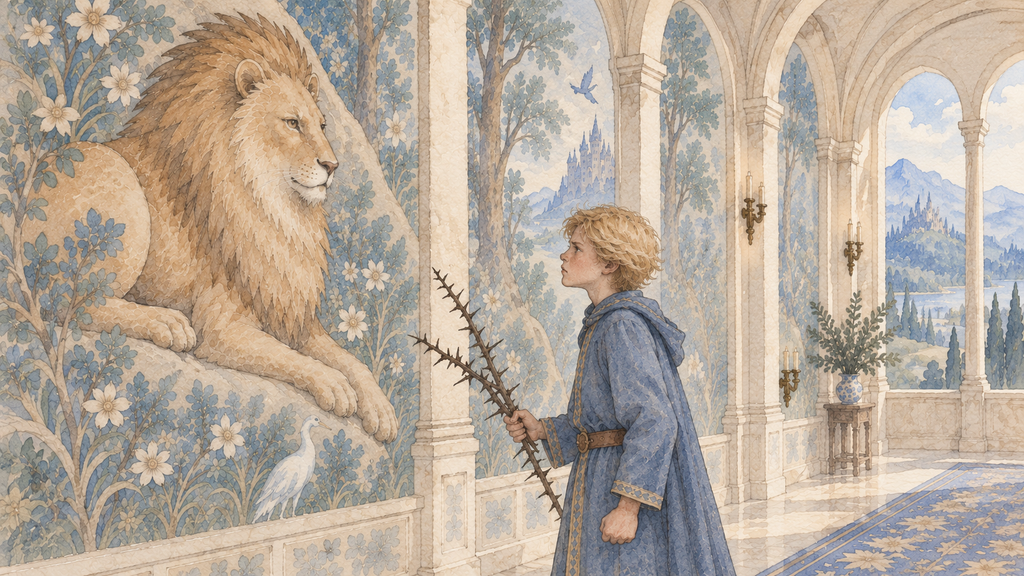
This was no dungeon. The young man had beautiful rooms, servants, food, warmth, music, every comfort a frightened father could arrange. The walls themselves were painted with forests and animals so the prince could enjoy the natural world without encountering any of its inconveniences, such as weather, mud, or apparently death by lion.
The king gave his son everything. Except a door. Among the paintings was a lion.
The King Wasn’t Cruel
That matters. The story would be easier if the father were simply a tyrant. We could identify the villain, shake our heads knowingly, and be home in time for tea. But the king is afraid.
He loves his son. He believes confinement is the price of keeping him alive. His intentions are protective, even tender. Which is precisely why the story still has teeth.
Some of the most suffocating words in the English language can be, I’m only doing this because I worry about you. The sentence may be completely sincere. It may also precede the removal of someone’s choices.
We do this with adult children, aging parents, disabled family members, people recovering from illness, people who have fallen, people who have made bad decisions, and occasionally people whose decisions simply make us nervous.
Sometimes limits are necessary. Some risks are real. But there is a difference between helping someone navigate danger and quietly replacing their life with one we have decided is safer.
Love does not automatically make control harmless.
The Painted Forest
The detail I keep returning to is the artwork. The prince is surrounded by paintings of the world he cannot enter. Forests climb the walls. Birds remain permanently in flight. Deer stand beneath painted trees. Horses run across landscapes no human foot can reach.
Here is the world, son. You just can’t enter it. There is something almost crueler about that than bare stone. A prison announces itself honestly. A beautiful cage can confuse you.
You are housed. You are warm. You are fed. Someone is looking after you. What exactly do you have to complain about?
Only this: Your life is no longer yours. That is not a small loss.
Safety Is Not the Same Thing as Living
Human beings need some sense that our choices matter. We need to experience ourselves as participants in our own lives rather than passengers being transported through them by more sensible people with clipboards.
The issue is not whether limits exist. Of course they do. Illness creates limits. Disability creates limits. Aging creates limits. Money, bodies, circumstances, and other people’s rights create limits.
The question is whether the person inside those limits still has meaningful choices.
There is an enormous difference between asking, How can we make this safer for you? and announcing, You are not doing that anymore.
One preserves agency. The other can slowly erase it.
When people repeatedly experience that nothing they decide changes anything, they may eventually stop trying. Psychology has a name for one version of this: learned helplessness. But human beings are messier than a tidy definition. Some become passive. Some withdraw. Some ruminate. Some become irritable. Some become furious.
And some start wanting to hit painted lions.
He Never Escaped
That is the strange brilliance of this fable. The prince does not run away and meet a lion in the forest. He never gets that far. He stands before the painted lion, the image of the creature responsible for his entire confinement, and his anger finally has somewhere to go. He reaches for a thorny branch to strike the painting.
A thorn pierces his finger. The wound becomes inflamed. Fever follows. And the prince dies inside the palace built to keep him safe. The king succeeded in keeping every lion away from his son. He did not succeed in keeping suffering away from him.
In trying to eliminate one danger, he created another kind of life entirely.
The Trouble With Zero Risk
Fear loves certainty. No falls. No bad relationships. No financial mistakes. No driving accidents. No exhaustion. No strangers. No possibility that the dreadful thing we imagined at three in the morning might actually happen.
So we begin trimming away risk. Then we trim a little more. Eventually we may discover that we have removed a substantial portion of someone’s life along with it.
There is no completely safe version of being alive. Walking contains the possibility of falling. Driving contains the possibility of crashing. Loving contains the possibility of grief. Choosing contains the possibility of choosing badly.
Autonomy has consequences. That is partly what makes it autonomy.
Real care may sometimes require saying no. But it should also remain curious. What can this person still do? What choices can remain theirs? Can a risky activity be modified rather than abolished? Can assistance increase freedom instead of merely increasing supervision?
And perhaps most importantly: Have we asked the person whose life we are reorganizing?
A person can be grateful for help and still resent control. They can understand your fear and still want their keys. They can love you and still want you out of the driver’s seat of their life.
Those things are not contradictions.
The Lion on the Wall
The real lion was never in the room. Fear was. Fear built the palace. Fear locked the door. Fear called the arrangement protection. And love paid for the furnishings.
Sometimes the cage is built by someone who loves you. Sometimes every bar has a perfectly reasonable explanation. Sometimes the person holding the key is frightened, exhausted, and completely convinced they are doing the right thing. They may even be partly right.
But the person inside the cage is still inside a cage. A palace does not become freedom because the wallpaper is beautiful. A painted forest is not a walk beneath trees.
And being kept alive is not quite the same thing as being allowed to live.
Reflective Question: 🦁 What would it look like to make your life safer without making it smaller?