The Fisherman and the Flute
He thought the fish would dance when he played. What happened when they didn’t says something uncomfortable about kindness, control, and what we do to keep the peace.
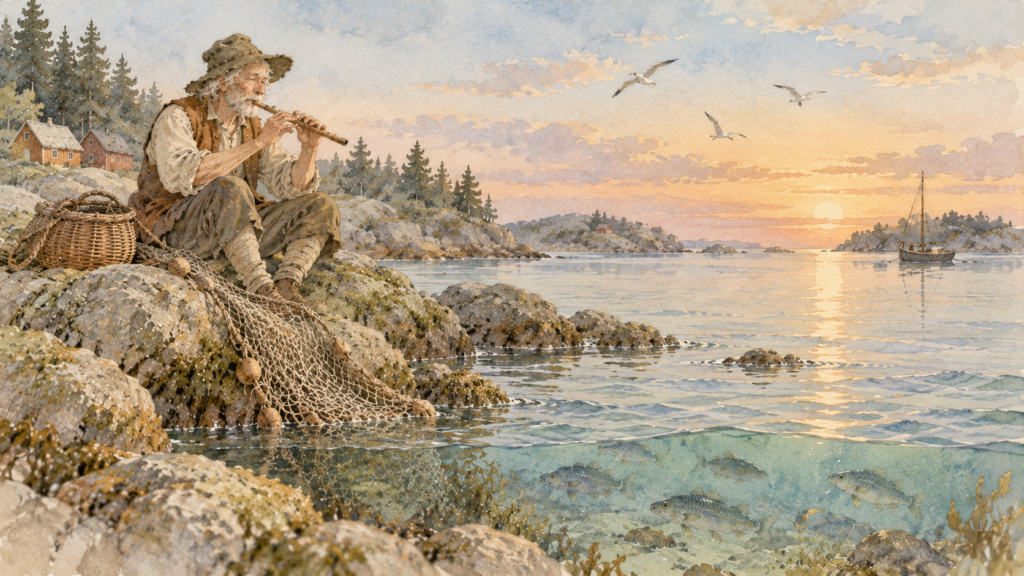
A fisherman went down to the shore carrying two things: his flute and his net.
He was good with both, although on this particular morning he decided to try the flute first. He climbed onto a rock overlooking the water and began to play, certain the fish would be so delighted by his music that they would leap from the sea and dance for him.
The fish, having apparently received no invitation to this arrangement, continued being fish. They swam beneath the surface. They darted between the rocks. They showed absolutely no appreciation for the concert being performed on their behalf.
The fisherman kept playing.
Still nothing.
Eventually he put down the flute, picked up his net, and cast it into the water. This worked considerably better. Soon he hauled a great catch onto shore, where the trapped fish twisted and flopped desperately against the net.
The fisherman looked at them and laughed.
Now you dance, he said. When I played for you, you would not dance at all.
Aesop apparently had no objection to leaving us with an uncomfortable little story.
Neither do I.
When the Flute Stops
There is something about this fable that becomes much less amusing once you have lived long enough to recognize it. The fisherman believes the fish are finally doing what he wanted. They are moving. They are jumping. At last, he has his dance.
Except they aren’t dancing. They are trying to survive. That distinction matters more than I once understood.
There are relationships in which kindness comes with an invisible agreement attached. Everything feels pleasant while you respond correctly. The music plays. There may be affection, generosity, praise, attention, help, reassurance, or all the other things we naturally associate with being cared for. You can mistake all of that for safety because, for a while, it feels like safety.
Then you say no.
Or you disagree. You stop explaining yourself. You make a choice the other person doesn’t like. You need something inconvenient. You set a boundary where previously there wasn’t one.
And somewhere in the background, the flute gets put down.
That’s when you discover whether the kindness was actually kindness or whether it was cooperation wearing a nice sweater.
Learning the Dance
I think many of us learn to dance long before we understand why we’re doing it. We become good at reading a room. We notice the slight change in someone’s voice. We recognize the pause before irritation, the expression that means we have ventured onto dangerous ground, the sudden chill after we’ve said something unwelcome.
So we adjust.
Usually it happens by inches. We explain ourselves more carefully. We choose the less troublesome opinion. We apologize quickly. We learn which subjects are best left alone. We become agreeable in places where we aren’t actually agreeing.
From the outside, this can look like peace.
From the inside, it can feel like constantly checking the weather.
The strangest part is that after enough years, you may forget you’re doing it. The accommodations become ordinary. You stop calling them accommodations at all. This is simply how the relationship works. This is simply what keeps things calm. This is simply what you do because Tuesday is already exhausting enough without adding an emotional hostage negotiation before dinner.
Seeing the Net
There is grief in recognizing this, and I don’t think we talk enough about that part.
Seeing the net isn’t necessarily a triumphant moment with swelling music and a woman marching toward the horizon in excellent boots. Sometimes it is terribly sad.
Because the flute was real too.
There may have been beautiful moments. There may have been laughter and tenderness and years of shared history. Someone can hurt you without every moment with them having been horrible. Human beings would be much easier to sort if difficult people were issued black capes and sinister background music, but apparently no one consulted me when designing the system.
So we grieve what was good. We grieve what we hoped the relationship could become. Sometimes we grieve the person we were inside it—the one who worked so hard to keep everything smooth and believed that if she could just find the right words, the right tone, the right amount of patience, perhaps the music would begin again.
But eventually another possibility appears.
Maybe the problem was never that you weren’t dancing correctly.
Maybe you weren’t supposed to dance on command at all.
When Your World Is Already Small
That realization can be especially complicated when illness, aging, grief, disability, or plain old life has already made your world smaller. Relationships matter enormously when your energy is limited and your circle has narrowed. Losing one can feel frightening even when keeping it requires you to disappear by degrees.
And sometimes that is exactly what happens. We protect a relationship because we are afraid of what will be left without it. We tolerate things at sixty or seventy that we might have walked away from at thirty, not because we’ve become weaker, but because the arithmetic has changed. Starting over costs more. Loneliness looks different. Energy isn’t an unlimited resource anymore, assuming it ever was.
Still, there is a difference between compromise and erasure.
There is a difference between kindness and compliance.
And there is certainly a difference between choosing to dance and thrashing because you’ve been caught in a net.
Sometimes We’re the Fisherman
These days I pay more attention to what happens when someone says no. Not just when I say it, either. I pay attention to my own reaction when another person disappoints me, changes her mind, sets a boundary, or refuses the part I had quietly assigned her in my head.
Because none of us is automatically the fish.
Sometimes we’re the fisherman.
That is the annoying thing about old fables. Just when you’ve comfortably identified the villain, Aesop wanders back into the room and points at your chair.
The healthiest relationships I know have room for people who occasionally refuse to dance. The music doesn’t stop because someone disagrees. Affection isn’t withdrawn as punishment. Boundaries don’t become evidence of betrayal. Nobody has to perform gratitude, obedience, cheerfulness, or endless availability to remain safely loved.
The fish in Aesop’s story couldn’t tell the fisherman any of this. They were rather occupied with trying to breathe.
But perhaps that’s why their story has survived.
Sometimes what looks like cooperation is fear. Sometimes what looks like peace is carefulness. And sometimes we become so practiced at keeping everyone else comfortable that we stop noticing how uncomfortable we have become ourselves.
Maybe the question isn’t whether we’ve learned the dance well enough. Maybe it’s whether anyone should have required us to dance in the first place.
Reflective Question: 🐟 Where in your life have you been working so hard to keep the peace that you haven’t stopped to notice whether you’re actually free?