How to find purpose and rebuild your sense of self when a role that once defined your life comes to an end.
There comes a strange moment in life when you realize that nobody needs you to do the thing you spent years doing.
The children are grown and managing their own lives. The job that structured your days belongs to someone else. The person you cared for no longer needs your help, perhaps because they recovered, moved away, or died. The household runs differently now, and responsibilities that once filled every available hour have quietly disappeared.
You may have spent years wishing for fewer demands on your time. Now that those demands are gone, you discover that freedom and feeling unnecessary can arrive together.
The difficult question isn’t always what to do with your time. Sometimes it’s much more personal: Who am I when I’m no longer doing what made me important?
When a Role Becomes an Identity
Most of us accumulate roles without giving them much thought. We become mothers, wives, employees, caregivers, organizers, problem-solvers, and the person everyone calls when something goes sideways.
Over time, those responsibilities become part of how we understand ourselves. We don’t simply perform a job; we become the capable person who knows how to do it. We don’t just care for someone; we become the person who is needed.
Then circumstances change. And while the practical responsibilities may end overnight, our sense of identity doesn’t necessarily change with them.
You can know perfectly well that your children should become independent and still miss being central to their lives. You can be relieved that a difficult caregiving responsibility has ended and still feel lost without its familiar routines.
Those feelings aren’t contradictory. They are part of leaving behind a life that required a particular version of you.
The Horse Who Remembered Another Life
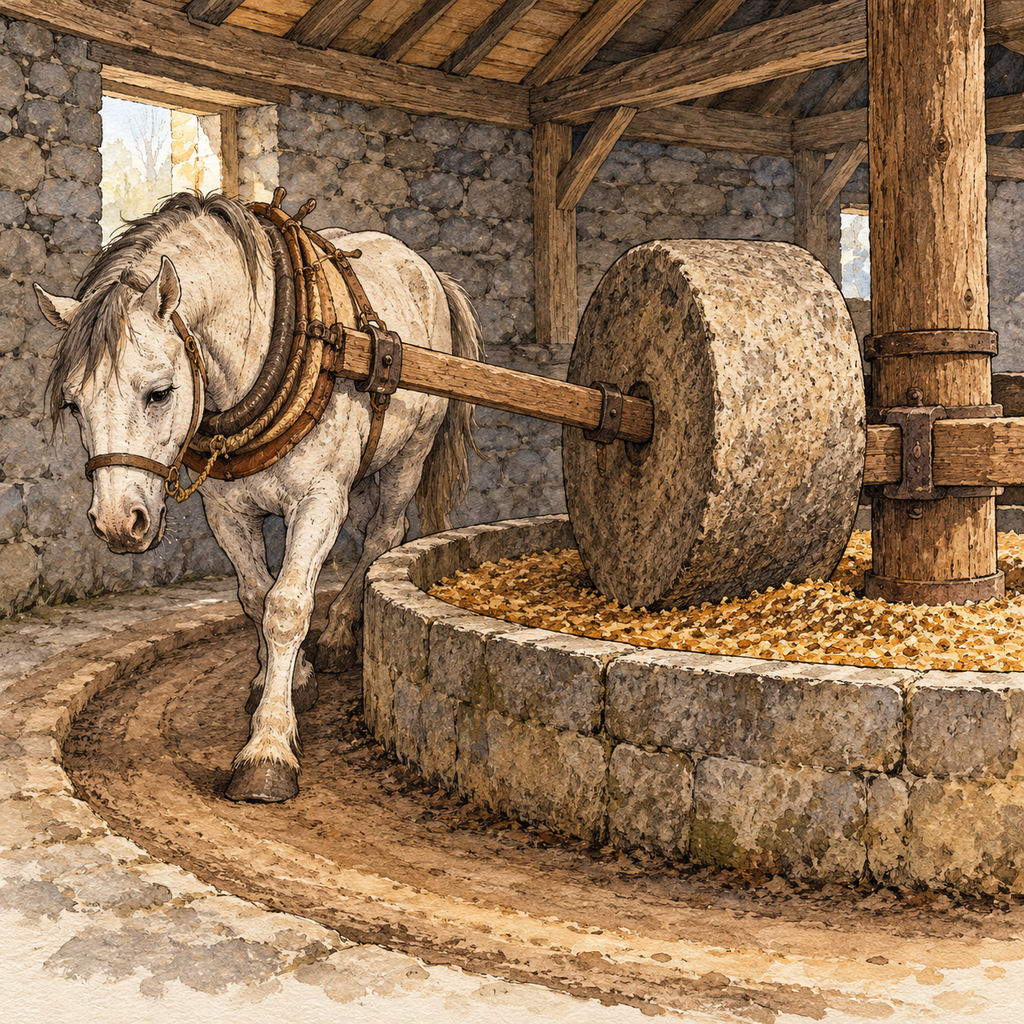
One of Aesop’s lesser-known fables, The Old Race Horse in the Mill (Perry #318), tells of an aging horse who had once enjoyed an important position. Depending on the telling, he had been a racehorse or a decorated warhorse, accustomed to excitement, attention, and special treatment.
Now he was working in a mill, walking in circles to turn a heavy stone.
The horse remembered his former life and lamented the difference between what he had once been and what he had become. The miller offered little sympathy. Fortune changes, he explained, and the horse would have to accept his circumstances.
Well, thank you, Mr. Miller. Most helpful.
The miller wasn’t entirely wrong. Circumstances change, and we cannot always return to what we once had. But his advice leaves out something important.
The horse’s former work had ended. That didn’t mean everything valuable about the horse had vanished.
And walking in circles because someone else decided that was his place wasn’t necessarily the only future worth considering.
Why Losing a Role Can Feel Like Losing Yourself
Psychologists use the term role identity to describe the way our responsibilities and social positions become connected to our understanding of who we are.
Research on retirement transitions has found that leaving an established role can require considerable identity adjustment. People must learn to think about themselves differently, particularly when their former responsibilities supplied purpose, structure, relationships, and recognition.
A 2020 study published in the Journal of Organizational Behavior examined how people navigate these changes. The researchers found that established identities can help people adapt, but can also make it harder to imagine themselves in unfamiliar roles.
In other words, your mind has spent years learning who you are through what you do. It may need time and experience to recognize that you are still a complete person when those activities change.
And this doesn’t apply only to retirement. The same underlying challenge can arise after widowhood, disability, an empty nest, or the end of caregiving.
The loss is real, even when the change was expected or welcomed.
5 Ways to Find Purpose When Your Old Role Ends
1. Separate who you are from what you used to do.
Write down three responsibilities you once carried, then identify the abilities or qualities behind them. Maybe you organized, comforted, anticipated problems, taught, or kept things running. The role may have changed, but those strengths are still yours.
2. Decide what you actually want to carry forward.
The goal is not to prove you are still useful at all times. The better question is which parts of yourself you still want to use, and where they genuinely fit in your life now.
3. Experiment without making a commitment.
Try a class, revisit an old interest, help with one small project, or spend time on something simply because it interests you. You do not need to turn every pleasant discovery into a new identity or obligation.
4. Give your days a few gentle anchors.
Choose something that maintains your life, something that connects you with another person or the wider world, and something you enjoy. A little structure can help when an old role no longer shapes your days.
5. Leave room for a life that is not built entirely around usefulness.
Not every empty space must be filled with a new responsibility. Sometimes meaning grows more easily when you stop trying to replace every lost role immediately.
Don’t Rush to Find Another Millstone
When an important role ends, filling the empty space immediately can be tempting. Volunteer for something. Join a committee. Offer to help everyone. Find another responsibility that proves you’re still needed.
Sometimes those choices bring genuine satisfaction. Sometimes they’re simply a way to avoid the discomfort of no longer having a familiar purpose.
Before agreeing to another obligation, consider three things: whether you genuinely enjoy the activity, whether it fits your present energy and circumstances, and whether you would still choose it if nobody praised you for doing it.
You can also experiment without making a commitment. Try a class, reconnect with an old interest, help with one small project, or spend an afternoon doing something purely because it interests you.
Think of these as opportunities to gather information about the person you are now.
You don’t need to turn every pleasant discovery into a new identity, a business, or a permanent Wednesday afternoon obligation.
Sometimes an interest is allowed to remain an interest.
Give Your Days Some Shape
Losing a role often means losing the routine that came with it. Meals, appointments, deadlines, and other people’s needs may have determined the rhythm of your days for decades.
Without that structure, even enjoyable freedom can feel strangely shapeless.
A useful starting point is to create three modest anchors for your day: something that maintains your life, something that connects you with another person or the wider world, and something you do because you enjoy it.
That might mean handling one household task, calling a friend, and spending time reading. On a day when energy is limited, the activities can be smaller. The point is not to manufacture a busy schedule but to give yourself a little continuity while your life takes on a different shape.
You can change these anchors as you discover what works.
And you can leave room for absolutely nothing. An unoccupied hour is not automatically a problem requiring correction.
You Are More Than Your Usefulness
There is a peculiar unfairness in teaching women to spend decades being indispensable and then expecting them to adjust gracefully when the world no longer requires the same things from them.
Some roles end naturally. Others are taken away by illness, loss, financial circumstances, or decisions beyond our control. Not every change brings exciting new opportunities, and pretending otherwise doesn’t help anyone.
But a smaller range of responsibilities doesn’t have to mean a smaller sense of self.
You may need to grieve what ended, recover from what it demanded, or learn what your current abilities allow. You may discover interests that have been waiting quietly for years. You may also find that a peaceful, ordinary life suits you better than another grand assignment.
The horse in Aesop’s story remembered the racetrack while walking around the millstone. Perhaps what he needed wasn’t another race or a more impressive mill.
Perhaps he needed to discover that he was still a horse when nobody was asking him to perform.
Your former role deserves recognition for what it contributed to your life. It doesn’t get to claim ownership of everything that comes afterward.
🐴 Something to consider: What part of yourself did you set aside while fulfilling an important role, and is there room to welcome a little of it back now?
🌿 You Might Also Enjoy
Nobody Warned Me I’d Grieve the Woman I Used to Be. When a familiar role or part of your identity disappears, you may find yourself missing the person you once were. Recognizing that loss can help you understand why finding a new sense of purpose takes time.
When the Life You Planned Is Gone. Sometimes the future we expected changes without our permission. Acknowledging the disappointment and uncertainty can help us begin considering what still matters and where we might go from here.
🌿 More Stories for the Life You’re Living
Life changes, sometimes dramatically and sometimes one bewildering little inconvenience at a time.
Join From The Fables for a monthly letter filled with timeless stories, practical wisdom, and a little humor about navigating life’s changes.
And there’s a welcome gift! You’ll receive a free copy of Best I Can Do Is a Mustache, our illustrated, irreverent look at menopause and its many surprises.
GET MY FREE BOOK & MONTHLY LETTER