How to build meaning when your life has changed and isn’t changing back.
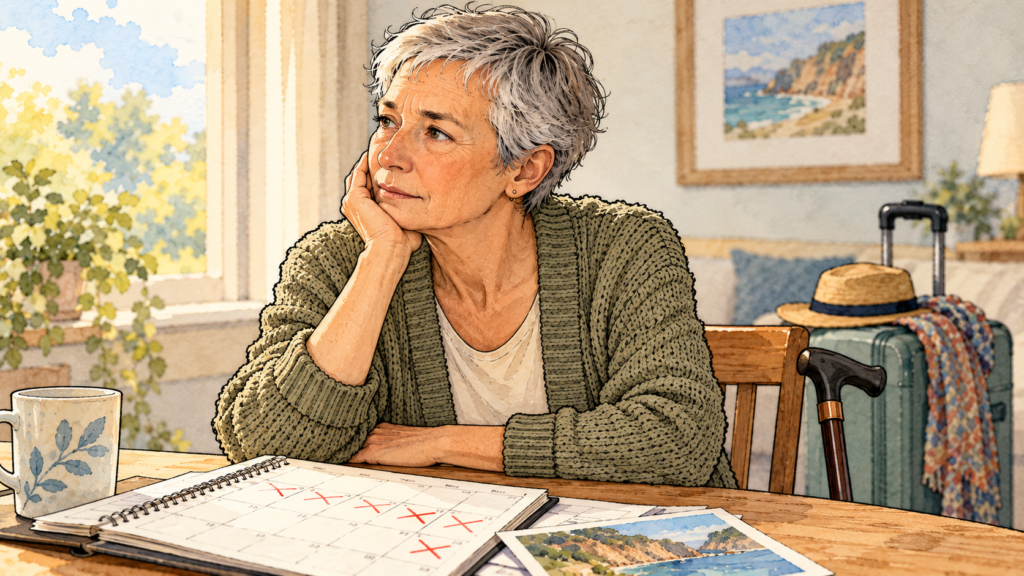
There is a particular kind of grief that begins when you realize you are not waiting for life to return to normal anymore. This may be normal now.
The illness is chronic. The marriage ended. The person you loved died. The children grew up and built lives that no longer revolve around yours. Retirement arrived and took more of your identity with it than you expected. Your body has different rules now. Your energy has limits you cannot negotiate away.
Or perhaps there was no single dramatic event at all. You simply looked up one day and realized that the life you had been organizing yourself around no longer existed.
That is a difficult thing to know what to do with.
We have plenty of language for beginning again. Fresh starts. New chapters. Reinvention. Starting over.
What we have far less language for is this: I did not choose this life, but it is the life I have. How do I make something meaningful inside it?
You Are Grieving More Than What Happened
When life changes permanently, the loss is rarely limited to the obvious thing.
Illness may take physical ability, but it can also change work, friendships, independence, confidence, routines, travel, money, and the way you imagined getting older. Widowhood is the loss of a person, but also of countless ordinary expectations built around that person. Retirement may be welcome and still remove structure, status, competence, and the daily evidence that you were needed somewhere.
That is part of why major change can feel so disorienting. You are not simply adjusting to a new schedule or a new set of limitations. You may also be trying to understand who you are now.
Researchers studying chronic illness have described this as a disruption of identity. When the conditions of daily life change, people often have to renegotiate their understanding of themselves. That makes sense, because identity is built partly through the things we repeatedly do. We say, I work. I care for people. I travel. I host Christmas. I am the strong one. I am independent. I am the person everyone calls.
Then something changes, and the verbs disappear before the person has figured out what should replace them.
This is why advice like “focus on the positive” can feel so spectacularly useless. You are not simply having a bad attitude about altered circumstances. You may be trying to work out how to remain yourself inside them.
An Oak, a Reed, and a Bad Day for Landscaping
There is an old Aesop fable called The Oak and the Reed.
A great oak tree is proud of its strength. The small reeds beside it bend whenever the wind blows. The oak does not. Then a violent storm comes. The reeds bend nearly to the ground and rise again when it passes. The oak resists until the force is greater than its roots can bear, and it falls.
The usual moral is that flexibility can be stronger than rigidity, which is useful enough. But there is something else worth noticing.
The reed survives without becoming an oak.
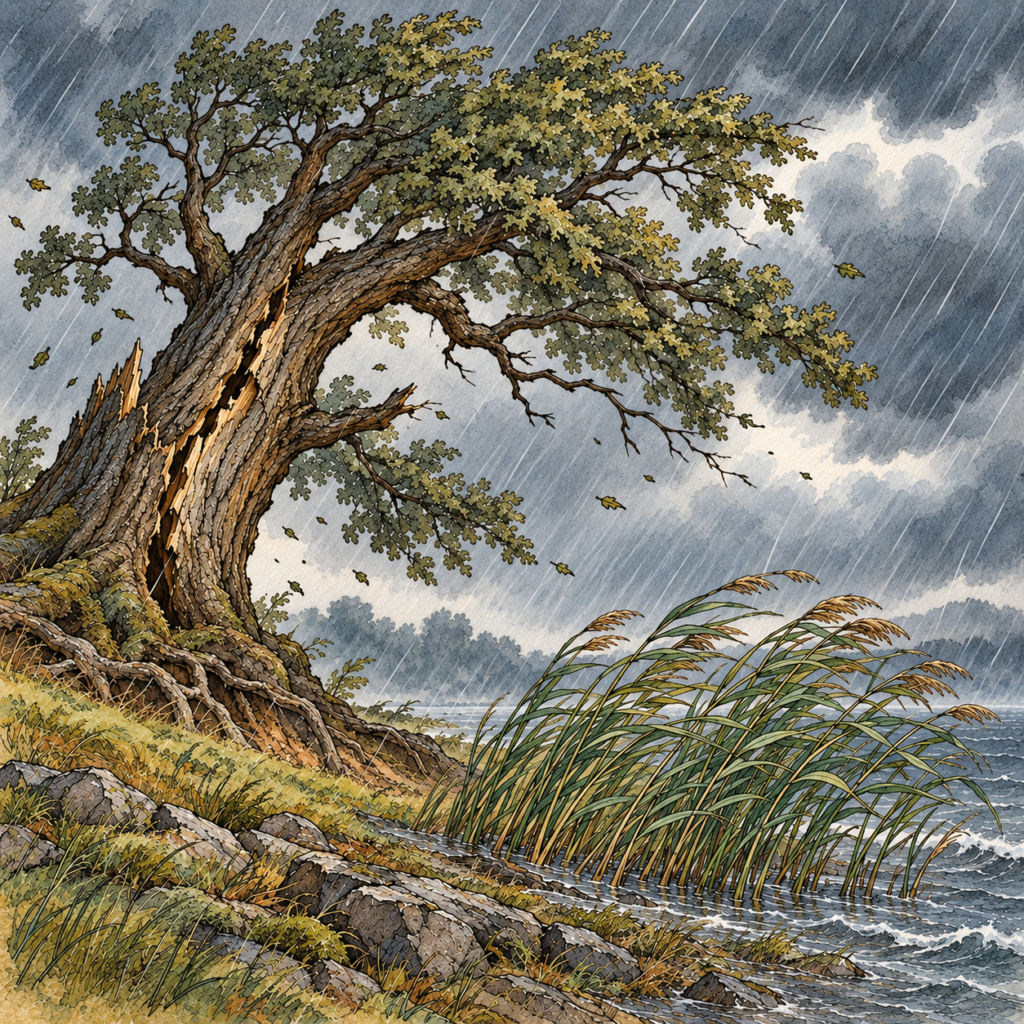
It does not overcome the storm by restoring everything to the way it was before the wind arrived. It survives because it responds to reality.
That distinction matters.
Adapting to a changed life does not mean deciding the loss was good. It does not mean lowering every expectation, becoming endlessly agreeable, or announcing that everything happens for a reason. Sometimes things happen for terrible reasons. Sometimes they happen for no satisfying reason at all.
Adaptation begins somewhere much less cheerful and much more useful: These are the conditions I am living with now. What can I build from here?
Stop Building for a Life You No Longer Have
This sounds obvious until you notice how often we do the opposite.
We plan the week for the energy we used to have. We keep a house according to standards developed when there were two healthy adults living in it. We expect ourselves to maintain friendships that now require more travel, stamina, or emotional labor than we can give. We measure a useful day by an old job. We compare today’s body with the one from fifteen years ago and allow the earlier version to grade the current one.
That creates a peculiar second layer of suffering. There is the actual limitation, and then there is the daily experience of failing at a life designed for someone with different circumstances.
One useful framework from the psychology of aging is called selection, optimization, and compensation. The terminology is dreadful. The idea is excellent.
In plain English, it means this: choose what matters, strengthen what still works, and find another way to do what has become difficult.
That is not surrender. It is intelligent redesign.
Choose What Still Deserves Your Energy
Changed capacity makes prioritizing unavoidable, and that can initially feel like another loss because you may no longer be able to fit everything into your life that once belonged there.
So it helps to stop asking, What should I still be able to do? and start asking, What matters enough that I want to protect room for it now?
Perhaps gardening matters, but having a perfect yard does not. Perhaps family matters, but hosting twelve people for Thanksgiving no longer does. Perhaps writing matters, but maintaining a punishing publication schedule does not. (Hallelujah!) Perhaps independence matters, but doing every task without assistance is not actually the definition of independence.
When resources become limited, priorities become visible. That is not always pleasant, but it can be clarifying.
You may discover that some of what you have been trying to preserve is not the thing you value at all. It is simply the old method.
Separate the Meaning From the Method
This may be one of the most useful questions in the entire process:
What am I actually trying to preserve?
Suppose you have always cooked large Sunday dinners, and now illness makes standing in the kitchen for hours impossible. It would be easy to conclude, I can’t do Sunday dinners anymore.
But what did Sunday dinner mean?
Was it feeding people? Tradition? A house full of voices? Seeing your grandchildren? Making the one dish everyone associates with you?
Those things are not the same as personally cooking six dishes from scratch.
Once you identify the part that carries the meaning, the method becomes negotiable. Order the main meal and make your famous pie. Let someone else host. Ask everyone to bring something. Use paper plates and scandalize an ancestor.
The tradition has changed. The meaning may still be perfectly intact.
This is where adaptation becomes less about replacement and more about translation. You are not necessarily looking for an entirely new life. Sometimes you are finding a new form for something that still matters deeply.
Build Supports Before You Are Desperate for Them
The word compensation sounds grim until you realize human beings have always done it.
Glasses compensate for eyesight. Calendars compensate for memory. Cars compensate for distance. Step stools compensate for shelves apparently installed by basketball players.
A life with changed capacity may require more deliberate support.
That might mean sitting while preparing food, arranging regular grocery delivery (thank you WalMart), putting difficult tasks at your best time of day, keeping commonly used items within easy reach, asking someone else to drive, reducing commitments, using mobility equipment, or dividing one large job across several days.
These adjustments can feel surprisingly emotional because they make change visible. A shower chair is not just a shower chair if it reminds you of what your body used to do without help.
But support is not evidence of failure. It is a tool.
The purpose is not to prove you can still do everything the old way. The purpose is to make your actual life work.
Let Something New Count
One of the crueler parts of major life change is that old accomplishments often continue to look more legitimate than new ones.
A full workday counts. Resting before you become completely depleted somehow does not.
Managing a household the old way counted. Learning to manage a smaller life with an unpredictable body feels unimpressive.
Caring for everyone else counted. Learning boundaries feels suspiciously like laziness.
But meaning does not require the old scale.
Research on adaptation after illness and major life change often points to the importance of maintaining continuity of self even when circumstances change. In other words, the goal is not always to invent an entirely new person. It may be to find ways to remain recognizably yourself under different conditions.
That can be a deeply practical question.
What qualities in you have survived the change? Perhaps you still love learning. Perhaps you still notice absurdity. Perhaps you still care deeply about people. Perhaps you still make beautiful things. Perhaps you are still curious, stubborn, observant, funny, exacting, generous, or impossible to impress.
Good. Those qualities are portable. They can come with you.
A Small Exercise for the Life You Have Now
If your life feels shapeless after change, try a simple exercise with three headings.
Under What is gone, name what has genuinely changed. Do not make yourself put a positive spin on it. If something is gone, it is gone.
Under What remains, list the abilities, relationships, interests, values, resources, and parts of yourself that are still here.
Then make a third column: What could change form. This is the interesting one.
Cooking may become simpler cooking. Travel may become nearby exploring. Work may become mentoring. Hosting may become inviting one person for tea. Gardening may become three pots on a balcony. Helping may become listening instead of doing. Independence may become deciding how help is given rather than refusing all help.
This is where life begins to have shape again. Not because the losses disappeared, and not because you learned to be grateful for them. Because loss stopped being the only architect.
You Do Not Have to Call It a Fresh Start
Some lives have clean beginnings. Others have renovations carried out while somebody is still living in the building. There are boxes everywhere. Nothing is where it used to be. One room is functioning reasonably well and another appears to contain nothing but extension cords and regret.
Still a life.
The oak in Aesop’s fable had only one idea of strength: remain exactly as you are. The reed had another. Respond to what is happening and remain yourself anyway. Perhaps that is a better definition of adaptation.
You do not have to love what changed. You do not have to be grateful for the lesson. You do not have to become a shinier, wiser version of yourself because something painful happened.
But you are allowed to stop designing your days around a life that is gone.
You can ask what matters now. You can protect it. You can change the method. You can make room for help. You can let smaller things count.
And slowly, sometimes rather untidily, you can build a life that fits the person who is still here.
🌳 What part of your old life are you still trying to preserve—and could you keep the meaning while changing the way you do it?