
The Bone Across the Bridge
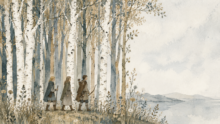
A hungry dog found a fine, meaty bone. Pleased with his good fortune, he carried it carefully in his mouth as he crossed a narrow wooden bridge over a quiet stream. The morning was still. The water below was so calm it reflected the world almost perfectly.
As the dog glanced down, he saw what looked like another dog staring back. That dog, he thought, had an even larger bone. Without stopping to think, he opened his mouth to snatch the bigger prize.
His own bone slipped from his jaws, splashed into the water, and disappeared. The other dog vanished too.
All that remained were ripples spreading across the surface where contentment had been only a moment before.
The Reflection That Promised More
It is easy to smile at the dog. Surely anyone can see he was fooled by his own reflection.
Yet we spend surprising amounts of our lives doing much the same thing. We tell ourselves life will finally feel complete when we have the newer house, the quieter schedule, the healthier body, the perfect relationship, or just a little more money in the bank. We picture a version of ourselves standing somewhere just ahead, holding a slightly bigger bone.
For a while, chasing that image gives us energy. Then we arrive. And somehow… it doesn’t stay magical for very long.
The life we longed for quietly becomes ordinary.
When Enough Quietly Becomes Invisible
This happens gently. The new sofa becomes the place we pile laundry. The holiday we counted down to becomes photographs on a phone. The kitchen we dreamed of becomes somewhere to wash dishes. Even good health, when we have it, quickly becomes something we stop noticing altogether.
Our minds have an extraordinary ability to become familiar with what once felt extraordinary.
The trouble begins when familiarity convinces us that what we already have is no longer valuable. Like the dog looking into the stream, we become fascinated by the possibility that somewhere else, someone else, has something better.
Sometimes the shadow is a bigger career. Sometimes it is another person’s body. Sometimes it is the version of ourselves we imagine we should have become by now.
Meanwhile, the life already in our hands slowly loses its shine—not because it has become less precious, but because it has become familiar.
Why Our Brains Keep Moving the Finish Line
Psychologists call this hedonic adaptation. It sounds technical, but the idea is surprisingly simple.
Human brains are remarkably good at adjusting to change. Whether something wonderful happens or something difficult happens, our nervous system gradually recalibrates. What once felt exciting becomes normal. What once felt impossible becomes part of everyday life.
This isn’t a character flaw. It’s one of the reasons human beings are so adaptable. If every pleasant experience stayed equally thrilling forever, our brains would struggle to notice new opportunities or respond to changing circumstances. From a survival perspective, constantly paying attention to what is new has always been useful.
The downside is that the emotional “finish line” keeps moving. The promotion becomes your normal job. The new home becomes your normal house. The thing you once celebrated becomes simply… Tuesday.
The brain isn’t trying to steal your happiness. It’s trying to help you adapt.
Living With a Body That Keeps Changing
For people living with fibromyalgia, chronic illness, or a highly sensitive nervous system, this idea can feel especially complicated. We often imagine that life will begin again when symptoms improve.
“If I could just sleep properly…”
“If I had less pain…”
“If I could keep up like everyone else…”
Hope is important. But sometimes we unknowingly place all our peace on the other side of a future we cannot fully control.
Meanwhile, small victories pass almost unnoticed. A day with slightly more energy. An afternoon without brain fog. A meal that didn’t trigger symptoms. A walk that felt easier than last month.
Because the nervous system adapts to improvements just as readily as it adapts to difficulties, even genuine progress can become invisible remarkably quickly.
We don’t mean to overlook it. Our brains simply stop highlighting what has become familiar.
Looking Up From the Water
The dog’s mistake wasn’t that he appreciated a larger bone. It was that he stopped appreciating the one already carrying him across the bridge.
There is a quiet invitation hidden inside this old story. Not to stop growing. Not to stop hoping. Not to pretend life is already perfect. Simply to notice when our eyes spend so long searching the water that we forget what we are already holding.
Contentment isn’t the absence of dreams. It is the ability to recognize today’s gifts before tomorrow turns them into ordinary scenery. Perhaps the life you have today isn’t everything you hoped for. Perhaps it never will be.
But somewhere in your past lives a version of you who would have looked at this very moment and thought, “If only I could get there.”
