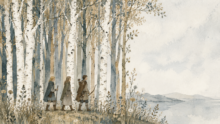

Jupiter was assigning duties and privileges to the gods. One by one they came forward and received their portion.
Then Grief arrived late. By then, there was nothing left to give her.
So Jupiter assigned Grief the tears shed for the dead.
And then came the warning. The more people fed Grief with continual mourning, the more powerful and demanding she would become.
The old moral is usually reduced to something simple: Do not mourn too long. But I think Aesop was saying something more unsettling than that.
I think he understood that grief can develop an appetite. And once it does, it begins finding more to eat.
Grief Moves In Quietly
At first, grief may arrive because something terrible happened.
A death. A diagnosis. A betrayal. A loss that divides life into before and after.
She does not necessarily arrive like a storm. Sometimes she arrives quietly.
She takes the spare room. She sits with you when nobody else knows what to say. She understands why you do not feel like talking.
She does not demand that you cheer up.
At first, there is almost something companionable about her. She knows the sorrow. Then she gets comfortable.
One Grief Wakes the Others
I have lived with grief for a long time. Long enough to notice something I did not expect. It breeds more.
One sorrow rarely stays politely inside its assigned room. Grief moves in quietly, then slowly starts rearranging the furniture.
A fresh loss can wake an old one. A present disappointment can suddenly connect itself to something that happened twenty years ago.
You begin grieving not only what happened, but what should have happened. What might have happened. What will now never happen.
And eventually, the losses begin forming a little committee. Apparently Grief is excellent at networking.
The Inventory Gets Longer
At first, grief may have a name. A person. A death. A marriage. A diagnosis. A moment when life divided into before and after.
But Grief has a talent for expanding the inventory. She starts bringing things into the house. The health you lost. The stamina. The independence. The years spent enduring something you should not have had to endure. The people who were supposed to love you better.
The version of yourself who had more confidence. The plans that quietly disappeared. The future you once assumed would be waiting for you.
None of these losses are imaginary.
That is what makes this difficult. Grief is not inventing sorrow out of thin air. She is becoming extraordinarily skilled at locating it.
Grief Changes the Lens
That may be the part of Aesop’s fable that matters most to me now.
The more Grief is fed, the more powerful she becomes. Not because mourning summons new tragedy. Not because crying is dangerous. Not because sorrow is some kind of spiritual failure.
But because the mind learns.
If you spend long enough searching for threats, you become better at finding threats.
If you spend long enough looking for loss, you become better at recognizing loss.
Grief can become a lens. And after a while, you may stop noticing that you are looking through it.
The world itself has not necessarily become entirely sorrowful. But sorrow has become easier to see.
Chronic Illness Keeps Adding Evidence
This gets especially complicated when grief is living alongside chronic illness. Because chronic illness keeps producing legitimate losses.
A body that once behaved one way now behaves another. Energy disappears. Plans become conditional.
Ordinary activities require strategy. Recovery takes longer. The world keeps asking for things the body cannot consistently give.
And each new limitation can feel like another small bereavement.
There is no funeral for losing stamina. Nobody sends flowers when your independence shrinks. There is no casserole committee when your world becomes smaller.
You simply adjust. And then adjust again.
And after enough adjustments, you may suddenly look around and realize how much has changed.
My world keeps shrinking, and I do not like the gloomy decor. That is the part nobody really warns you about.
Adaptation is praised as resilience, and sometimes it is. But adaptation can also mean quietly surrendering one piece of your old life after another until the smaller life starts feeling normal.
Then one day you notice the walls have moved inward. That realization is grief too.
The Nervous System Remembers
Grief is often discussed as though it exists entirely in thought. It does not. The body participates.
Sleep can change. Appetite can change. Concentration can become unreliable. The nervous system can remain watchful. Fatigue can deepen. Blood pressure can spike. Pain can feel louder.
For someone whose system is already sensitive, overloaded, or exhausted, grief becomes one more source of strain.
It does not have to cause every symptom to make every symptom harder to carry. Sometimes it simply lowers the threshold.
And then life feels heavier before anything new has actually happened.
When Sorrow Starts Recruiting
This is the part I am beginning to recognize. Grief does not always wait for another catastrophe. Sometimes she recruits ordinary things.
A difficult conversation. A memory. A photograph. An anniversary.
A body that cannot do what it did last year. Someone else’s happy news.
A familiar place. A quiet house. An empty chair. Even the passage of time itself can become evidence.
And once Grief has been around long enough, she can begin whispering: See? Another thing gone. Another thing changed. Another thing you cannot get back.
That is how sorrow accumulates. Not always through one enormous event. Sometimes through repetition.
And slowly, without quite noticing when it happened, you may realize she is no longer simply living with you. She has started deciding what belongs in the room.
Perhaps This Is What Aesop Meant
I used to resist the moral of this fable. “Do not mourn too long” sounds harsh. It sounds like something people say when another person’s grief has become inconvenient.
But perhaps the warning is not about a timetable. Perhaps it is about attention.
Grief deserves her due. She deserves tears. She deserves remembrance.
She deserves honesty. She deserves the acknowledgment that something mattered and that its loss changed us.
But Grief is greedy.
Give her every disappointment, every memory, every uncertain future, every change in the body, every regret, every relationship, every quiet afternoon—and eventually you may realize Grief is no longer staying with you.
You are living in her house. That, I think, is the danger.
I Do Not Want to Lie About Sorrow
I am not interested in pretending everything is fine. It is not. Some things are genuinely sad. Some losses are permanent.
Some wounds do not become charming little life lessons with enough journaling and herbal tea. And I am not interested in forcing gratitude over grief like a tablecloth.
But I am becoming interested in noticing when Grief begins claiming things that are not entirely hers.
A difficult day is not the same as a ruined life. A changed body is not the same as no life at all. A painful chapter is not necessarily the final chapter. And sorrow, however practiced, is not the only thing I am still capable of finding.
Perhaps that is the task now. Not starving grief. Not denying her. Not pretending she should have left already. But learning her appetite.
Recognizing when one sorrow begins summoning another. Noticing when Grief turns from witness into collector. Noticing when she begins rearranging the furniture. And remembering that not everything belongs to her.
Some things still belong to curiosity. Some to creation. Some to laughter.
Some to bread rising on the counter. Some to walking beneath changing leaves.
Some to the small stubborn part of us that keeps making something anyway.
Grief deserves her due. She does not get the whole house.
💔Has grief ever made you notice losses you had not been grieving before?
