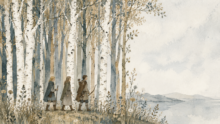

When the Woods Grew Quiet
Long ago, a hunter kept a faithful hound.
For many years the old dog had been the pride of every hunt. He could pick up a scent where others found nothing. His legs carried him across hills and through forests without hesitation. When wild boar charged, he never retreated. His master trusted him completely.
But years have a way of visiting every creature.
The hound’s muzzle turned gray. His stride shortened. His teeth, once strong enough to hold the fiercest game, had grown worn smooth by time.
One autumn morning the hunter released his dogs into the woods. They followed the scent of a great wild boar until the old hound caught it first. With one determined leap he seized the animal by the ear.
For a brief moment it seemed as though the old days had returned.
Then the boar twisted violently. The hound’s aging teeth slipped. The animal broke free and disappeared into the forest.
The hunter was furious.
“You useless old dog!” he shouted. “After all these years, you’ve failed me.”
The old hound lowered his head, not in shame, but in sadness.
“My master,” he replied quietly, “my heart is as willing as it ever was. If I have failed, it is because age has taken my strength—not my loyalty.”
The forest fell silent.
The hunter suddenly remembered all the seasons that had come before this one. The countless hunts. The dangers faced together. The years of faithful service that had brought them both safely home.
Sometimes we judge an entire life by a single difficult day.
When Yesterday Becomes the Standard
There is something painfully familiar about this old story.
Most of us expect change to arrive dramatically—with fireworks, celebrations, or obvious milestones.
Instead, it often arrives quietly. One day you discover that something which once felt effortless now asks for recovery. You notice yourself planning differently. Resting more. Choosing carefully.
Letting someone else carry what you once carried without thinking.
None of those moments announces itself as the beginning of a new season.
They simply accumulate until one day you realize you’ve been comparing today’s self to someone who no longer exists.
And somehow, yesterday always seems to win.
The Job You Never Applied For
Chronic illness has a remarkable way of changing our identity before it changes our beliefs about ourselves.
Many people living with fibromyalgia still measure success using rules they created when they had more energy.
The dependable employee. The parent who could always say yes. The friend who never canceled. The person who solved everyone’s problems.
The body changes first. Identity usually arrives much later.
That gap can become exhausting.
You may still expect yourself to perform like the younger hound while quietly wondering why everything feels so much harder than it used to.
The answer is rarely laziness.
More often, you’re carrying an outdated job description.
Why Familiar Feels Safer
Our nervous systems are remarkably practical. They prefer familiarity over uncertainty.
Even when an old identity is no longer possible, it still feels predictable. The brain knows how to be the capable one. The reliable one. The strong one.
Creating a new identity requires uncertainty, and uncertainty always asks the nervous system to spend energy.
That is one reason change—even good change—can feel surprisingly uncomfortable. Accepting new limits doesn’t simply alter your calendar. It changes the story you’ve been telling yourself about who you are.
No wonder the body hesitates. It isn’t resisting growth.
It’s searching for safety while the map is being redrawn.
The Measure Was Never Speed
The old hound believed something his master had forgotten. Worth is not measured only by present performance.
There are seasons for running. There are seasons for watching. There are seasons for teaching younger dogs where the hidden paths begin.
Many people living with chronic illness quietly mourn the version of themselves that seemed capable of everything.
That grief deserves kindness.
But grieving an old identity doesn’t mean your life has become smaller. It simply means your gifts may no longer look the way they once did.
Wisdom often replaces speed. Discernment replaces urgency. Presence replaces productivity.
Those are not consolation prizes. They are different strengths.
The Forest Still Knows Your Name
Perhaps that is why this little fable has survived for thousands of years.
It reminds us that usefulness changes shape throughout a lifetime.
The old hound never stopped being loyal. He never stopped caring. Only his body had changed.
If you’re living through a season where your capacity feels different than it once did, perhaps your task is not to become who you were.
Perhaps it is to become fully present with who you are now. There is surprising peace in retiring an identity that no longer fits. Not because you have given up.
But because your life is asking something gentler of you.
The forest has never expected every season to look like spring.
Perhaps we don’t have to expect that of ourselves either.
