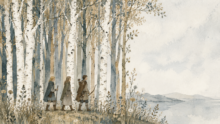

Two Bags for Every Traveler
There is an old fable that says every person begins life with two bags.
One hangs in front, where it is easy to see. It is filled with the faults of everyone else.
The other hangs behind, resting between the shoulders. It is filled with our own. Because it sits beyond our view, we seldom notice what it contains.
The traveler in the story walks from village to village carrying both. The front bag is always within reach. If someone speaks too sharply, it is there. If a neighbor is impatient, careless, boastful, or selfish, the traveler can look down and find another reason to add it to the collection.
The bag behind remains quiet.
Its weight is familiar enough to ignore. Its contents are never examined because they cannot easily be seen.
The traveler does not believe she is carrying anything unusual. She simply continues down the road, convinced she understands the world rather well.
The fable ends there.
No dramatic punishment. No clever twist.
Only a reminder that where we place our attention often shapes what we believe to be true.
The Road Looks Different Now
Most of us don’t spend much time collecting other people’s faults.
In fact, if you live with chronic illness, you may do the opposite.
Instead of looking outward, you begin looking inward.
When symptoms refuse to follow predictable rules…
When friends say, “But you looked fine yesterday.”
When doctors disagree.
When family members don’t understand why plans change at the last minute.
You slowly begin asking yourself questions you never intended to ask.
Maybe I’m making too much of this.
Maybe everyone else manages better.
Maybe I should just try harder.
The old fable quietly shifts.
The bag behind no longer feels like a place where our own shortcomings hide.
It becomes the place where we tuck away our certainty.
When You Stop Trusting Your Own Experience
One of the loneliest parts of living with fibromyalgia or another invisible illness isn’t the pain.
It’s the uncertainty.
After enough moments of being misunderstood, many people stop trusting themselves before anyone else has the chance to doubt them.
You begin explaining your symptoms before they’re questioned.
Apologizing for resting before anyone objects.
Wondering whether you’re allowed to say you’re struggling today because yesterday happened to be better.
The exhaustion isn’t only physical.
It’s emotional.
You’re constantly checking your own reality.
Then something unexpected happens.
You read a post written by someone you’ve never met.
They describe the strange fatigue that arrives without warning. The food that was safe last week but isn’t today. The guilt of cancelling plans. The relief of staying home. The way your body changes the rules without asking permission.
You pause.
Your shoulders soften.
You didn’t learn anything new.
You simply recognized yourself.
The Mirror We Borrow From Others
Psychologists have long known that people have blind spots.
We naturally see some things more clearly than others. We understand only part of ourselves because we experience life from the inside, while observing everyone else from the outside.
Our minds are always trying to create a story that makes sense.
Usually that helps us.
But repeated misunderstanding changes the story.
When your experiences are dismissed often enough, your brain starts treating outside opinions as more reliable than your own observations. It isn’t weakness. It’s an attempt to resolve conflicting information.
If everyone else seems certain, perhaps they’re seeing something you’ve missed.
Over time, your internal compass becomes quieter.
This is why community matters so much.
Not because strangers know your body better than you do.
But because they hand you something you’ve been missing:
A mirror that reflects your experience accurately.
The People Who Hand Us Back Ourselves
Finding community doesn’t always mean joining a large support group or introducing yourself to dozens of new people.
Sometimes it’s much smaller than that.
One thoughtful conversation.
A quiet online community.
A friend who doesn’t ask you to justify resting.
Someone who responds with,
“That makes sense.”
Those three words do something remarkable.
They interrupt self-doubt.
They remind you that your experience exists whether or not everyone understands it.
Community doesn’t remove pain.
It doesn’t cure fibromyalgia.
It doesn’t make difficult days disappear.
But it can return something illness quietly steals:
Confidence in your own lived experience.
Sometimes the greatest gift another person offers isn’t advice.
It’s accurate recognition.
The Journey Becomes Lighter
The traveler never set either bag down.
Neither do we.
Life continues to ask us to carry uncertainty, limitations, changing bodies, and unanswered questions.
But perhaps the fable was never only about noticing faults.
Perhaps it is also about learning where we choose to look.
When we walk beside people who see us clearly, we spend less time wondering whether our experience is real.
We stop carrying our story as though it needs defending.
The road doesn’t become shorter.
The bags don’t disappear.
But somehow, they become easier to carry when we no longer walk alone.
