
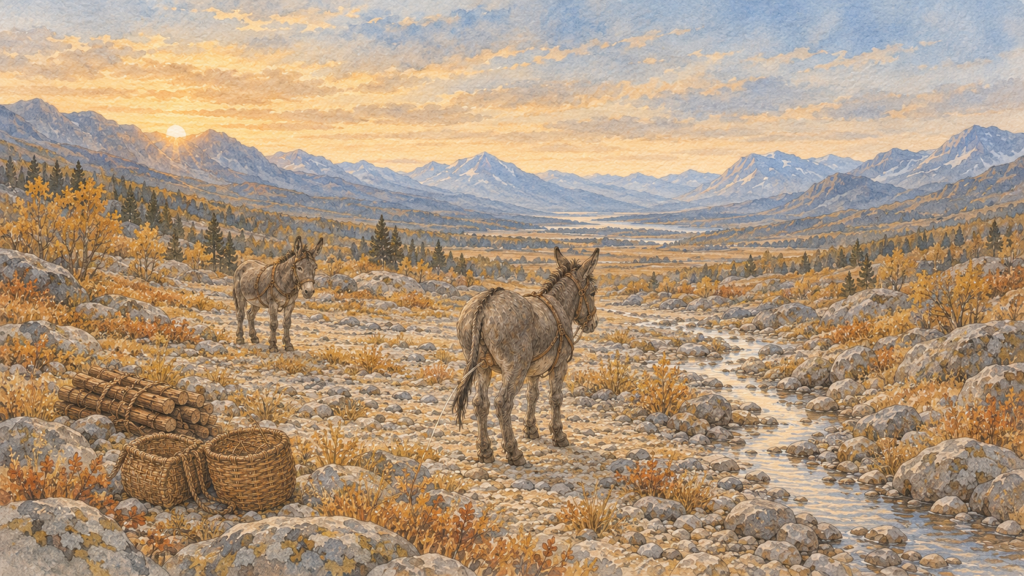
When the light changes, so do I.
The Donkeys Appeal to Jupiter
A group of donkeys had grown thoroughly tired of carrying heavy loads. Every morning brought another burden, another road, and another person who apparently believed donkeys came with unlimited mileage. No matter how much they carried, there was always something else waiting to be tied across their backs.
Eventually, they appealed to Jupiter. Surely the ruler of the gods could lighten their loads, shorten their journeys, or grant them some relief from a life spent carrying everyone else’s belongings.
Jupiter listened and gave them his answer. Their suffering would end, he said, when they produced enough urine to form a river.
In other words, Jupiter told the donkeys to piss off. Literally.
Unfortunately, the donkeys believed him. From that day forward, whenever one encountered a place where another donkey had urinated, he stopped and added his own contribution. Surely, with enough patience and cooperation, they would eventually complete the river and earn their freedom.
They are presumably still working on it.
The traditional moral is not especially kind to the donkeys. They are portrayed as foolish creatures who remain trapped because they cannot recognize the impossibility of Jupiter’s demand. I understand them more than Jupiter probably intended.
Surely This Nap Will Do It
There are days when fibromyalgia fatigue feels like a debt I should be able to finish paying. I sleep later, get up, accomplish very little, and become tired enough to need a nap. Sometimes the nap helps. Sometimes I wake feeling as though I have merely changed locations for the exhaustion.
Still, I keep hoping the next stretch of sleep will be the one that restores me. Perhaps another hour will do it. Maybe I need an afternoon with nothing required of me, followed by an early night and a late morning. Surely this nap will finally reach the opposite bank.
When I wake tired again, it is tempting to assume I have not rested enough. I add another hour to the river, then another, waiting for the satisfying moment when the fatigue is finished and I can declare the debt paid.
Chronic fatigue rarely provides a receipt confirming that the transaction has been completed.
Autumn Arrives Through the Light
This pattern becomes more noticeable when the seasonal light begins to change. The calendar may insist that autumn is approaching, but Arizona offers very little supporting evidence. The thermometer remains offensively committed to summer. There are no crisp mornings, glowing trees, or respectable piles of leaves announcing that a new season has arrived.
Nevertheless, the light changes. It begins arriving a little later and leaving a little earlier. The difference may be small enough to miss if I am watching only the clock, but my body does not miss it.
I begin sleeping later. Naps become more necessary, and the familiar fatigue settles more heavily over the day. The weather has not changed enough to explain it, yet something inside me has already registered that the season is turning.
Autumn does not always knock on the front door. Sometimes it slips quietly through the eyes and begins rearranging the furniture.
The Body Notices Minutes
Light entering the eyes is one of the brain’s strongest timing signals. It helps regulate the circadian rhythm, the roughly twenty-four-hour system involved in sleep, alertness, body temperature, hormone timing, and other daily processes. Morning light helps tell the brain that the day has begun. Increasing darkness helps prepare the body for night.
Daylight begins shortening immediately after the summer solstice, even while summer temperatures remain firmly in charge. The difference arrives in minutes, but the body is built to notice repeating patterns in light. It does not wait until humans unpack the decorative pumpkins.
Aging may also affect the strength and regularity of the circadian rhythm. This does not simply mean older people become unusually impressed by darkness. It means the internal clock and its response to seasonal changes can become less robust and less tidy.
Fibromyalgia adds another complication because sleep is often already fragmented or nonrestorative. A person can spend enough hours asleep and still awaken without feeling restored. Pain can disrupt sleep, while poor sleep can increase pain sensitivity and fatigue. Each problem is entirely willing to assist the other.
Research has not established that shorter days directly cause fibromyalgia flares, and I am not claiming that they do. Still, what we know about light, circadian timing, aging, and disrupted sleep offers a reasonable explanation for why a subtle environmental shift may land heavily in a body already struggling to regulate sleep and energy.
The change in daylight may be modest. The body receiving it is not starting from neutral.
Rest Is Not the Foolish Part
The donkeys were not foolish because they stopped beside the road to relieve themselves. They were foolish because they believed their suffering would become legitimate only after they completed an impossible river.
I can offer myself a similar bargain. I may rest without guilt once I have rested enough to feel completely well. I may accept my limitations after I have conclusively proved that another hour of sleep will not correct them. I may admit I am exhausted after every available remedy has failed to transform me into a cheerful woodland creature at sunrise.
That standard is no more achievable than Jupiter’s.
Rest can prevent further depletion. It can reduce immediate strain, quiet some of the internal commotion, and make the next part of the day more manageable. A nap does not become worthless because I wake with fibromyalgia still firmly installed.
Rest is support, not a river I can finish.
The trouble begins when I judge rest only by whether it makes me feel fully restored. If it does not, I assume I slept too little, rested incorrectly, or somehow failed at an activity that involved lying perfectly still. Then I contribute another hour to the river.
My Body Has Changed Its Schedule
Recognizing the seasonal pattern does not remove the fatigue, but it can remove some of the surprise. If I know the changing light affects my sleep and energy, I can leave more room around demanding days. I can notice that I am sleeping later without immediately turning it into a character review. I can respond before I am completely flattened instead of waiting until exhaustion begins making every decision for me.
That is not surrendering to the season. It is acknowledging that a living body is not required to function identically in every month. Sometimes the light has shifted, the nervous system has noticed, and the body is asking for a different arrangement.
Jupiter offered the donkeys relief only after an impossible achievement. I do not have to make myself the same offer. The thermometer may continue insisting that it is summer, but the light says otherwise, and my body has heard it.
The river does not need to be finished before the burden becomes real.
Reflection Question: 🫏 What if you do not need to finish being tired before your need for rest becomes legitimate?