Sometimes the problem is what we won’t release.
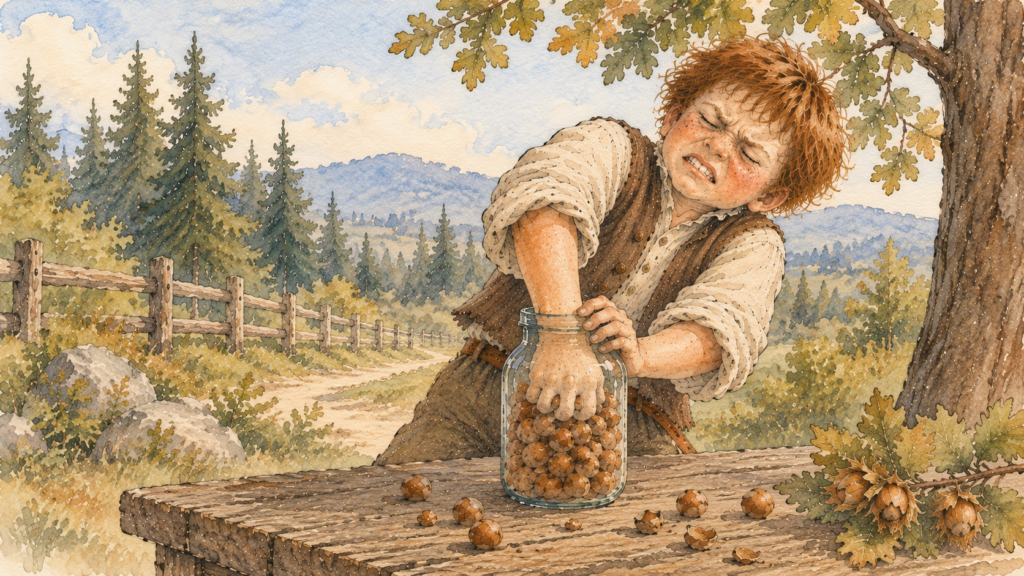
A boy came upon a jar filled with filberts and slipped his hand through its narrow mouth. He could have taken a few. Instead, delighted by his good fortune, he closed his fingers around the biggest handful he could manage.
Then he tried to pull his hand out. It would not come.
The boy tugged. He twisted his wrist. He pulled harder, which is a remarkably popular human response to discovering that something is not working. Still, his fist remained wedged inside the jar.
Someone watching finally told him the obvious: let go of half the filberts, and your hand will come out easily.
The boy did not like this answer.
He wanted the filberts he had already claimed. All of them. Opening his hand felt too much like losing something.
And so there he stood, holding tightly to a wonderful handful of nuts he could not actually have.
The Good-Day Trap
I suspect Aesop would have understood chronic illness rather well.
There is a particular kind of morning when you wake up and realize you feel better. Not well, necessarily. We needn’t get carried away. But the pain is quieter. Your head is clearer. You have some energy. Perhaps you slept reasonably well and nobody needs anything from you before breakfast.
Immediately, the list appears.
Laundry. Change the sheets. Answer those emails. Clean the bathroom. Work on the thing you abandoned three days ago. Take the longer walk. Make actual food instead of assembling something vaguely edible over the sink.
You feel good, so you reach into the jar. Then you grab everything.
The trouble is that feeling better and having unlimited capacity are not the same thing. A good hour is not necessarily a good day, and a good day is certainly not a notarized promise concerning tomorrow.
I know. Very inconvenient.
When Capable Becomes Catching Up
Pushing usually doesn’t begin with recklessness. It begins with relief.
When you’ve spent days or weeks unable to do what you wanted, a little returning energy can feel almost intoxicating. You don’t merely want to use it. You want to make up for lost time.
That’s where pacing becomes difficult. Pacing asks us to stop while we still have something left. Not when we’re exhausted. Not when the pain has become impossible to ignore. Not when we’re lying down wondering why unloading the dishwasher apparently required the physical resources of an Arctic expedition.
Earlier.
That can feel absurd when you’re finally having a decent day. Everything in you says, But I can still do more.
Yes.
That’s often exactly when pacing asks you to stop.
Tomorrow Gets a Vote
Bodies living with chronic illness, fibromyalgia, persistent pain, fatigue, or nervous-system sensitivity don’t always send an immediate invoice.
Exertion can have delayed consequences. You may get through the grocery store, put everything away, make dinner, and feel rather pleased with yourself. Then several hours later—or the next day—the increased pain, fatigue, fog, or other symptoms arrive.
This delay makes pacing maddeningly difficult to learn because the connection between activity and consequence isn’t always obvious.
The body has limits, but it doesn’t necessarily install a flashing red light on the dashboard.
Sometimes we have to learn the earlier signals ourselves: muscles tightening, thoughts becoming fuzzier, irritability creeping in, movements becoming less coordinated, or that peculiar moment when everything suddenly feels like more trouble than it did twenty minutes ago.
Those signals aren’t character flaws. They’re information.
Opening the Hand
This is where I think the boy with the filberts becomes more interesting than a simple warning about greed. He isn’t trapped because he took something. He’s trapped because he cannot bear to take less.
There is a difference.
For those of us living with limited energy, “less” can carry an enormous emotional weight. Doing less may remind us of what we once could do. Leaving something unfinished can feel irresponsible. Resting before we’re exhausted may look suspiciously like laziness, especially if we were raised in families where sitting down while someone else was working was practically a misdemeanor.
So we keep our fist closed. One more chore. One more errand. One more hour. We keep pulling harder because releasing something feels like surrender. But pacing isn’t surrender. It’s learning the size of the opening.
Enough Is Not Defeat
A paced life isn’t necessarily a smaller life. It is a life arranged around reality rather than argument. Some days you may have a generous handful of energy. Other days you may have three filberts and one of them looks questionable.
The skill isn’t forcing every day to hold the same amount. It’s learning to notice what today’s body can actually carry. That requires something pushing never does: self-trust.
You begin trusting that stopping now doesn’t mean you’ll never continue. Leaving the laundry doesn’t make you irresponsible. Resting while you still feel reasonably good isn’t wasting the good spell.
You’re protecting it. You’re leaving enough room for your hand to come back out of the jar.
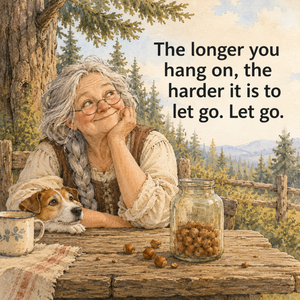
And perhaps that is the quiet wisdom hidden inside this very small fable. We spend so much of our lives being told to hold on, try harder, give more, finish what we started.
Sometimes that’s good advice. And sometimes the only way forward is to open your hand.
Reflective Question: 🥜 What are you holding onto today that might be costing you more energy than it is worth?