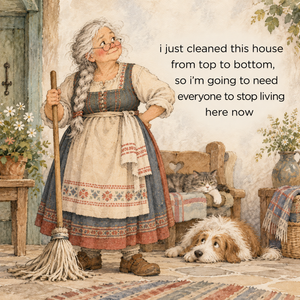
One sorrow can wake another until you discover Grief has been quietly redecorating the entire house.
Grief and Her Due
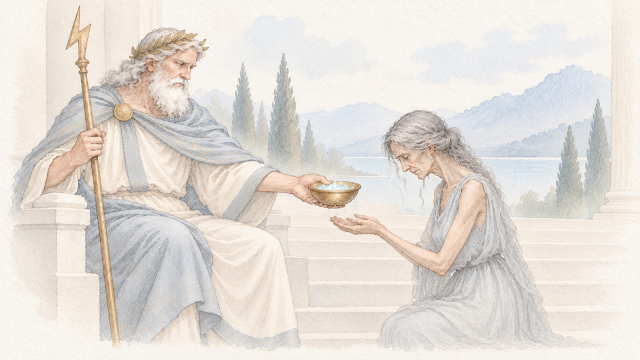
Jupiter was handing out assignments to the gods, which apparently required considerably less paperwork in those days than it would now. One by one they came forward and received their portions. Then Grief arrived late.
By that point, Jupiter had apparently run out of departments.
The good assignments were gone. There was, naturally, still paperwork for sorrow. So Jupiter gave Grief the tears shed for the dead. Excellent benefits package.
The warning attached to the job was less amusing. The more people fed Grief through continual mourning, the stronger and more demanding she would become.
The old moral is usually reduced to something rather stern: do not mourn too long. I have never particularly liked that version. It sounds suspiciously like something said by people who have grown tired of somebody else being sad.
But I wonder if the fable is actually warning us about something different. Maybe Aesop understood that grief can develop an appetite. And once it does, it gets very good at finding lunch.
Grief Rarely Travels Alone
Grief usually arrives with legitimate identification. Someone dies. A marriage ends. A diagnosis lands in your lap. A body stops cooperating. Something happens that divides life into before and after, and Grief quite reasonably comes through the door.
At first, she may even be good company.
She does not tell you to cheer up. She does not suggest gratitude journaling. She does not explain that everything happens for a reason while you are resisting the urge to throw a lamp.
She simply knows why you are sad. The trouble is that one sorrow rarely stays politely inside its assigned room.
A fresh loss can wake an old one. A disappointment today can suddenly introduce itself to something that happened twenty years ago. You begin grieving what happened, what should have happened, what might have happened, and what will now never happen.
Before long, the losses have formed a committee.
Apparently Grief is excellent at networking.
Then She Starts Collecting
At first, Grief’s belongings fit in a corner. A photograph. A letter. An old plan. A key. A pair of shoes that once represented freedom. You notice the little pile, but the rest of the house still feels like yours.
Then she finds more.
The stamina you lost. The independence. The relationship that should have been kinder. The years spent enduring something you should never have had to endure. The trip you assumed you would take someday. The version of yourself you thought would still be here.
None of these losses are imaginary. That is what makes this so complicated. Grief is not manufacturing misery out of thin air. She is simply becoming extremely efficient at locating it.
And when you live with chronic illness, she has plenty of material.
A body changes. Energy disappears. Ordinary errands require negotiations resembling a minor international summit. Plans become conditional. Recovery takes longer. You begin measuring activities not only by whether you can do them, but by what they are going to charge you afterward.
There is no funeral for stamina.
Nobody brings a casserole because you can no longer spend an afternoon wandering through shops without calculating the nearest chair.
You adjust. Then you adjust again.
Eventually you can become so accomplished at adapting that you forget how much adapting you have done.
My world keeps shrinking, and I do not particularly care for the decorating scheme.
Resilience Has a Strange Side Effect
We praise adaptation, and rightly so. Human beings are astonishingly good at making life work inside changed circumstances.
But resilience has a peculiar side effect.
Grief takes the chair, so you use the stool. She fills one corner, so you walk around it. She piles things near the window, so you move something else. She crowds the table, so you learn to work in the little space that remains.
None of this means you have stopped living. Quite the opposite. You are still making bread, answering messages, walking the dog, washing the same three spoons that apparently reproduce overnight, and finding ways to get through Tuesday.
But adaptation can disguise surrender.
One day you may look around and realize your life has been taking place entirely in the spaces Grief left available.
That is different from having grief in your life.
That is beginning to live in Grief’s house.
The Body Keeps Its Own Inventory
Grief is not only an idea. The body participates.
Sleep changes. Concentration goes wandering. Fatigue gets heavier. Pain may feel louder. The nervous system becomes more watchful, particularly if it was already running a little too enthusiastically in that department.
Grief does not have to cause every symptom to make every symptom harder to carry.
Sometimes it simply lowers the threshold.
Then an ordinary difficult day starts looking like evidence that everything is difficult. A changed body begins looking like evidence that everything has been lost. One sorrow points toward another and says, “See? There’s one too.”
That is the part of this fable I understand differently now.
The danger is not crying too much. The danger is Grief becoming the lens through which everything else is viewed.
She Gets Her Due, Not the House
I am not interested in pretending sorrow is secretly wonderful. Some things are simply sad. Some losses remain losses. Some wounds refuse to become charming little lessons no matter how much herbal tea is involved.
Grief deserves her due.
She deserves tears. She deserves remembrance. She deserves the acknowledgment that something mattered and its absence changed us.
But she is greedy.
Give her every disappointment, every old wound, every uncertain future, every change in the body, every quiet afternoon and every memory that wanders through, and eventually she stops being a guest.
So perhaps the work is not forcing Grief out.
Perhaps it is noticing when she starts collecting things that are not entirely hers.
Some things still belong to curiosity. Some belong to laughter. Some belong to making something simply because you still can. Some belong to bread rising on the counter, changing leaves outside the window, a dog needing his walk, and the stubborn little part of a person that continues participating in life.
Grief gets her due.
She does not get the whole house.
Reflective Question: 🥹 Has grief ever made you notice losses you had not been grieving before?