Sometimes a smaller life becomes so familiar that we stop noticing how much we once expected from ourselves and the world.
The Nightingale and the Cage
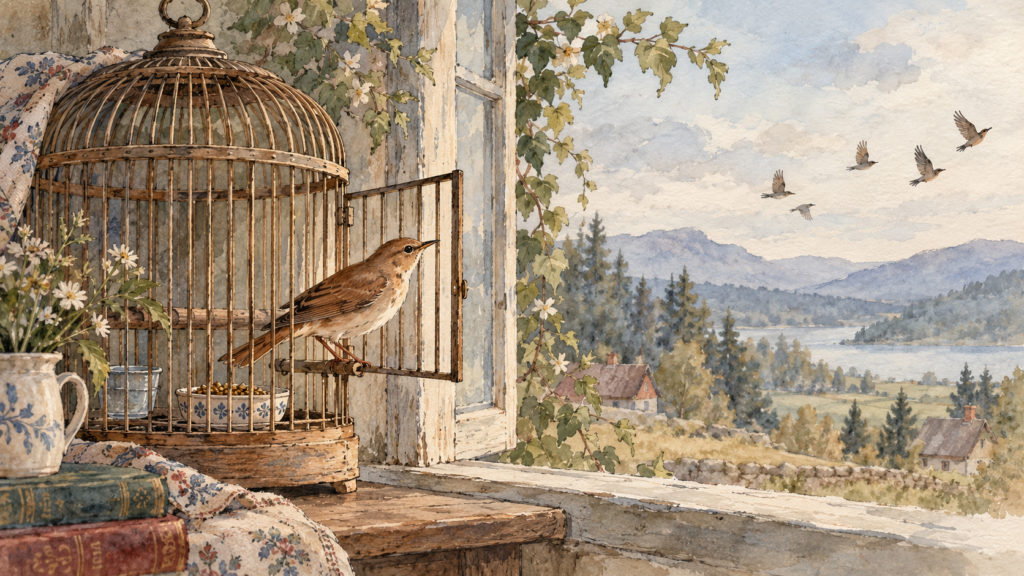
There was once a nightingale who lived in a wooden cage beside an open window. It was not a dreadful cage, which makes the story considerably more troublesome. She had clean water, seed in a little dish, shelter when the weather turned, and a reliable perch beneath her feet. Nobody frightened her. Nobody starved her. She was protected from cold rain, hungry creatures, and most of the general nonsense involved in being a small bird in a very large world.
Still, she could see the world beyond the window. Other birds flew across the fields and disappeared into the trees. She watched them go wherever they pleased, while her own travels extended roughly from one side of the cage to the other. Comfortable confinement remains confinement, even when somebody has thoughtfully supplied snacks.
Then one day the cage door was left open. The nightingale hesitated. She knew her perch, her food bowl, the sounds of the room. Outside was enormous and unfamiliar. But eventually she flew through the open window and into the world she had watched for so long.
Freedom was glorious for approximately as long as freedom cooperated. Then it rained.
The wind blew harder than it had looked from inside the cottage. Food did not arrive politely in a ceramic dish. Shelter had to be found before nightfall. The nightingale searched wet ground and thin bushes for something to eat and discovered that independence involved considerably more administration than she had anticipated. She had wanted the sky. She had not considered the weather.
Eventually, cold and exhausted, she returned to the cottage. There stood the familiar cage with its dry perch, food, water, and protection. The door remained open. Nothing forced her back inside. The nightingale went in anyway, and she stayed.
Perhaps she had become wise. Perhaps she had become frightened. Perhaps she had discovered that safety mattered more to her than freedom. Or perhaps she had simply become so accustomed to the cage that, once she understood the price of living outside it, the bars no longer looked quite like bars.
A Life Rarely Shrinks Overnight
Most of us do not deliberately decide to make our lives smaller. It happens through a long series of entirely sensible choices. We stop driving at night because our eyes are tired. We decline an invitation because yesterday cost us too much. We stop going to the place with the stairs, the place with the terrible chairs, and the restaurant where apparently shouting across the table is part of the dining experience.
Each decision makes sense. When chronic illness, aging, grief, disability, fatigue, or plain old diminished reserves enter a life, adaptation is not failure. Sometimes it is how we keep functioning at all. We rearrange things. We conserve energy. We stop spending ourselves on activities that require three days of recovery afterward just to prove we can still do them.
The strange part is how quietly the new boundaries become normal. The world narrows by inches, not miles, so there is rarely a dramatic moment when we notice it happening. Nobody announces that Tuesday was the last time we would do a particular thing. We simply stop doing it, then stop thinking about doing it, and eventually forget that it once belonged to us.
Small Can Be Very Comfortable
There are genuine pleasures in a smaller life. Home has the correct chair. The bathroom is exactly where you left it. Nobody cares if you change clothes at two in the afternoon because the waistband has suddenly become an enemy of the state. Predictability can be deeply comforting when the body itself has become unpredictable.
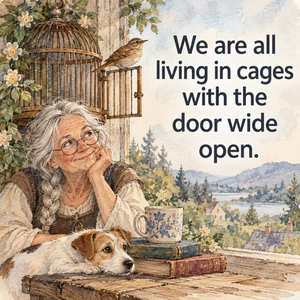
There is also something slightly insulting about the assumption that a good life must be large. We are encouraged to collect experiences as though somebody is checking our punch card at the end. More travel. More activities. More socializing. More goals. Apparently, sitting quietly with a good book and a dog who believes the kitchen contains the secrets of the universe does not photograph impressively enough.
A smaller life can be rich. Choosing less can be wisdom. Peace is not automatically evidence that somebody has given up. Sometimes the cage is not a cage at all. Sometimes we have simply figured out what matters and stopped volunteering for nonsense.
The difficulty is knowing the difference.
Adaptation Has Excellent Camouflage
Human beings are remarkably good at getting used to things. That ability saves us. We adjust after loss. We establish new routines. We find another way to do something, or eventually discover that we can live without doing it at all. The disappointment becomes less sharp. Life fills the empty space.
Sometimes, though, adaptation becomes so complete that we forget there was an empty space. We stop doing something because it hurts. After a while, we stop expecting to do it. Eventually we may start telling ourselves we never really cared about it anyway.
That is where I think the nightingale gets interesting.
She was not dragged back into the cage. The door was open. She had tried the larger world and discovered that it demanded things from her. There was weather out there. Hunger. Uncertainty. Effort. The cage offered safety without negotiation.
I understand that bird more than I would like to.
There are things I no longer want badly enough to pay what they cost me, and I do not think that requires an inspirational intervention. I have reached an age where “You can do anything if you want it badly enough” mostly makes me wonder who is going to handle the laundry afterward.
But there are other things I may have stopped wanting because wanting them became painful.
Those deserve another look.
The Door Can Stay Open
The answer is not to fling ourselves dramatically into the wilderness every time life becomes comfortable. The nightingale does not need a motivational speaker yelling, “Fly, girl!” while she is still drying out from the storm.
Maybe the gentler question is whether the door still opens.
Can I try something without promising to keep doing it? Can I go somewhere once? Call someone I miss? Sit outside instead of inside? Begin something badly? Want something again without immediately calculating whether I can sustain it forever?
A smaller life may be exactly the right life. But I want it to be a life I am choosing now, not merely the one I gradually became accustomed to.
The cage can be warm. The perch can be comfortable. The snacks may, frankly, be excellent.
I would still like to know the door opens.
Reflective Question: 🐦 What have you stopped wanting because wanting it began to feel too difficult?