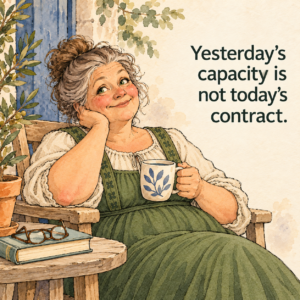

Learning to adjust your expectations when your capacity changes from one day to the next.
Yesterday, you cleaned the kitchen, answered your messages, finished a project, and even had enough energy left to enjoy the evening. You went to bed feeling rather pleased with yourself. Tomorrow, you thought, you might finally tackle that closet.
Then tomorrow arrived.
You woke up tired, your thoughts were moving through molasses, and making breakfast seemed to require an unreasonable amount of planning. The closet could wait. Unfortunately, your expectations hadn’t received the message.
Instead of adjusting your plans, you started negotiating with yourself. Perhaps another cup of coffee would help. Maybe you just needed to get moving. After all, you managed perfectly well yesterday.
And there it is. The assumption that yesterday’s performance established a standard you are now obligated to maintain.
But what if today is simply a 60 percent day?
The Trouble With Expecting Consistency
Most of us have spent decades organizing our lives around relatively predictable abilities. We knew how much work we could accomplish, how long an errand would take, and what we could reasonably expect from ourselves.
Then something changed. Perhaps it was aging, chronic illness, disrupted sleep, medication, grief, or simply the accumulated demands of a complicated life. Suddenly, our capacity became less predictable.
The frustrating part isn’t always having less energy. It’s not knowing how much we’ll have when we wake up.
We continue making plans for the woman who had a wonderful Tuesday, then become irritated when Wednesday’s woman cannot keep up. We treat changing capacity as a failure of discipline rather than information about our present circumstances.
And we rarely extend ourselves the understanding we’d offer someone else. If a friend told us she was exhausted, we’d probably suggest she take things easier. When we’re exhausted, we give ourselves a lecture about getting our act together.
A rather peculiar double standard.
The Olive Tree Had Something to Prove
Aesop told a story about an Olive Tree and a Fig Tree.
The Olive Tree was proud of remaining green throughout the year. It looked magnificent in every season and enjoyed reminding the Fig Tree of its superiority. Each autumn, the Fig Tree lost its leaves and stood bare through winter, while the Olive Tree continued displaying its splendid foliage.
Then a heavy snowfall arrived. The snow settled on the Olive Tree’s leaves, accumulating until the weight broke its branches. The bare Fig Tree, however, allowed the snow to fall harmlessly through its branches to the ground. The Fig Tree survived.

The story isn’t suggesting that losing your leaves is always preferable. It’s reminding us that what serves us under one set of conditions may become a burden under another.
The Olive Tree’s impressive consistency offered little protection when circumstances changed.
Sometimes the wisest thing we can do is stop insisting on carrying everything.
Why Your Capacity Changes
Our bodies and brains don’t operate with identical resources every day. Sleep quality, stress, physical exertion, illness, pain, and emotional demands all influence how much we can comfortably manage.
Sleep is particularly important. According to the National Institutes of Health, insufficient sleep can affect attention, memory, decision-making, emotional regulation, and reaction time. Tasks that ordinarily feel straightforward may require noticeably more effort after a poor night.
Mental activity counts, too. Handling appointments, managing family difficulties, making decisions, or navigating an emotionally demanding conversation can leave us feeling depleted even when we’ve barely moved from a chair.
For people with certain chronic illnesses, exceeding their limits can also worsen symptoms. The Centers for Disease Control and Prevention describes pacing as a way to balance activity and rest, particularly for people who experience post-exertional malaise.
This doesn’t mean everyone has precisely 60 percent of some measurable daily energy supply. The percentage is simply a useful way of recognizing that our capacity varies.
The important question isn’t why we can’t always reproduce yesterday’s performance. It’s how we can make sensible decisions using the capacity available today.
Plan for the Day You Actually Have
Begin by checking in with yourself before making demands. How did you sleep? Is pain or discomfort demanding attention? Are you thinking clearly? Is something emotionally draining already occupying your mind?
Then choose a reasonable plan based on those answers.
On a good day, you might manage several demanding activities. On a more difficult day, you might choose one important task and leave room for ordinary necessities. On a particularly challenging day, essential care and rest may need to take priority.
One useful approach is to divide your plans into three categories: what must happen today, what would be helpful, and what can wait. Be careful about that first category. We have a remarkable talent for declaring everything essential, including reorganizing a cupboard nobody has opened since Easter.
Next, consider the cost of each activity. A doctor’s appointment isn’t merely the time spent with the doctor. It may include getting ready, traveling, waiting, concentrating, and recovering afterward. Those demands belong in the day’s plan.
Finally, leave some room for the unexpected. A schedule that requires every available ounce of effort leaves little flexibility when life behaves like life.
Don’t Spend Tomorrow’s Energy Today
Better days bring their own temptation. When we finally feel capable, we want to catch up on everything we’ve postponed. Laundry, cleaning, errands, phone calls, projects—we attack the backlog with the enthusiasm of someone recently released from captivity.
Sometimes that works. Sometimes the following day brings a substantial bill.
For people who experience symptom flare-ups after exertion, the consequences can be particularly serious. But even without that condition, filling every good day to capacity may leave too little time for recovery.
Instead of treating increased capacity as an invitation to do everything, consider what deserves that opportunity. Complete something important, certainly. Enjoy doing something pleasurable, too.
And perhaps stop before you’re completely exhausted. A good day doesn’t have to become a productivity emergency.
A Different Measure of Success
The hardest adjustment may be changing how we measure a successful day.
For years, success might have meant completing everything on the list. Now it may mean choosing wisely, meeting important responsibilities, protecting our health, and leaving enough of ourselves available for the people and pleasures that make life worthwhile.
That isn’t lowering our standards indiscriminately. It’s making our standards responsive to reality. The Fig Tree wasn’t trying to become a permanently leafless tree. It simply existed differently when the season required it. Its value didn’t disappear with its leaves. Neither does yours when your capacity changes.
Some days you’ll have considerably more to work with. Other days, 60 percent may be an ambitious estimate. The aim is not to predict every fluctuation perfectly, but to stop treating those fluctuations as evidence of personal inadequacy. Yesterday’s capacity is not today’s contract. And tomorrow deserves to be approached on its own terms.
🫒 Something worth considering: If you planned tomorrow around the energy you actually had, rather than the energy you thought you should have, what would you change?