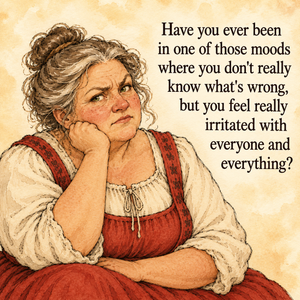

When fatigue, pain, stress, sensory load, and reduced capacity pile up, ordinary annoyances can start feeling enormous. Sometimes the problem isn’t that you’ve become less patient. You simply have less capacity left for patience.
There are days when another human being chewing seems like an act of aggression. The television is too loud, the grocery store is too bright, the phone will not stop making noises, and somebody asks a perfectly reasonable question at precisely the wrong moment. You hear yourself answer with an edge in your voice and immediately wonder what has happened to you. You used to be able to run errands, make dinner, answer the phone, listen to somebody tell a long story, and remain a reasonably civilized person through all of it. Now the refrigerator hum is getting on your nerves.
That change can be unsettling, especially if you have always thought of yourself as patient or easygoing. It is tempting to assume you have simply become cranky with age, or that you are turning into someone who cannot tolerate other people. But irritability is not always a personality problem. Sometimes it is a capacity problem. When your body and brain are already using a large share of their resources to manage pain, fatigue, stress, poor sleep, concentration, or sensory input, there may simply be less left over for tolerating the ordinary friction of daily life.
That is why the thing that finally sends you over the edge is often ridiculously small.
When One Small Sting Lands on an Already Full Day
Aesop’s The Bear and the Bees begins with a bear approaching a hive in search of honey. A single bee stings him. Furious, the bear attacks the hive, and the rest of the bees respond exactly as bees might be expected to respond. Instead of enduring one sting and moving on, the bear ends up with an entire swarm after him.

Traditionally, the fable is a warning about allowing a small injury to provoke a reaction that makes everything worse. That lesson still works. But the story also gives us a useful picture of irritability, because the sting that causes the explosion is not always the whole story. Sometimes it is simply the thing that arrived after there was almost no tolerance left.
The person talking too loudly may not really be the problem. The problem may be the poor night’s sleep, the aching knee, the doctor’s appointment, an hour of paperwork that required more concentration than it used to, the traffic coming home, and the three other things you had to solve before lunch. Add fluorescent lights, a crowded store, somebody asking where you put something, and a dog that has apparently decided barking is its life’s work, and suddenly one more sound feels unbearable. The final annoyance may be tiny. The load underneath it is not.
Why Your Tolerance Can Shrink
We often talk about patience as though it were a fixed virtue: some people possess it and others do not. In reality, the ability to regulate irritation depends partly on the condition of the brain and body doing the regulating. Pain demands attention even when you are not consciously thinking about it every second. Poor sleep can make emotional regulation more difficult. Fatigue reduces the energy available for concentration and self-control. Stress keeps the nervous system prepared to respond to possible problems, while noise, bright light, crowds, conversation, decisions, and interruptions all require processing.
None of these things has to be catastrophic to matter. Their effects can accumulate. If your body is already working harder than it once did just to get through an ordinary day, the cushion between “slightly annoying” and “absolutely intolerable” may become thinner.
That is especially relevant when your capacity has changed. Chronic illness can reduce stamina. Pain can consume attention. Menopause and other physical changes can disrupt sleep. Grief can make concentration surprisingly difficult. Caregiving can mean that part of your mind is always occupied by somebody else’s needs. Aging itself can change how quickly we recover from physically or mentally demanding days. Sometimes several of these things are happening at once.
Your old tolerance may have depended on resources you no longer have in the same quantity. That does not mean you have become difficult. It means the margin you once had has narrowed. When there is plenty of margin, the barking dog is irritating. When there is almost none left, that same dog can feel as though it has been personally commissioned to ruin your afternoon.
Irritation Can Be Information
One of the most useful things you can do is stop thinking of irritability only as bad behavior that must be suppressed. Sometimes it is an early warning that you are approaching the edge of your available capacity. You may become irritable before you consciously recognize how tired you are. Noise suddenly bothers you. You cannot follow a conversation while preparing dinner. Somebody standing too close feels intrusive. A small change of plans seems wildly unreasonable. You begin snapping at people you actually like.
If you start recognizing those signals, you can respond earlier instead of waiting until you are thoroughly depleted. That might mean leaving a social gathering while you are still enjoying yourself rather than staying until your nervous system has filed a formal complaint. It might mean doing two errands instead of five, choosing the quieter restaurant, turning off the television while you are trying to talk, or leaving an unscheduled hour after an appointment instead of squeezing another obligation into the space simply because the calendar says it fits.
The calendar, after all, is not your nervous system. It does not know what the previous activity cost you.
This is one of the adjustments that can be difficult when capacity changes. We are accustomed to judging whether we “have time” for something. Time is only part of the equation. You can have ninety free minutes and still not have ninety minutes of usable energy, concentration, patience, or sensory tolerance. Learning to plan around capacity instead of clock time can prevent a surprising amount of unnecessary misery.
Lower the Load Before You Blame Yourself
When everything begins irritating you, it may help to ask a more useful question than Why am I being so awful today? Ask instead, What am I already carrying? Think back over the previous several hours. Did you sleep badly? Are you in more pain than usual? Have you eaten? Have you spent most of the day concentrating? Have you been in noisy or crowded places? Have several people needed things from you? Have you had any time at all when nobody was talking, asking questions, making noise, or requiring a decision?
The answer will not always be obvious, but patterns often appear once you begin looking for them. You may discover that your tolerance reliably disappears after grocery shopping, long appointments, family visits, poor sleep, several consecutive busy days, or periods when pain is worse. That information lets you change the conditions instead of repeatedly reaching overload and then blaming your personality.
Some of the changes can be very ordinary. Turn off background noise you are not actually enjoying. Sit somewhere quiet for a few minutes between demanding activities. Use earplugs or noise-reducing headphones in environments that overwhelm you. Break errands into smaller trips. Give yourself recovery time after social activity. Postpone something that genuinely does not need to be done today. If you live with other people, tell them when your tolerance is dropping before you reach the stage where you communicate this by slamming a cupboard.
It can also help to become more direct about what you need. “I’m overloaded and need twenty quiet minutes” is useful information. It is not a moral failure, an accusation, or a request for permission to exist. People cannot always accommodate us, but they have a much better chance of understanding what is happening when we explain the need before irritation turns into conflict.
The goal is not to eliminate every annoyance from your life. Nobody gets that arrangement. The goal is to stop making your system absorb unnecessary load when it is already working near capacity.
When Irritability Deserves More Attention
There is an important difference between understanding ordinary overload and explaining away a significant change. Irritability can have many causes, and sometimes it is worth discussing with a healthcare professional. A sudden or dramatic change in mood or behavior, irritability that becomes severe or persistent, or a change that appears alongside new problems with sleep, thinking, pain, medication, or physical health deserves attention.
That does not mean every short fuse is evidence of illness. It means you do not have to choose between “I’m merely cranky” and “something terrible must be wrong.” Bodies change, medications change, hormones change, sleep changes, and health conditions change. If your irritability feels noticeably different from your usual response to stress or fatigue, mentioning it is sensible.
Getting older should not become an explanation that automatically ends every investigation. “I’m getting older” may be relevant. It should not be the only answer anyone is allowed to give.
Maybe You Haven’t Become a Crank
There is something painful about discovering that you cannot comfortably tolerate what you once could. Even a small change can feel like evidence that another version of yourself is slipping away. You may remember being the woman who could handle the noisy restaurant, the full day of errands, the late night, the houseful of people, the complicated holiday, and the last-minute change of plans. Needing something different now can feel like losing ground.
But adaptation is not the same thing as disappearance. It is learning the conditions under which the person you still are can function best.
You may need quieter restaurants now. You may enjoy visits more when they are shorter. You may need a recovery day after something that once barely slowed you down. You may discover that three errands are perfectly manageable and the fourth is where civilization begins to collapse. There is useful knowledge in that. Once you know where your limits tend to be, you can stop repeatedly proving that they exist.
The bear in Aesop’s story could not control whether a bee stung him. He could control whether he threw himself at the entire hive.
We cannot arrange a life in which nothing hurts, nobody interrupts us, every room is quiet, and nobody ever chews within hearing distance. We can, however, become much better at noticing when we are already carrying too much. Sometimes the wise response to increasing irritation is not to demand more patience from yourself. It is to reduce the load while you still have enough capacity left to choose how.
🐻 Reflective question: When your tolerance suddenly disappears, what was your body or mind already dealing with before the final little annoyance arrived?