
At some point, everyday conversation begins to sound like a meeting of the household maintenance committee. We discuss appointments, groceries, passwords, bills, and whether the washing machine is making that noise again. Useful subjects, certainly, but hardly cause to reach for a dictionary and exclaim, “Well, would you look at that!” Even our words have been assigned sensible shoes and a clipboard.
When life has become smaller through illness, limited money, reduced energy, or simply too many responsibilities, it is easy to let curiosity shrink along with the calendar. Reading must improve us. Hobbies must become useful. Even fun is expected to arrive with measurable benefits and preferably a receipt. Meanwhile, a ridiculous word that could brighten an ordinary Tuesday sits neglected, waiting for someone with sufficiently questionable priorities to appreciate it.
The Pleasure of a Completely Unnecessary Word
Consider the sheer satisfaction of discovering that something familiar has a name you never knew. You have been watching dogs sprawl on their bellies for years, but splooting—lying with the back legs stretched behind—makes the scene instantly funnier. The dog has displayed absolutely no ambition. An excellent afternoon, by most reasonable standards.
And there is balter, an old word meaning to dance clumsily. I immediately think of Elaine from Seinfeld, executing that gloriously alarming dance with complete conviction. She wasn’t lacking enthusiasm; her limbs had merely declined to coordinate. What a splendid thing it is to have a word that describes movement without requiring elegance. You needn’t perform it yourself to enjoy it, especially when your knees have filed a formal objection.
The Rooster Who Preferred His Breakfast
In Aesop’s The Cock and the Jewel (Perry 503), a rooster scratches around looking for something to eat and finds a precious stone instead. Someone else might prize it, but he would far rather have a grain of barley. Having established his priorities, he leaves the jewel behind and returns to the serious business of breakfast.
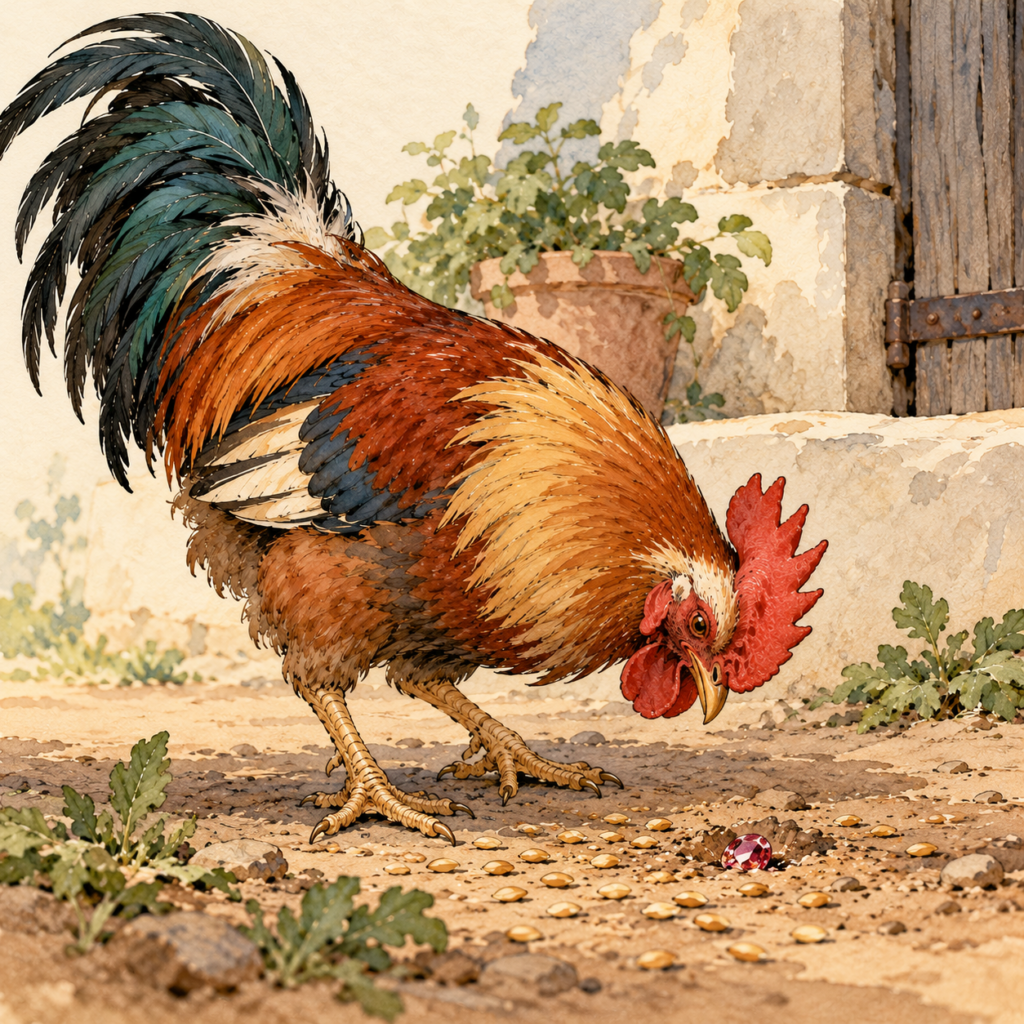
It’s hard to fault the rooster. Pearls and gemstones are notoriously disappointing when you’re hungry. But the story also reminds us that value depends on what we’re looking for. A magnificent word is useless when you are trying to remember why you entered the pantry, yet it might be your brightest discovery all week. Neither needs to be wrong. The trick is making room for both the barley and the jewel.
Why a Little Curiosity Feels So Good
Curiosity is more than a pleasant personality quirk. In a 2014 study published in Neuron, researchers found that people remembered information better when they were especially curious about it. Their brain scans also showed activity involving areas associated with motivation and memory. This doesn’t mean learning snaccident will prevent dementia. It suggests that interest can help make learning memorable. Another study, published in 2023, found that older adults, like younger ones, better remembered foreign vocabulary they considered important.
Psychologist Barbara Fredrickson has also described how positive emotions, including interest and joy, can widen what we notice and feel inclined to explore. A little surprise can interrupt the march of obligations without solving them. Sometimes opening a small window is enough.
Five Words to Take Out for a Spin
Snaccident is a playful blend of snack and accident: when you somehow finish the entire bag of chips without having made a conscious decision to do so. There may be witnesses, but no reliable testimony. It is modern slang rather than an ancient linguistic treasure, and all the better for admitting its own ridiculousness.
Splooting belongs to the newer, informal side of the dictionary too. It describes the flat-bellied, hind-legs-out pose often adopted by dogs, particularly corgis. Fernweh, by contrast, comes from German and means longing for faraway places—the opposite direction from homesickness. You can experience it while looking at a travel photograph, even if an actual journey is outside your current budget or capacity.
Balter has a much longer history: Scottish records show it used for clumsy dancing centuries ago. And phosphenes is a scientific term for the flashes or patterns of light we can perceive without light entering the eye, sometimes noticed when the eyes are closed. There is something charming about the fact that the brain’s peculiar little light show has such an elegant name.
Give Your Words Somewhere to Live
You don’t need a vocabulary course or a gold-edged notebook, tempting though that sounds. Keep a note on your phone, the back of an envelope, or a scrap tucked inside a book. Collect one word that makes you smile. I find most of my odd words on Pinterest, where I save them to a board called Ballyhoo. The word itself means a noisy commotion, extravagant publicity, or an attention-grabbing fuss, which seems an entirely appropriate name for a collection of words demanding to be noticed. I do check their meanings in a reliable dictionary, though, because those lovely internet word cards occasionally let enthusiasm get ahead of accuracy. Then use your discoveries in a sentence, send them to a friend, or tuck them away for the perfect occasion. You never know when ordinary conversation might be improved by a little linguistic ballyhoo.
Better still, invite somebody to trade discoveries with you. Ask for a word that describes a feeling, an animal’s peculiar habit, or a family member’s baffling behavior. The conversation may fix nothing, but it might contain actual laughter, a perfectly respectable outcome.
The rooster was entitled to prefer barley. We need barley too: appointments kept, groceries bought, the business of carrying on. But when a verbal jewel turns up among the sensible things, we don’t have to step over it. We can tuck it into a pocket, admire its sparkle, and perhaps make an unsuspecting friend say, “You know there’s a word for that?”
💬 Now, Here’s a Thought…What wonderfully unnecessary word would you love to bring back into conversation?
🌿 You Might Also Enjoy
The Thought Slipped Away Midsentence. You were halfway through saying something when the thought simply vanished. Why does that happen, and why does it seem to happen more often as we grow older? Explore the science behind those frustrating memory lapses, with a little humor and practical help for finding your train of thought again.
Why Do I Need to Recover From Seeing People I Like? Even enjoyable conversations and visits with people we love can leave us surprisingly exhausted. Discover why socializing takes energy, how our nervous systems respond, and why needing a little quiet afterward doesn’t mean we enjoyed the company any less.
🌿 More Stories for the Life You’re Living
Life changes, sometimes dramatically and sometimes one bewildering little inconvenience at a time.
Join From The Fables for a monthly letter filled with timeless stories, practical wisdom, and a little humor about navigating life’s changes.
And there’s a welcome gift! You’ll receive a free copy of Best I Can Do Is a Mustache, our illustrated, irreverent look at menopause and its many surprises.
GET MY FREE BOOK & MONTHLY LETTER