

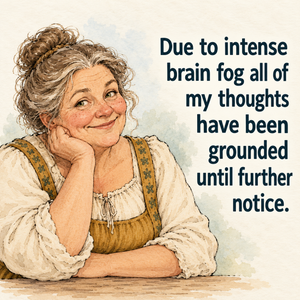
Fibro fog can interrupt a perfectly ordinary conversation, leaving you searching for a word you know as well as your own name.
You’re telling a friend about something that happened yesterday. The story has a beginning, a middle, and a rather good point. Then, just as you reach the important bit, a word disappears. Not an exotic word, either. Something like colander. You know exactly what it is: the bowl with holes that lives in the kitchen. You can picture it, explain its purpose, and probably remember which cupboard it’s in. Its name, however, has left no forwarding address.
When this happens often, the joke wears thin. You may lose the thread while answering a question, forget why you walked into a room, or struggle to follow a conversation when two people speak at once. Someone finishes your sentence, and you smile because correcting them would require another sentence. Later, the missing word returns while you’re brushing your teeth. Unfortunately, the audience has gone home, and the colander has missed its big moment.
When Words Become a Source of Worry
The most difficult part isn’t always forgetting a word. It’s what you fear people will conclude. A pause during a chat with a friend is one thing; losing your train of thought while explaining symptoms to a doctor or making a decision about your own life can feel much more consequential. You may wonder whether you sounded confused, whether you were taken seriously, or whether someone has quietly decided you need help with things you can still manage.
That worry can make you work even harder at sounding fluent. You rehearse a sentence before speaking, watch the listener’s face, and try to retrieve the missing word quickly. Now your attention has several jobs instead of one. There is a particular injustice in having to concentrate on appearing capable when you were capable all along.
A Partridge, a Fox, and an Ill-Timed Remark
In Aesop’s lesser-known The Partridge and the Fox (Perry 562), a fox praises a partridge and persuades her to close her eyes. The moment she does, he catches her. The partridge then persuades him to speak before eating her. When he opens his mouth, she escapes. Both discover that a poorly timed action can undo a perfectly good plan.

Of course, fibro fog isn’t a foolish decision, and a lost word is hardly the same as losing your dinner. But the fox provides a useful comic picture of the gap between what we intend and what actually happens when we open our mouths. Some days the timing simply refuses to cooperate.
What Happens When Your Thinking Feels Foggy
Fibro fog is an everyday name for cognitive difficulties many people with fibromyalgia report. Studies have found problems, on average, with attention, working memory, and some aspects of processing information. Working memory is your brain’s temporary workbench: it holds the start of a sentence while you assemble the end, or keeps a question in mind long enough to answer it.
Persistent pain may compete for that limited attention. Poor sleep and fatigue can add another burden, and interruptions may make it harder to find your place again. Not everyone experiences the same difficulties, and researchers are still examining exactly why they happen. The important distinction is that a delay in retrieving a word does not automatically mean you have lost the knowledge behind it. Knowing what a colander does and being able to say “colander” on demand are related, but separate tasks.
Ways to Make Conversation Easier
Start by giving yourself permission to pause. “I know what I mean; give me a moment” is a complete and respectable sentence. If the word remains elusive, describe it or use a simpler substitute. You don’t need to turn every conversation into a timed examination. And if someone guesses incorrectly, you can say, “Not quite. Let me finish.”
Before an important appointment or discussion, write down the two or three points you most want to make. Keep the note where you can see it, and return to it if the conversation wanders. This is especially useful when pain, emotion, or time pressure makes it difficult to hold several thoughts at once. A written reminder is a tool, not an admission of defeat.
Reduce distractions where possible. Turn off the television during a phone call, ask for one question at a time, or choose a quieter place for a serious discussion. If mornings are usually clearer for you than evenings, arrange demanding conversations accordingly when you have that choice. None of these steps cures fibro fog; they simply reduce the number of things your attention must juggle.
Your Voice Is Still Yours
If thinking or language problems are new, suddenly worse, or interfering with safety, have them assessed rather than assuming fibromyalgia explains everything. Medication effects, sleep problems, and other conditions can also contribute. Sudden difficulty speaking, particularly with facial drooping or weakness, calls for emergency help.
For the ordinary stumbles, though, you are allowed to take your time. A pause doesn’t cancel your experience, judgment, or right to be heard. The people worth talking with can learn to wait while you find your way back to the sentence. And when colander finally turns up at bedtime, you may greet it with considerably less enthusiasm than it deserves.
🤦🏼♀️ What About You? What would change if you gave yourself—and asked others to give you—a little more room to finish your thoughts?
🌿 You Might Also Enjoy
Maybe Today Is a 60 Percent Day. Some days, your available energy doesn't match your plans. Here's another way to think about what you can realistically manage.
Oh Look, the Body Rewrote the Manual. Again. When your body changes the rules without consulting you, adapting becomes its own peculiar adventure.
🌿 More Stories for the Life You're Living
Life changes, sometimes dramatically and sometimes one bewildering little inconvenience at a time.
Join From The Fables for a weekly letter filled with timeless stories, practical wisdom, and a little humor about navigating life's changes.
And there's a welcome gift! You'll receive a free copy of Best I Can Do Is a Mustache, our illustrated, irreverent look at menopause and its many surprises.
GET MY FREE BOOK & MONTHLY NEWSLETTER