

The hidden cognitive, sensory, and emotional workload of socializing—and why even enjoyable company can require recovery afterward.
You had a wonderful afternoon. The conversation was lively, everybody laughed, and you genuinely enjoyed yourself. Nobody offended you, nothing went wrong, and you wouldn’t have missed it for the world.
So why, after everyone leaves, do you feel as though you’ve worked an eight-hour shift?
Perhaps you find yourself sitting in the quiet, unable to concentrate on a book or decide what to make for dinner. Even answering a friendly text seems like one request too many. You love these people. You’re already looking forward to seeing them again. But right now, you’d rather not hear another human voice.
It’s a peculiar contradiction, especially if you remember a time when you could entertain all afternoon, clean the kitchen afterward, and still have enough energy for an evening out.
And occasionally, someone notices your exhaustion and asks, with genuine bewilderment, what you could possibly be so tired from. After all, you’ve only been sitting around talking.
That’s when the afternoon becomes even more exhausting. Now you feel obliged to explain yourself.
The Work Nobody Sees
Socializing involves considerably more than sitting in a chair and talking. Your brain is continuously listening, interpreting, remembering, responding, and deciding where to direct its attention.
In a group conversation, you’re following several voices, recognizing expressions, remembering names and details, choosing when to speak, and adjusting to changes in subject. You’re also managing the ordinary courtesies that make company pleasant: showing interest, noticing when someone feels excluded, and finding the right moment to contribute.
Then there’s the environment. Background music, clattering dishes, overlapping conversations, bright lights, and uncomfortable seating can all add to the demands.
For someone whose energy or physical capacity has changed, these activities may require more effort than they once did. Chronic pain, poor sleep, hearing difficulties, illness, or simply an already demanding day can make an otherwise delightful gathering feel surprisingly expensive.
None of this means the enjoyment was imaginary. It means the enjoyment came with work attached.
The Donkey, the Frogs, and a Difference of Opinion
In Aesop’s The Donkey and the Frogs, a donkey is carrying a heavy load of firewood when he attempts to cross a swamp. He loses his footing, falls into the water, and discovers that the weight on his back makes it impossible to get up.
Naturally, he begins to groan.
The frogs who live in the swamp hear his complaints and are thoroughly unimpressed. They spend their entire lives in that water. If the donkey is making such a fuss after falling in for only a few minutes, they wonder, whatever would he do if he had to live there permanently?
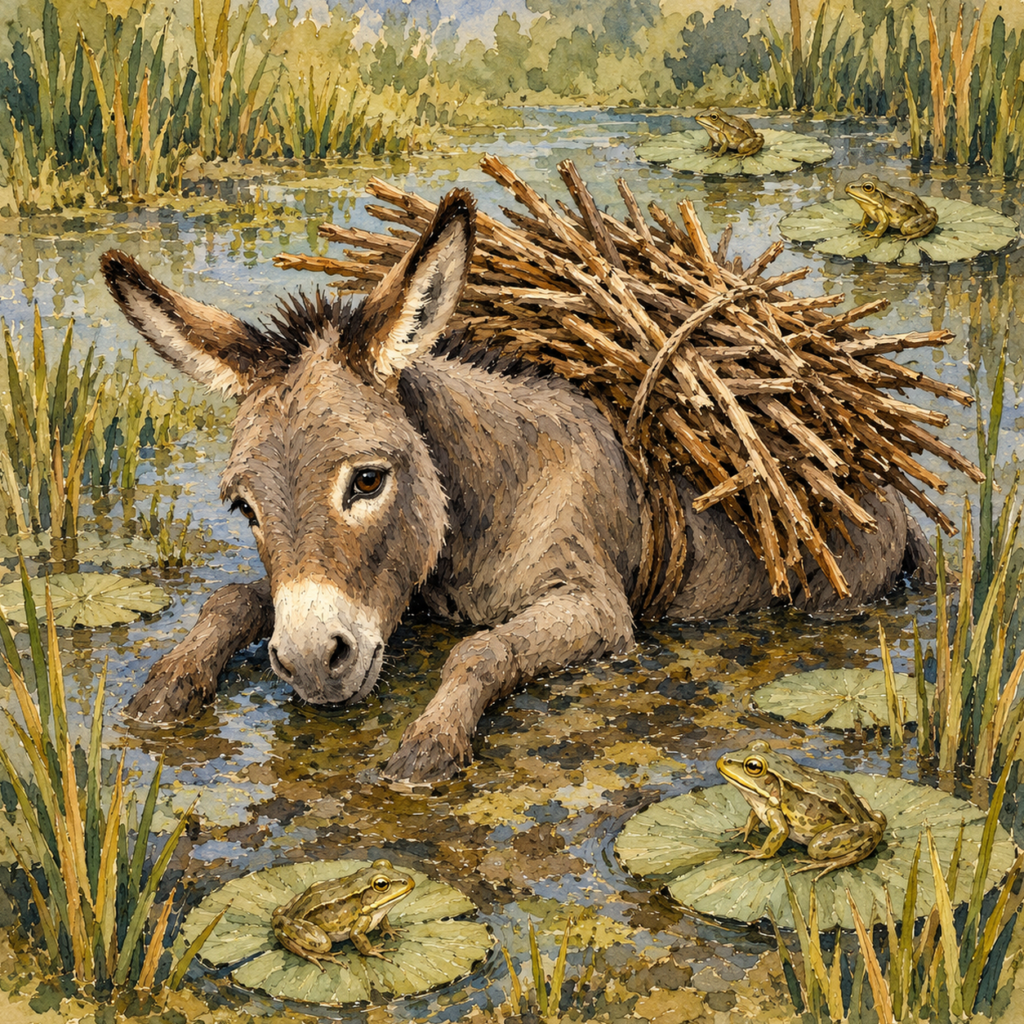
The traditional fable uses the frogs’ response to criticize excessive complaining about difficulties that others endure regularly. But there’s another detail worth noticing.
The frogs belong in the swamp. They are built for the water, familiar with their surroundings, and entirely unburdened by a load of firewood.
The donkey is none of those things.
What is ordinary life for the frogs is an entirely different physical experience for the donkey. The frogs judge his distress by their own circumstances without considering what he’s carrying.
It’s a useful picture of something that happens between people, too. A lively gathering that leaves one person energized may leave another utterly depleted. Both attended the same event. Both may have enjoyed themselves. But they didn’t necessarily do the same amount of work to participate.
And like the frogs, people sometimes overlook the weight someone else is carrying.
Why Conversation Can Leave You Exhausted
Researchers studying hearing and cognition have established that understanding speech, particularly in noisy surroundings, requires mental effort. The brain must separate a person’s voice from competing sounds and make sense of what it hears.
This becomes especially relevant when hearing changes. You may still understand every word, but it can require greater concentration. Listening effort research shows that successful comprehension does not necessarily mean listening was effortless.
Hearing is only one part of the picture. Social occasions also require attention, memory, decision-making, and emotional responsiveness. The combined demands may feel especially noticeable when you’re already tired or managing physical discomfort.
There’s an emotional dimension, too. You might be genuinely happy to see your friends while quietly worrying about keeping up, concealing discomfort, or disappointing someone by leaving early. Perhaps you’re trying to remain cheerful despite a headache or pain that has been getting progressively worse.
That kind of self-monitoring can make an enjoyable afternoon harder. And there is no universal timetable for recovery. Some people feel refreshed after company. Others need an hour alone. Still others may need the remainder of the day, depending on their health, the environment, and the demands of the occasion.
The goal isn’t to diagnose every tired feeling as a medical problem. It’s to recognize that the visible activity doesn’t always reveal the effort required to participate. The frogs saw a donkey in the water. They didn’t give much thought to the firewood on his back.
Keep the People. Change the Arrangement.
When social occasions become tiring, the temptation may be to decline invitations altogether. Yet meaningful relationships remain important throughout life. The National Institute on Aging emphasizes that social connection supports well-being, while persistent loneliness and isolation are associated with significant health risks.
The better approach is often to adjust how you socialize rather than abandon the relationships you value.
Choose quieter surroundings. A conversation with one friend in a peaceful café may be more satisfying than a noisy restaurant filled with overlapping conversations. If hearing is difficult, reducing background noise can make a meaningful difference.
Experiment with shorter visits. You don’t have to stay until you’re exhausted to prove that you’ve enjoyed yourself. Try ninety minutes instead of three hours, then notice how you feel afterward.
Leave space around the occasion. Avoid scheduling errands, appointments, or demanding household work immediately before or after a gathering when possible. Give yourself time to arrive without rushing and return home without another obligation waiting.
Make recovery ordinary. Changing into comfortable clothes, sitting quietly, having something to drink, or spending a little time alone may be enough. You don’t need an elaborate recovery ritual. Sometimes the most useful thing is simply having nothing else to do.
Tell people what works for you. A cheerful explanation can prevent misunderstandings: “I love our afternoons together, but I run out of steam earlier these days. I’m going to head home while I’m still enjoying myself.”
That isn’t rejecting anyone. It’s making the next visit more likely to happen.
Find Out What’s in Your Load of Firewood
Before deciding that socializing itself is the problem, consider what makes particular occasions demanding. Perhaps you enjoy conversation but struggle with background noise. Maybe sitting in an uncomfortable chair aggravates your back. You might discover that driving across town takes more out of you than spending time with the people you came to see.
For your next few social occasions, pay attention to where you were, how long you stayed, and how you felt afterward. Notice whether the conversation, noise, travel, physical discomfort, or length of the visit seems to make the greatest difference.
These observations can help you make specific changes instead of withdrawing from activities you love.
If you regularly struggle to hear conversations, consider a hearing assessment. If exhaustion is new, severe, persistent, or noticeably worsening, discuss it with a healthcare professional rather than assuming it’s simply part of getting older.
Understanding your limits isn’t the same as surrendering to them. It gives you information you can use to remain involved in the parts of life that matter.
You Can Love the Visit and the Quiet Afterward
Our donkey had a difficult time in the swamp, and the frogs couldn’t understand why. Their mistake, from our modern perspective, was assuming that everyone experiences the same circumstances in the same way. Human beings make that mistake rather frequently.
Someone who leaves a party full of energy may find it difficult to understand why you need the evening to recover. You might even find it difficult to understand yourself, particularly if you remember when your stamina was greater.
But changed capacity doesn’t have to mean a smaller emotional life. You can remain affectionate, interested, funny, and sociable without being endlessly available.
You can treasure an afternoon with friends and still be grateful when the door closes behind them. You can enjoy a family celebration and need a peaceful evening afterward. You can love the people in your life without having the energy to spend every available hour with them.
The people matter. The pleasure matters. And so does having enough energy left to enjoy seeing them again.
🫏 Let’s Turn This Around… When you come home exhausted from an enjoyable visit, have you considered what invisible load you were carrying—and what might make that load a little lighter next time?
🌿 You Might Also Enjoy
Leave Before You’re Empty. Enjoying someone’s company doesn’t mean you have unlimited energy. Sometimes knowing when to leave helps you preserve both your well-being and your enjoyment of being together.
Maybe Today Is a 60 Percent Day. Even pleasant activities can take more out of you than expected. Recognizing that your energy varies can help you make plans that work with your capacity rather than against it.
🌿 More Stories for the Life You’re Living
Life changes, sometimes dramatically and sometimes one bewildering little inconvenience at a time.
Join From The Fables for a monthly letter filled with timeless stories, practical wisdom, and a little humor about navigating life’s changes.
And there’s a welcome gift! You’ll receive a free copy of Best I Can Do Is a Mustache, our illustrated, irreverent look at menopause and its many surprises.
GET MY FREE BOOK & MONTHLY LETTER