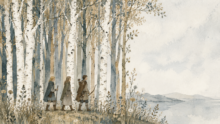

Where the Water Lies Still
There are old stories told around Scottish hearths about a creature that waits where the water lies still.
Not in the middle of a storm. Not in wild rivers or crashing seas.
The kelpie prefers the quiet places—a mist-covered loch, a familiar ford, the edge of a village where people come each day to fetch water, wash clothes, or lead sheep to drink.
It does not chase anyone. That is the curious thing. It simply stands in the shallows, dark and beautiful, as though it has wandered there by chance. Its coat shines with water. Its posture is calm. Nothing about it asks to be feared.
A weary crofter might pass with tools over one shoulder and barely glance at it.
A shepherd could stop with the flock and wonder where such a fine horse had come from.
A washerwoman, standing ankle-deep at the edge of the loch with a basket of damp linen beside her, might shade her eyes against the evening light and think only this: What a remarkable creature.
The old stories say the danger begins with a single touch. Someone reaches out to stroke the horse’s neck. Or climbs onto its back, believing they have found unexpected help for the journey home.
At first, nothing seems wrong. The kelpie stands quietly. The ride feels easy. Only later does the horse begin to move toward deeper water. And by then, the rider cannot climb down.
The old storytellers were never really interested in frightening children. They were trying to explain something quieter.
Sometimes what asks the least of us in the beginning asks the most in the end.
The Shape of a Good Day
There is a kind of day that reminds me of the kelpie.
If you live with fibromyalgia, chronic illness, or a nervous system that rarely settles, you probably know it well. You wake up expecting another difficult morning.
Instead…
Something has shifted. Your shoulders don’t ache quite as much. The heaviness in your legs has lifted. Your thoughts arrive more clearly.
Nothing dramatic. Just… easier.
You begin to think the words every one of us has thought:
“Maybe today.”
Maybe today I’ll catch up on the laundry.
Maybe I’ll answer those emails.
Maybe I’ll clean the kitchen.
Maybe I’ll meet a friend for lunch.
Maybe I’ll finally do all the things that have been waiting while my body couldn’t.
None of those decisions are foolish. In fact, they make perfect sense.
When your life has been limited for so long, a small window of energy feels precious. Of course you want to use it. Of course you want to feel like yourself again.
And for a while, everything goes beautifully. That is what makes the trap so convincing.
When the Ride Feels Easy
The crash doesn’t arrive while you’re folding the washing. It doesn’t interrupt halfway through the grocery store.
Often it waits. An hour later. That evening. Sometimes the next morning.
Your legs feel strangely heavy. Your muscles begin to burn. The fog settles back over your thoughts.
You replay yesterday in your mind, trying to understand how such ordinary tasks could leave you feeling as though you’ve climbed a mountain.
This is where many people turn their frustration inward.
“I should know better.”
“I pushed too hard again.”
“Why can’t I ever get this right?”
But the body tells a different story.
What the Body Thinks It Knows
When we live with chronic pain, our nervous system becomes exquisitely tuned to changes in comfort and discomfort. Relief is not simply pleasant—it is compelling.
When pain quiets, even briefly, the brain naturally assumes resources have returned.
It interprets less pain as more capacity. Those two things are not always the same. Pain may soften long before the body’s energy systems have recovered. Your nervous system is trying to help you seize an opportunity. It simply cannot always predict the cost that will arrive later.
That isn’t weakness. It isn’t poor discipline. It isn’t a character flaw.
It’s a body doing its best with imperfect information.
Saving Something for Tomorrow
Over time, many of us learn to approach good days differently. Not with fear. Certainly not with suspicion. But with curiosity.
Instead of asking, “How much can I get done?”
we begin asking, “How much of this good day would I like to keep for tomorrow?”
It is a very different question. One comes from scarcity. The other comes from stewardship.
The old stories never said we should avoid the water forever.
People still had sheep to tend. Laundry still needed washing. Children still had to cross the loch. Life continued.
The wisdom was never about refusing the journey. It was about learning that appearances are not always the whole story.
Sometimes the kindest thing you can do on a good day is leave a little strength untouched. To stop while you still feel well.
To come home before the water grows deep. That isn’t wasted energy.
It is tomorrow’s gift.
Leaving the Water Before Dark
Perhaps that is what the old storytellers hoped we would remember. Not that the world is full of hidden dangers. But that wisdom often looks like pausing when everything inside us wants to keep going.
The body learns this slowly. One gentle day at a time.
And perhaps that is the truest ending to the kelpie’s story.
Not that we never walk beside the water again—
but that, with time, we learn to recognize the quiet difference between a gift…
and something that only looks like one.
