
The Light That Looked Like Direction
Some paths only appear when we are already lost.
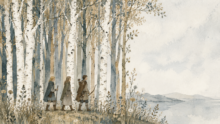
In the old stories, travelers crossing marshland sometimes saw a light moving ahead of them. It hovered low over the bog, pale and flickering, not quite fire and not quite lantern. It did not shout. It did not chase. It did not announce itself as danger.
It simply appeared. A small light in a wide, uncertain place.
And if the traveler had already lost the path, if the fog had thickened, if the ground had become difficult to read beneath their feet, that light could begin to feel like an answer.
There it was, glowing faintly ahead. Something visible. Something moving.
Something that seemed to know where it was going. So the traveler followed.
Not foolishly. Not recklessly. Not because they wished to wander deeper into danger. They followed because the marsh offered no clear road, no steady landmark, no reassuring sign that said, “This way is safe.”
The wisp only had to resemble direction. That was enough.
Step by step, the traveler moved toward it. Across damp grass. Past dark pools. Over ground that looked firm until weight was placed on it. The light drifted farther away, always just beyond reach, always present enough to keep hope alive.
And by the time the traveler realized the light was not leading them out, they were deeper in the marsh than before.
The old stories call this the will-o’-the-wisp. A light mistaken for guidance. A glow that appears when the land is hardest to read.
A small uncertainty followed through a larger one.
When the Mind Becomes Marshland
This still happens, though most of us are not wandering through actual bogs at twilight. We are standing in kitchens, staring into open cupboards. We are reading the same sentence three times. We are holding a phone and forgetting who we meant to text. We are walking into rooms with purpose, only to arrive with absolutely no record of the original mission.
A tiny household haunting. Very inconvenient. Poorly timed.
For those living with fibromyalgia, chronic fatigue, chronic illness, or nervous system overload, brain fog can feel very much like marshland.
Not empty. Not broken. Just difficult to read.
A thought rises, almost clear, and then softens at the edges. A plan forms, but by the time you try to act on it, part of it has slipped away. You know there was a reason you opened the laptop, picked up the notebook, started the laundry, walked across the room.
There was a thread. You had it. And then it vanished into the reeds.
This is one of the quieter frustrations of chronic illness. Pain is often easier to name. Fatigue, though misunderstood, at least has a word people recognize. But brain fog is slippery. It can make you feel unreliable inside your own mind.
You may look fine. You may sound fine. You may even be functioning well enough that no one realizes how much effort it takes to keep track of ordinary life.
But inside, everything is requiring extra handling.
The Relief of Anything Clear
On brain fog days, clarity becomes strangely precious.
A clear thought can feel like a warm handrail on a dark stairway. A small plan can feel like salvation. A sentence that lands the first time can feel like winning a minor award no one else knows you were nominated for.
This is where the will-o’-the-wisp becomes such a useful image. When nothing is steady, anything that feels clear becomes tempting. A sudden idea. A new plan. A small burst of certainty. A task that seems to make sense for three beautiful seconds.
So you follow it. Not because it is perfect. Not because you are certain it is right. Because it is something. And when your mind is fogged, something can feel much better than nothing.
That does not mean you are careless. It means your system is trying to orient. The brain is always looking for pattern, direction, and completion. When energy is low and cognitive processing is strained, it will often grab the clearest available signal.
Even if that signal is not the best one.
Even if it is only clear because everything else is blurred.
Why Brain Fog Feels So Heavy
Brain fog is not a character flaw. It is not laziness wearing a shawl. It is not lack of discipline, poor motivation, or some moral failure to “try harder.”
With fibromyalgia and chronic illness, the nervous system is often already working under strain. Pain signals, poor sleep, sensory sensitivity, inflammation, stress hormones, blood sugar shifts, medication effects, and fatigue can all affect how clearly the brain processes information.
The brain is not separate from the body. It is not floating above the situation with a clipboard, calmly supervising.
It is in the weather.
When the body is overwhelmed, the mind may become slower, more fragmented, or harder to access. Working memory can feel weaker. Attention may scatter. Words may disappear. Decisions may take more effort than they “should.”
And that word—should—is often where the suffering deepens.
I should be able to do this. I should remember why I came in here. I should not need to write down something this simple. I should be sharper than this.
But brain fog does not respond well to shame. Shame adds pressure, and pressure asks the nervous system for more resources when it is already rationing them.
It is a bit like yelling at a lantern because the marsh is foggy.
Understandable, perhaps. Not especially effective.
Fewer Steps Through Uncertain Ground
The kindest response to brain fog is not force. It is structure without punishment.
Fewer steps. Shorter lists. Notes written down before the thought wanders off into the bog to start a new life. One task visible at a time. Less switching. More pauses. More permission to move at the speed of the mind you actually have today.
Not the imaginary one who slept beautifully, woke refreshed, remembered passwords, answered emails, cooked dinner, drank water, and folded laundry in the same lifetime.
That woman sounds lovely. We wish her well.
But today may require a smaller road. And that is not failure. That is adaptation.
On brain fog days, you may need to trust simpler forms of guidance. A written note. A timer. A familiar routine. A quieter room. Food. Rest. Hydration. A pause before saying yes. A little less input coming from every direction at once.
These are not signs that you are weak.
They are little planks across the marsh.
The Light Was Not the Whole Story
The will-o’-the-wisp is often treated as a warning against being misled. And yes, there is truth in that.
But for someone living with chronic illness, there is another truth beneath it.
The traveler does not follow the light because they are foolish. They follow because they are tired, uncertain, and standing in a place where nothing else is clear.
That matters.
Because brain fog can make you feel ashamed of the ways you reach for direction. It can make you second-guess your judgment, your intelligence, your reliability, your ability to manage a life that already asks more than it should.
But perhaps the more compassionate reading is this: You are not failing because the marsh is hard to cross. You are not foolish because a small light felt like relief. You are a person trying to find your way with limited visibility.
Some days, the wisest thing is not to keep chasing the light.
It is to stop, breathe, soften the demand, and let the fog be real before choosing the next step.
Not every hard day is heavy. Some are unclear.
And on those days, gentleness is not giving up. It is how we keep from getting lost.
