
When The Path Went Quiet
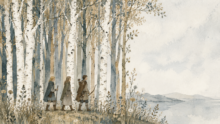
Two travelers were making their way through a forest, speaking as travelers do when the road is long and the trees seem harmless. They had likely promised one another ordinary things before they set out: that they would keep together, watch the path, share the danger, and arrive somewhere else with the story improved by retelling.
For a while, nothing challenged this arrangement. The trees stood still. The path continued. Their friendship, or what passed for it on a pleasant road, seemed sturdy enough.
Then a bear appeared.
There was no time for discussion. No careful weighing of options. No noble speech about loyalty beneath the pines. One traveler, quick and able, ran to the nearest tree and climbed into its branches. From there, hidden among the leaves, he watched what would happen below.
The other traveler could not climb. Perhaps he was slower. Perhaps the bear was already too close. Perhaps his body simply would not do what the moment required. So he did the only thing left to him. He fell flat to the ground and lay as still as death.
The bear came near.
It lowered its great head and sniffed the man’s face, his ears, his breath, his hands pressed near his neck. The forest must have gone terribly quiet then. The kind of quiet that makes every heartbeat feel rude.
The man did not move.
At last, the bear turned away and lumbered back into the woods, leaving him alive on the forest floor.
What The Bear Seemed To Say
When the danger had passed, the man in the tree climbed down. We might imagine him brushing bark from his sleeves, trying to make his descent look more casual than it was. Perhaps he laughed a little too quickly. People often do, after they have failed someone and would rather not make a whole ceremony of it.
“What did the bear whisper in your ear?” he asked.
The man who had lain on the ground answered that the bear had given him advice.
It told him never to travel with a friend who leaves him when danger comes.
A tidy moral, yes. Almost too tidy. The old fables were not known for cushioning the blow. They tended to walk in, place the truth on the table, and leave before anyone could say, “That feels a bit direct.”
But this one stays with us because the wound is so familiar. The bear was frightening, certainly. But the deeper revelation was not the bear. It was the man in the tree.
The Long Walk Back
This still happens.
Not usually with bears, mercifully. Most of us are dealing with texts, invitations, family gatherings, unanswered messages, and the strange emotional weather of trying to return to people after a season of being unwell, overwhelmed, grieving, exhausted, or simply absent from ordinary life.
Reconnecting can sound like a simple thing from the outside. You send the message. You meet for coffee. You answer the invitation. You step back into the room.
But inside, it may feel much heavier than that. Because you are not only returning to a person. You are returning with memory.
You remember who checked in and who disappeared. You remember who understood when your body could not keep up and who made you feel like an inconvenience wrapped in a cardigan. You remember who was gentle with your silence and who treated it like a betrayal.
And perhaps most painfully, you remember the people who climbed into the tree.
The Invitation With Thorns
When you live with chronic illness, fibromyalgia, fatigue, pain, grief, sensitivity, or limited capacity, absence often becomes part of your life. Not because you are careless. Not because you do not value people. But because your body sometimes gives you a smaller room to live inside.
You cancel plans you wanted to keep. You read messages and do not have the strength to answer. You miss birthdays. You go quiet. You become less available, less predictable, less easy to include.
Then, when a little strength returns, there is the strange work of re-entry.
You may want connection. You may miss people deeply. You may long for ordinary warmth: a laugh, a familiar voice, someone who remembers you without needing the full medical appendix.
And still, the thought of reaching out can feel heavy.
Because a simple message can carry a whole forest inside it.
Will they be glad to hear from me? Will they be irritated? Will I have to explain everything? Will they think I am dramatic? Will they quietly decide I am too much work now? Have I been gone too long? Did my absence change my place in their life?
This is why reconnection can feel so tiring before anything has actually happened. The visible task is small. The invisible one is enormous.
Where The Body Remembers
The nervous system learns from experience. It notices patterns, especially around safety, abandonment, rejection, and belonging. If you have been left alone during difficult seasons, your body may begin to treat reconnection as a risk rather than a relief.
This does not mean you are being unreasonable. It means your system is trying to protect you from being dropped again.
Social energy is not only about talking, smiling, listening, and finding something clean enough to wear. Though let us not underestimate the laundry portion of human connection. Social energy also includes the effort of being perceived. It includes deciding how much truth to tell. It includes managing someone else’s possible disappointment. It includes trying not to apologize for existing at half capacity.
For a sensitive or chronically stressed body, these things are not small. They can activate the same internal alarm that says, Be careful here. This person may not stay. This may cost more than it gives.
So you may delay. You may draft the message and delete it. You may keep things light because honesty feels too exposed. You may over-explain because being misunderstood feels worse.
None of this is weakness. It is the body remembering the tree.
A Friend Who Climbs Down
The softer truth is this: reconnection does not require you to become the old version of yourself in order to be loved again.
You do not have to return at full volume. You do not have to compensate for absence with performance. You do not have to prove that your limits are temporary, tidy, or charmingly manageable.
Some relationships will struggle with the slower version of you. Some people only knew how to walk beside you when you could keep pace. Some may interpret your limits through their own discomfort and call it distance, neglect, or drama.
That will hurt. It is allowed to hurt.
But not every traveler belongs on the next road.
There are also people who can climb down. People who do not need a polished explanation before offering kindness. People who can receive a simple, honest sentence: “I’ve been quieter than I meant to be. I’m finding my way back slowly.” People who do not punish you for needing time, space, rest, or a gentler way of belonging.
Those are the companions worth noticing.
The ones who adjust.
The ones who look back.
The ones who understand that difficulty is not the moment to disappear. It is the moment to come closer, even if coming closer looks quiet.
You are allowed to reconnect slowly. You are allowed to choose carefully. You are allowed to let some relationships remain where the bear revealed them.
And if your return feels heavier than it should, maybe it is not because you are making too much of it. Maybe you are carrying the memory of every time you had to lie still on the ground while someone else found a safer branch.
The bear left.
But now you know who did, too.
Walk gently from here. Choose companions who do not need the forest to stay easy before they decide to stay.
