
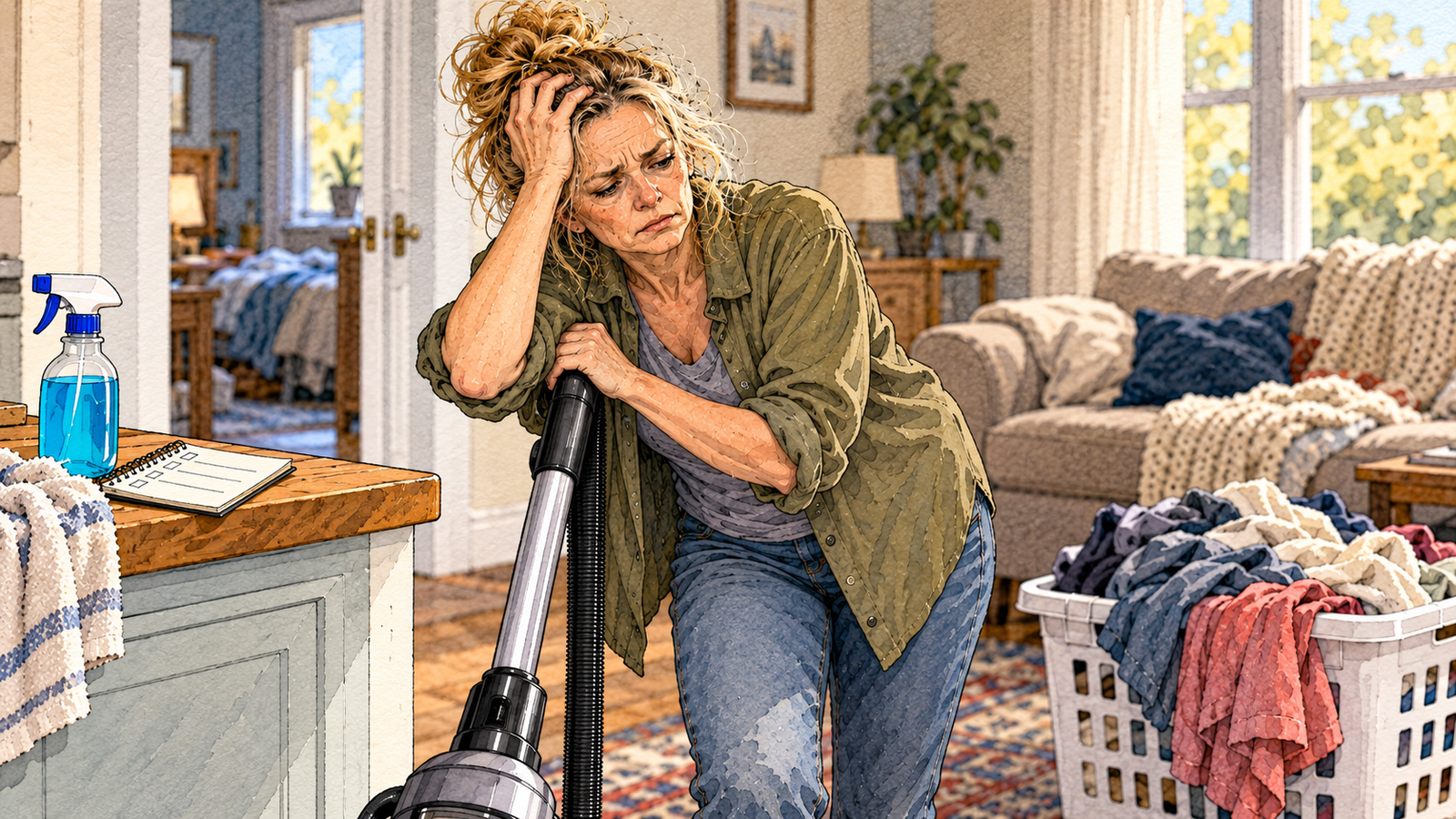
You make a plan for the day using perfectly reasonable information: what you have always been able to do. Clean the house, run a couple of errands, answer the messages, make dinner, maybe even do something pleasant afterward. Nothing heroic. Nobody is crossing the Alps. Then somewhere between vacuuming the living room and changing the sheets, your body quietly closes the office for the day.
The unnerving part is not only that your energy changed. It is that your expectations did not. You still remember how long the old version of you needed for a job, how many things fit into an afternoon, and how quickly you recovered. So when the arithmetic stops working, the first suspect is usually you. Maybe you are lazy. Maybe you have lost discipline. Maybe you need a better system, a better attitude, a better planner, a better breakfast. Or maybe—stay with me here—the instructions are simply out of date.
Nobody Sent the Revised Edition
Bodies change. Age, illness, pain, grief, sleep, medications, hormones, stress, caregiving, work, and plain old accumulated mileage can all alter what a day costs. Sometimes the change arrives with paperwork and a diagnosis. Sometimes you simply notice that Tuesday now costs what Tuesday, Wednesday, and half of Thursday used to cost combined.
The problem is that old rules are sticky. If you once cleaned the whole house in a day, then clearly the house should still be cleaned in a day. If you used to travel from breakfast until bedtime, apparently vacations must continue to resemble military campaigns. If you have always been the dependable one, the organizer, the host, the woman who could squeeze in one more thing, changing the way you do any of that can feel alarmingly close to changing who you are.
Aesop’s Old Hound Knew the Problem
In The Old Hound (Perry 532), an aging hunting dog goes after a boar just as he always has. He knows the work and still has the nerve for it. He catches the animal by the ear, but his old teeth can no longer hold it, and the boar escapes. His master scolds him for failing.

The hound’s answer is the part worth carrying forward: the willingness is still there. The body is what changed. He does not need a lecture about effort; he is already making the effort. He does not need to rediscover his purpose or develop a growth mindset. He needs someone to notice that courage and capacity are not the same thing. We could stand to notice that about ourselves, too.
The Rules That Outlive Their Usefulness
We are remarkably loyal to old instructions. “I used to be able to do this” can become less a memory than a court summons. We drag the present into the witness box and demand that it explain why it no longer resembles 2008.
Yes, sweetheart, we know. There are records.
But the useful question is not whether you once could. The useful question is whether the old method still serves the life you have now. There is nothing noble about spending all of today’s energy proving that yesterday’s schedule is still legally binding. A packed calendar does not become realistic merely because you wrote on it in ink. The body has reviewed the agenda and would like several amendments.
Accepting change is less sentimental and more practical than it sounds. You do not have to approve of every change. Some of them stink. You can miss your old stamina, your old freedom, and your old speed while still refusing to organize your entire life around capacities that are no longer reliably available.
Keep the Life, Change the Method
The goal is not to give up everything that takes effort. It is to get clearer about what you are actually trying to keep.
Maybe you still want a welcoming home, but the whole house no longer needs to be conquered before lunch. Maybe travel still matters, but six attractions in one day can go directly into the sea. Maybe you still love seeing people, but every visit does not need to become an all-day event. Work, creativity, family, gardening, learning, usefulness, and adventure can still belong in your life even if the machinery around them needs an overhaul.
That is the distinction worth protecting: the method is not the meaning. You can change how you clean without becoming someone who does not care about her home. You can pace yourself without becoming unambitious. You can decline an invitation without becoming antisocial. You can need recovery time without turning rest into your personality. You can stop being everybody’s emergency department without becoming selfish.
A useful way to rewrite the manual is to watch for friction. What repeatedly wipes you out? What still gives enough back to justify the cost? What are you doing because it matters, and what are you doing because an earlier version of your life trained you to think you should? That little audit is more useful than another round of “try harder.”
Get the Pencil
The old hound was still the old hound. His teeth changed. His history did not. His instinct did not. His courage did not. That may be the most important thing to remember when your own manual gets revised: capacity can change without erasing identity.
So cross out what no longer fits. Rewrite what needs rewriting. Keep what still matters. And when the body issues yet another edition without so much as a courtesy email, fine. Get the pencil.
✏️ What old instruction are you still following because it worked for a previous version of your life—and what would you change if the goal were to keep the life, not the method?
Pass this along to someone who could use a little understanding without another lecture. 👉
🌿 You Might Also Enjoy
Maybe Today Is a 60 Percent Day For the days when doing less is not failure but an honest response to the energy you actually have.
The Five-Minute Version Still Counts. A reminder that scaling something down can be a way of keeping it in your life instead of losing it altogether.
🌿 More Stories for the Life You’re Living
Receive The FTF Monthly Letter, along with the free book The Best I Can Do Is a Mustache.





[…] match your plans. Here’s another way to think about what you can realistically manage.Oh Look, the Body Rewrote the Manual. Again. When your body changes the rules without consulting you, adapting becomes its own peculiar […]