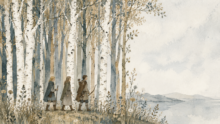

The Farmer’s Impossible Request
There was once a lion who fell deeply in love with a farmer’s daughter.
The farmer, however, did not trust lions.
“You may marry her,” he said, “but first you must let me remove your claws. Then your teeth. A husband should not frighten his family.”
The lion wanted love more than anything. So he agreed.
One by one, he surrendered the very things that had always protected him. His claws were clipped away. His great teeth were pulled. Each sacrifice seemed small enough on its own, and each brought him one step closer to the life he imagined.
When at last he returned, harmless and hopeful, the farmer laughed.
Without claws or teeth, the lion could no longer defend himself. The farmer drove him away with nothing more than a stick.
The lion had mistaken becoming harmless for becoming welcome.
The two are not the same.
The Doorway Between Worlds
Old fables have a way of slipping quietly into modern life.
Most of us have never traded our claws for love. But many of us have traded something.
We swallow our exhaustion because everyone else seems to keep going.
We ignore hunger until it becomes urgency.
We eat while answering emails, watching the news, replaying conversations, or mentally writing tomorrow’s shopping list.
Somewhere along the way, caring for ourselves becomes another task to complete efficiently.
And then we wonder why lunch feels like hard work.
When The Table Feels Busy
If you live with fibromyalgia or another condition shaped by a sensitive nervous system, this may sound familiar.
One day a meal feels perfectly fine.
The next day the very same meal leaves you bloated, nauseated, exhausted, or wondering whether your digestive tract has formed a union and gone on strike.
It is tempting to blame the food. Sometimes the food truly is the problem. But sometimes the food simply arrived in a body that was already carrying too much.
Pain. Stress. Noise. Poor sleep. Too many decisions. Too little recovery.
Your body was not only digesting lunch. It was digesting the entire day.
The Body Reads The Room
Digestion is not just a stomach event. It is a nervous system event.
Before your body commits energy to producing stomach acid, releasing digestive enzymes, moving food through the intestines, and absorbing nutrients, it quietly asks a simple question:
Do we have enough safety to do this right now?
When life feels relatively calm, the body shifts toward what scientists call the parasympathetic—or “rest and digest”—state. Blood flow supports digestion. Muscles relax. The gut and brain communicate more smoothly.
When life feels overwhelming, the body shifts resources toward protection instead.
That is wonderfully useful if you are escaping a bear. Less useful when you are eating grilled chicken.
The body is not trying to sabotage your lunch.
It is following priorities that have kept humans alive for a very long time.
Unfortunately, it has not yet learned the difference between a charging predator and checking email before breakfast.
What The Lion Really Needed
The lion believed safety came from removing the parts of himself that seemed inconvenient.
Many of us approach our bodies the same way. If only I found the perfect diet. If only I eliminated one more food. If only I tried harder. If only my body behaved.
But your body is not trying to make your life difficult. It is trying—sometimes awkwardly, sometimes dramatically—to protect you.
That does not mean every symptom has an easy answer.
It does mean self-blame is rarely the right one.
Perhaps the gentlest question is no longer: “What did I eat?”
Perhaps it is: “What was my body carrying before I took the first bite?”
Those answers are often far more interesting. And occasionally far more forgiving.
The Meal Arrives Too
The lion did not need fewer claws. He needed a place where he could remain fully himself and still be safe.
Perhaps our bodies are asking for something similar. Not perfect meals. Not perfect health. Not another impossible set of rules taped to the refrigerator.
Perhaps they are simply asking for a quieter beginning. A slower first bite. One deep breath. A chair instead of standing at the counter. A few less alarms ringing all at once.
Sometimes the kindest thing you can change is not the meal itself.
It is the moment the meal arrives in.
And perhaps that is the oldest wisdom hidden inside this little fable:
A body that feels even a little safer often knows far better what to do with the nourishment already waiting before it.
