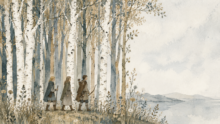

A Handful Of Nettles
A boy was walking through the countryside one spring morning when he noticed a patch of fresh green nettles growing beside the path.
They looked ordinary enough. Soft leaves. Bright new growth. Nothing about them seemed especially dangerous.
Curious, he stretched out a cautious hand. Instead of taking hold, he brushed the leaves lightly with his fingertips. Instantly they stung him.
He cried out and jerked his hand away, convinced the plants were far more vicious than anyone had warned.
When he complained to his father, the older man smiled gently.
“Grasp the nettles firmly,” he said. “They sting those who touch them timidly.”
It is one of Aesop’s shortest fables. And perhaps one of his most surprising. The lesson isn’t really about nettles.
It’s about hesitation.
The Sting That Lingers
Most of us imagine courage as something dramatic. Standing on a stage. Making a life-changing decision. Walking away from everything we’ve ever known. But life usually asks something quieter.
Send the email. Make the appointment. Rest before your body forces you to. Say “no.” Say “yes.” Begin.
Instead, we often hover. We circle the difficult thing for days, weeks, sometimes years.
The conversation stays unfinished. The decision stays unmade. The change stays waiting.
Like the boy, we keep brushing against the nettles instead of moving cleanly through them.
The Places We Hesitate
Living with chronic illness teaches hesitation in ways healthy people rarely notice. Should I commit to lunch next week? Can I promise I’ll have enough energy? Will this food upset my stomach? Should I push through? Should I cancel?
Every decision carries uncertainty. Eventually, many of us stop making decisions at all. We postpone. Delay. Wait for perfect certainty.
Ironically, that uncertainty often becomes more exhausting than the decision itself.
The nervous system remains on alert, rehearsing every possible outcome without ever reaching one.
The body doesn’t know whether to prepare, recover, or relax.
It simply stays ready.
Why The Brain Prefers Finished Stories
Our brains are remarkably uncomfortable with unfinished situations.
Psychologists sometimes call this the Zeigarnik Effect—the tendency for unfinished tasks and unresolved decisions to occupy more mental space than completed ones. Add a sensitized nervous system, chronic pain, or ongoing stress, and uncertainty becomes even louder.
Every postponed decision becomes another open tab. Every avoided conversation quietly consumes attention. This doesn’t mean every decision should be rushed.
Quite the opposite. It means that once you’ve decided, allowing yourself to move forward often creates more calm than endlessly standing at the edge of the nettles.
A Kinder Way To Read The Story
For years, I thought this fable was telling us to be brave. Now I think it’s telling us something gentler.
Indecision has a cost. Not because we’re weak. Not because we’re doing life wrong. But because carrying unresolved tension asks our nervous system to remain prepared for something that never quite arrives.
Sometimes the kindest thing we can do for ourselves is not to become fearless. It’s simply to stop hovering. To choose. To release.
To let the body discover that uncertainty doesn’t have to last forever.
Leaving The Nettles Behind
Spring is full of tender things. New leaves. New beginnings. New chances.
Some of them ask us to move carefully. Others ask us to move clearly.
The boy wasn’t hurt because nettles exist. He was hurt because he couldn’t quite decide whether to touch them or leave them alone.
Perhaps that’s the quieter wisdom hidden inside this little fable.
Some pains belong to life. Others belong to standing too long at the edge of it.
