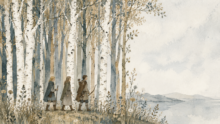

Not every escape feels like freedom.
A fox’s tail is no small thing. It is balance, beauty, confidence. It is part of how a fox moves through the world. When he returns to the forest without it, the other foxes stare. Some laugh. Others whisper.
Ashamed of what has happened, the fox calls a gathering. He stands before the others and declares that tails are unnecessary. They catch on branches. They slow a fox down. They are more trouble than they are worth. Really, everyone would be better off without one.
The speech is persuasive—until an older fox quietly replies. “If you still had your tail,” he says, “would you be giving us the same advice?”
The meeting ends. The younger fox leaves with the same missing tail he arrived with—and the same unhealed shame.
When The Wound Becomes The Story
There is something quietly heartbreaking about this fable. The fox survived. That should have been enough. Instead, the greatest struggle began after the danger had passed.
He could not bear what his loss seemed to say about him. Many people living with fibromyalgia know this feeling well. The illness changes more than the body. It changes routines, relationships, confidence, careers, plans, and sometimes the way we imagine ourselves. These changes rarely happen all at once. They arrive one small adjustment at a time until, one day, life looks unfamiliar.
And because fibromyalgia is invisible, those losses often go unseen.
Others notice that you canceled. They don’t notice what it cost you to try.
The Quiet Weight Of Shame
Pain is difficult. Shame is often heavier. There is shame in needing more rest than everyone else. Shame in forgetting words halfway through a sentence. Shame in wondering whether people believe you. Shame in feeling like you’ve become someone you never intended to be.
Why can’t I do this anymore? Because this is who I am now. The explanation feels safer than uncertainty.
The Body Protects More Than Muscles
There is another reason this happens. Our nervous system is always trying to protect us.
When someone lives with persistent pain, repeated disbelief, or years of pushing beyond their limits, the brain begins paying close attention to anything connected with safety. Being believed becomes safety. Having an explanation becomes safety. Even familiar suffering can begin to feel safer than uncertainty.
More Than One Story Can Be True
The beautiful part of the fable isn’t that the fox lost his tail. It’s that losing his tail didn’t have to become the only thing that defined him.
He survived. He adapted. He still had wisdom to gain, friendships to keep, forests to explore. His life had changed. It had not ended. The same can be true for us.
Fibromyalgia changes what we can do. It does not decide everything we can become. Healing is not pretending nothing was lost. Healing is allowing your identity to become larger than the loss. There is room for symptoms. There is room for grief. There is also room for curiosity. For kindness. For laughter on a day when your body unexpectedly cooperates. For discovering interests that have nothing to do with illness. For remembering that you are still more than the hardest chapter of your life.
Learning To Carry A Different Story
Perhaps the wisest fox in the forest wasn’t the one with the perfect tail. Perhaps it was the one who eventually learned that surviving the trap was never meant to become the whole story.
Many people with fibromyalgia spend years trying to prove their pain. Eventually, a quieter invitation appears. Not to deny what happened. Not to minimize it. But to loosen shame’s grip just enough for something else to grow beside it.
Little by little, the story becomes larger than the wound. And perhaps that is what healing often looks like—not becoming who you were before, but discovering that you have always been more than the part of yourself that hurt.
