

When doctors can’t explain your symptoms, other people may decide it’s time for you to return to work—even when your body is telling you otherwise.
An inconclusive medical test ought to mean one thing: we haven’t found the answer yet. Unfortunately, when somebody else is helping pay the bills, it can acquire an entirely different meaning. How much longer are you going to wait? And when are you going back to work?
You know what your body does when you push it. You know how a quick errand can consume an afternoon, how concentration disappears halfway through an ordinary task, and how a good morning doesn’t guarantee a good evening. What you can’t produce is the tidy diagnosis that would make those limitations understandable to everyone else. So each appointment brings two worries: what the doctor will say, and what your family will make of it.
Medical uncertainty is hard enough without feeling that your credibility is on trial.
When a Good Day Becomes Evidence Against You
A diagnosis can provide a treatment direction, help document accommodations, and give loved ones a name for what they see. Without one, you’re left explaining symptoms that fluctuate and limitations that aren’t always visible. A normal test result may rule out one possibility; it doesn’t magically restore your stamina.
Still, other people may take your occasional good days as proof that you could work. You went shopping on Tuesday. You visited a friend on Saturday. Surely you could manage a few shifts?
That reasoning overlooks the difference between doing something once and doing it reliably. A visit can be shortened. Errands can be abandoned. A job generally expects you to arrive on schedule, remain productive, and come back tomorrow, regardless of what yesterday cost you.
And heaven help you if someone catches you laughing. Evidently, enjoyment is now a functional-capacity assessment.
The Complicated Price of Help
When an adult child helps with expenses, gratitude and anxiety can become uncomfortable roommates. You appreciate the assistance. You also know it may not last forever, and you may hear a deadline in questions that once sounded like concern.
“How did your appointment go?” can become “Did they find anything yet?” followed by the question you dread: “Have you thought about looking for work?”
Perhaps your daughter is worried about money. That concern may be entirely real. But her financial worry cannot tell her what your body can sustain. Both problems deserve serious attention, and neither should be used to dismiss the other.
Living under that possibility changes ordinary days. You start rehearsing explanations before anyone asks. You worry that every unfinished chore will be counted against you, and every completed one will be used to argue that you’re fine. Even rest begins to feel like something requiring a witness.
Damocles Had a Lovely Dinner Waiting
The ancient story of the Sword of Damocles begins with a courtier who envied Dionysius, ruler of Syracuse. Damocles thought the ruler’s luxurious life must be delightful, so Dionysius invited him to experience it for himself.
The food was magnificent, the surroundings beautiful, and the servants attentive. Then Damocles looked up and discovered a sharp sword suspended above his head by a single horsehair. The ruler wanted him to understand that privilege came with danger. Damocles suddenly lost interest in dinner and asked to leave.

Nothing about the food had changed. But he could no longer enjoy what was in front of him because of what might happen next.
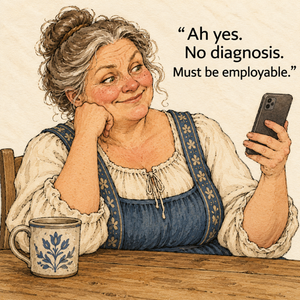
My sword has acquired a rather modern name: Jobocles. It doesn’t threaten to fall from a palace ceiling. It arrives on a smartphone displaying job openings while I’m still trying to find out why everyday life has become so difficult.
The Cost of Watching the Ceiling
Anticipating a difficult conversation takes energy. So does repeatedly imagining what will happen if another test is inconclusive. Stress research shows that uncertainty and expected threats can keep us alert even when nothing is happening at the moment. When energy is already scarce, that vigilance feels particularly expensive.
Of course, preparation matters. Financial arrangements may need to change. Medical questions need pursuing. But there is a difference between making a practical plan and holding an imaginary argument with your daughter at two in the morning.
The first may help you tomorrow. The second usually just ruins tonight.
What You Can Document Without a Diagnosis
Rather than trying to win an argument about whether you’re sick enough, begin recording what you can do consistently. Note the activity, the symptoms it brings, and how long recovery takes. If washing dishes leaves you needing an hour of rest, that’s useful information. If you manage a social outing but spend the following day recovering, record both days.
Bring that record to appointments. Ask your healthcare professional to document functional limitations and discuss whether particular work demands would be realistic or safe while the investigation continues. You don’t have to wait for a perfect diagnostic label to describe what daily life actually looks like.
Financial conversations need their own space. Acknowledge the household problem without agreeing that employment is the automatic answer. You might explore assistance, benefits, or other practical options together. The discussion should be about workable choices, not a verdict on your character.
You can be grateful for help and still ask to be treated with respect. Those positions aren’t mutually exclusive.
The Sword Does Not Get the Whole Day
Damocles could leave the banquet. Most of us cannot simply walk away from health problems, family obligations, or financial dependence. We still have appointments to attend and decisions to make, perhaps with no satisfying answer in sight.
But uncertainty doesn’t deserve every peaceful hour. You can enjoy a book, a conversation, or a good cup of coffee without presenting it as evidence of recovery. Pleasure is not a sworn statement that you’re fit for employment.
Maybe a diagnosis will eventually explain everything. Maybe it will explain only part of the picture. Either way, another person’s impatience cannot manufacture capacity your body doesn’t have.
A missing diagnosis is not an employment contract.
🗡️ What takes more of your energy right now: managing your symptoms, or worrying about what someone else will demand if the doctors can’t explain them?
🌿 You Might Also Enjoy
When the Life You Planned Is Gone. When the future you imagined begins to unravel, uncertainty can make it difficult to know what comes next. Sometimes the first step is acknowledging how much has changed.
Why Am I Suddenly Irritated by Everything? When you’re already carrying worry or tension, even ordinary interruptions can feel like too much. Understanding what’s contributing to that irritation may help you respond differently.
🌿 More Stories for the Life You’re Living
Life changes, sometimes dramatically and sometimes one bewildering little inconvenience at a time.
Join From The Fables for a monthly letter filled with timeless stories, practical wisdom, and a little humor about navigating life’s changes.
And there’s a welcome gift! You’ll receive a free copy of Best I Can Do Is a Mustache, our illustrated, irreverent look at menopause and its many surprises.
GET MY FREE BOOK & MONTHLY LETTER