

There is a peculiar rule many of us seem to carry around without remembering who taught it to us: you are allowed to stop when things become unbearable. Not before. You may leave the gathering when you are exhausted, abandon the errands when your legs are aching, end the conversation when you are too tired to listen properly, or finally sit down when your body has made standing no longer negotiable. Until then, apparently, you are expected to keep going. After all, you can.
That little word causes an astonishing amount of trouble.
You can stay another half hour. You can stop at one more store. You can finish the kitchen before you sit down. You can keep talking even though you stopped enjoying the conversation twenty minutes ago. None of these things is necessarily untrue. The problem is that “I can do it” and “doing it is a good use of what I have left” are entirely different questions.
When Your Old Stopping Point No Longer Works
This becomes especially important when your capacity has changed. Perhaps age has changed it. Perhaps illness, pain, medication, poor sleep, grief, stress, caregiving, surgery, or some combination of things has changed it. Whatever the reason, you may still be operating according to rules written for a body and a life you no longer have.
Once, you could go to lunch, browse a few shops afterward, stop at the grocery store on the way home, put everything away, make dinner, and think nothing of it. Now lunch is pleasant, the first shop is fine, and somewhere in the second one you notice that you are getting tired. You could go home right then.
Instead, you think, I’m still doing okay.
So you stay. Someone suggests coffee. You agree. You remember you need something from the pharmacy. It seems silly not to stop when you are already out. By the time you finally reach home, the perfectly pleasant lunch has somehow turned into a six-hour expedition, and the rest of your day belongs to the sofa.
The mistake was not going to lunch. It may not even have been going to the shop afterward. The mistake was assuming that the correct time to stop was the moment you could no longer continue.
The Widow Who Wanted a Little More
There is an old Aesop fable called The Widow and Her Hen. A widow owns a hen that lays one egg every day. It is doing exactly what she needs it to do, reliably and well. But one egg begins to look insufficient once she imagines two.
So she feeds the hen more. Surely more food will produce more eggs. Instead, the hen grows overfed and stops laying altogether.

The old moral is about greed, but there is something else sitting quietly inside the story that feels very familiar: the widow had something that was working, and she spoiled it by insisting on more.
That happens to us surprisingly often. Lunch was enough. The appointment was enough. One store was enough. The hour-long visit was enough. The half-finished garden was enough for today. But enough can be difficult to recognize because nothing dramatic happens at enough. There is no alarm. No collapse. No obvious reason you must stop.
So we add a little more. Then a little more after that. And sometimes the extra is exactly what costs us the rest of the day.
Your Body Is Not a Gas Gauge
Bodies are inconveniently poor at behaving like fuel gauges. There is no neat little needle telling you that you have exactly twenty-three percent left. Fatigue can also be temporarily disguised by interest, conversation, adrenaline, caffeine, necessity, or the simple fact that you are busy doing something.
You may not feel the full cost until the activity stops and the stimulation fades. Then you get home, put down your bag, and discover that your body has apparently been keeping minutes of the meeting.
This is part of the reason pacing is useful for people dealing with reduced or unpredictable capacity. In plain English, pacing means paying attention to the cost of activity before the bill becomes enormous. It does not mean doing nothing, refusing every invitation, or arranging your life around avoiding effort. It means becoming a little more deliberate about when you spend your energy and, just as importantly, when you stop spending it.
The goal is not to find the absolute outer edge of what you can tolerate every single time.
That is an odd way to live when you think about it. We rarely apply that logic anywhere else. You do not drive until the car sputters to a halt before deciding perhaps it is time for gasoline. You do not wait until every scrap of food is gone before considering groceries. Yet many of us use complete depletion as proof that we were finally entitled to stop.
Leave While You’re Still Having a Good Time
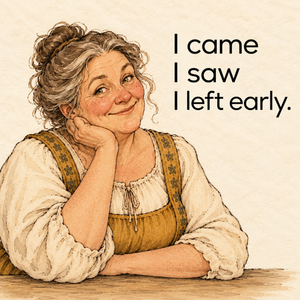
There is another possibility: leave while you are still having a good time.
This takes practice because it can feel strangely wrong at first. If the visit is still enjoyable, why leave? If you are not yet exhausted, why stop? If your back is only beginning to complain, why sit down?
Because you know what comes next.
Leaving a gathering while you are still enjoying yourself can mean that the gathering remains a pleasure instead of becoming something you must recover from. Stopping the errands when the important ones are finished can leave enough energy to eat dinner instead of staring resentfully at a cracker. Ending a phone call when your attention starts fading can preserve your affection for the person on the other end.
There is something wonderfully civilized about saying goodnight before you begin silently wishing everyone would disappear.
And there is something practical in recognizing that the extra half hour may not be free. Neither is the final store, the last chore, or the “quick stop” on the way home.
The widow’s hen was already giving her something useful. Sometimes that is the lesson we need too. Enough was already enough.
Make the Decision Before You’re Depleted
It helps to make some of these decisions before you are tired enough to bargain badly with yourself. Decide that you will stay for an hour and a half rather than “seeing how it goes.” Tell your friend when you arrive that you may leave early. Plan one major errand instead of assuming you will do everything because you are already out.
Leave a blank space after a medical appointment instead of treating it as the opening act for the grocery store, bank, post office, and lunch with Susan.
And when you notice the first signs that you are fading, believe them.
Your signs may be physical: aching, weakness, heavier movement, worsening pain. They may be mental: losing the thread of conversation, becoming indecisive, forgetting what you came into the room for. They may even be emotional. Fatigue has a remarkable ability to turn perfectly ordinary human beings into people who chew too loudly.
You do not have to wait for the dramatic sign.
Stop Using Misery as Proof
That may be the hardest part of all, because misery has a peculiar usefulness. Misery provides evidence. Once you are exhausted, hurting, overwhelmed, or barely functioning, nobody—including you—can argue that you should have stopped.
But what if you stopped before you could prove it? What if you went home while you still looked perfectly fine? What if somebody thought you could have stayed longer? Well, perhaps you could have. That was rather the point. You wanted to arrive home with something left.
There is no medal for using every available ounce of yourself before bedtime. There is no moral superiority in finishing the shopping if finishing it means losing tomorrow morning. And adapting to a changed life does not mean shrinking everything until nothing enjoyable remains.
Sometimes the adaptation is much smaller than that. Keep the lunch. Skip the extra store. Go to the party. Leave at eight. Plant the flowers. Leave the last pot for tomorrow.
The widow thought one egg was not enough because she could imagine two. We do something similar when a good afternoon turns into an exhausting one simply because we cannot resist adding one more thing. Sometimes protecting your capacity means recognizing the value of stopping while something is still working.
Perhaps the question is not, “Can I keep going?” Perhaps it is, “Has this already been enough?” That remaining bit of energy is not wasted. It is yours.
🐔 A question to carry with you: Where in your life are you still waiting until you are completely depleted before giving yourself permission to stop?
🌿 You Might Also Enjoy
Maybe Today Is a 60 Percent Day. Some days, the energy you have simply doesn’t match the energy your plans require. Learning to adjust your expectations can make those days easier to manage.
How to Accept Your Limits Without Disappearing. When your abilities change, it can feel as though parts of your identity are slipping away. But making room for your limits doesn’t mean giving up what matters to you.
🌿 More Stories for the Life You’re Living
Life changes, sometimes dramatically and sometimes one bewildering little inconvenience at a time.
Join From The Fables for a monthly letter filled with timeless stories, practical wisdom, and a little humor about navigating life’s changes.
And there’s a welcome gift! You’ll receive a free copy of Best I Can Do Is a Mustache, our illustrated, irreverent look at menopause and its many surprises.
GET MY FREE BOOK & MONTHLY LETTER