
Making room for the life you still have
There is a particular kind of exhaustion that comes from trying to live as though nothing has changed. You make the plans you would once have made. You expect yourself to keep up with the house, the family, the errands, the appointments, the friendships, and all the ordinary things that used to fit inside a day. Then your body refuses to cooperate. Something gets cancelled. Something remains unfinished. Something that once seemed simple costs more than you expected. By evening, you are not only tired. You are disappointed in yourself.
The problem is not always that you have done too little. Sometimes you are still measuring yourself against the capacity of a woman who no longer lives in your body. That change may come from illness, pain, disability, aging, grief, caregiving, poor sleep, medication, financial strain, or the accumulated wear of a life that has asked a great deal of you. Whatever caused it, the result can feel strangely similar: there is less room than there used to be, and accepting that can feel dangerously close to giving up.
It isn’t.
Acceptance is not deciding that nothing can improve. It is not lowering every expectation or surrendering your personality along with your stamina. It is simply beginning with what is true. And truth is a much sturdier place to build a life than denial.
The Load Changed Before You Did
One of the crueler parts of reduced capacity is that your expectations often lag behind your body.
You may still think of yourself as the woman who could clean the house in a morning, work all day and go out that evening, host the holiday, keep everyone organized, remember every appointment, and say yes without first calculating the cost. Your mind may still be operating from an old set of assumptions long after your body has changed the terms.
That gap can create a great deal of unnecessary shame.
When you cannot do what you once did, it is easy to interpret the difference as laziness, weakness, poor discipline, or failure. But sometimes none of those things are happening. Sometimes the load remained the same while the capacity available to carry it changed.
That is a practical problem, not a character flaw.
The Horse and the Donkey
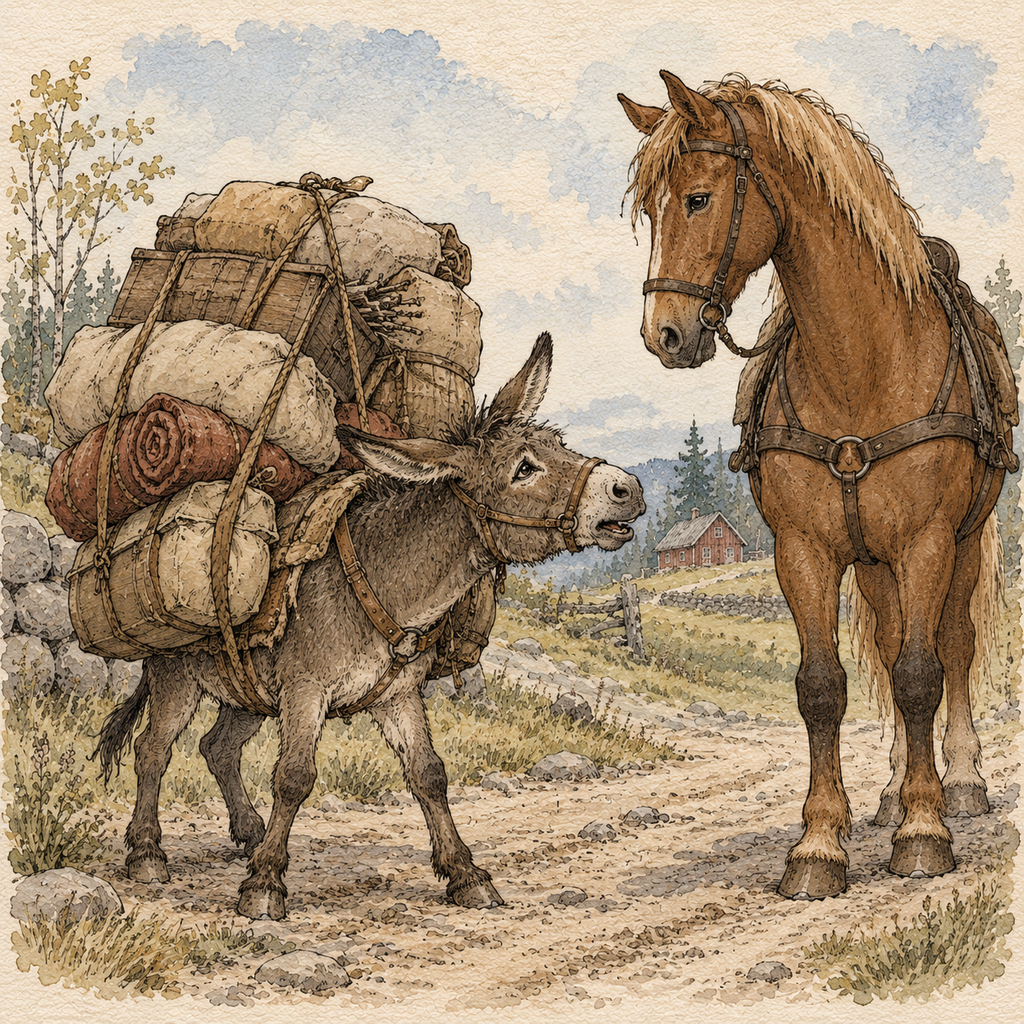
Aesop’s The Horse and the Donkey begins with a simple problem. A donkey is carrying a load that has become too heavy. Traveling beside him is a horse, and the donkey asks the horse to take part of the burden. The horse refuses.
Before long, the donkey collapses.
His load is then placed on the horse, leaving the horse to carry far more than the small portion he had originally refused.
The usual lesson is about helping another person before their trouble becomes yours. But there is another part of the story worth noticing. The donkey knew the load was too much before he fell. He did not need to become more disciplined, more cheerful, or more determined. He needed the burden reduced.
Human beings are not nearly as sensible about this as donkeys.
When our own capacity changes, we rarely say, “The load is too heavy now. Something needs to come off.” We are more likely to ask, “What is wrong with me?”
That question matters because it changes where we look for the solution. If you believe the problem is a personal failure, you will keep trying to correct yourself. You will push harder, organize better, shame yourself more efficiently, and wonder why none of it restores the energy or strength you used to have.
But if the problem is a mismatch between your current capacity and the load you are carrying, then the solution becomes different.
You begin to look at the load.
Your Body Is Working With a Budget
Your body is always budgeting its resources. Your brain, heart, muscles, digestion, immune system, temperature regulation, concentration, balance, and countless repair processes all require energy. Pain, poor sleep, chronic illness, stress, medication effects, hormonal changes, and aging can increase those demands or reduce what is available for everything else.
This is one reason ordinary tasks can become unexpectedly expensive.
Grocery shopping, for example, is not merely walking through a store. It may involve transportation, standing, decision-making, visual processing, noise, temperature changes, remembering what you need, carrying bags, putting everything away, and then somehow producing dinner afterward. A task that looks small on paper may require half a dozen systems to work at once.
The useful question, then, is not always, “Can I do this?”
You may very well be able to do it.
A better question is, “What will doing this cost me, and what will that cost prevent me from doing later?”
That is not pessimism.
It is information.
Look at the Load, Not Your Character
Once you begin thinking this way, the problem changes. Instead of asking how to force yourself to keep doing everything, you can begin asking whether everything still deserves to be carried.
Some responsibilities are necessary. Others are habits. Some belong to an earlier stage of life. Some were taken on because you were the dependable one. Some remain simply because nobody has stopped to question them.
A meal can become simpler. A visit can become shorter. A garden can become three pots. A holiday can move to somebody else’s house. A weekly obligation can become monthly. Help can be accepted before collapse rather than afterward.
None of these changes means the thing no longer matters.
It means you have stopped confusing the old way of doing something with the only way of doing it.
That distinction is important because efficiency has limits. A better planner will not solve an impossible workload. A more organized schedule will not manufacture energy. Sometimes the answer is not to fit more into the day.
Sometimes the answer is to ask less of it.
Make It Smaller Without Making It Meaningless
One of the hardest parts of reduced capacity is that many of us learned to recognize value by size.
A proper dinner was cooked from scratch. A useful volunteer stayed all afternoon. A good grandmother organized the outing. A productive person finished the whole project. A worthwhile day had visible results.
Then capacity changes, and the smaller version begins to feel like failure.
But smaller and meaningless are not the same thing.
You may no longer be able to host the entire holiday meal, but perhaps you can make the pie everyone remembers. You may not manage a large garden, but you can grow herbs in the kitchen window. You may not spend an entire day with grandchildren, but you can give one child an hour of your full attention. You may not be able to contribute the way you once did, but you may still have knowledge, humor, steadiness, skill, encouragement, or experience that matters deeply to someone else.
The activity became smaller.
The meaning did not.
This may be one of the most important adaptations in later life: learning to preserve the essence of something after its scale has changed.
Leave Something for the Life You Still Have
Life can easily shrink into maintenance. Appointments, medications, laundry, bills, errands, paperwork, housework, recovery from housework, and trying to stay ahead of the next thing can use nearly every bit of available energy.
A person can become very efficient at managing a life she no longer gets to inhabit.
Something you care about has to survive the budget.
That may be writing. Reading. Sitting outside with coffee. Studying something that still interests you. Calling someone you love. Attending worship. Making something with your hands. Feeding birds. Listening to music. Teaching a grandchild something only you know.
These things can look optional beside laundry and appointments, but they are not optional if they are part of what makes your life feel like yours.
There is another habit many women have to unlearn: stopping only when the body forces them to stop. We tend to treat energy as something that should be completely used. If there is a little left, surely one more thing can fit. One more load of laundry. One more errand. One more favor.
But using every available scrap of capacity leaves no margin for anything unexpected and, just as importantly, no room for pleasure.
Margin is not wasted energy.
It is what makes a life less brittle.
Sometimes the wisest use of available energy is not using it.
Acceptance Is Not Disappearance
There is grief in all of this. Some limits deserve to be mourned. Some losses cannot be turned into blessings, and there is no need to try. You may genuinely miss the woman who could work all day and still go out that evening. You may miss traveling easily, cleaning the whole house in one morning, caring for everyone, earning your own money, moving without calculating the consequences, or trusting your body without thinking about it.
Acceptance does not ask you to pretend you are pleased about those losses.
It asks something quieter and more useful.
Can you stop requiring your present life to look like your former life before you allow it to matter?
The donkey in Aesop’s story knew the burden was too heavy before he collapsed. Perhaps there is wisdom in noticing earlier. Not every load must still be carried because you once could carry it. Not every responsibility must remain yours because it once was. And not every smaller life is an empty one.
Sometimes the work is simply to remove enough weight that there is still a woman underneath it.
And then, with whatever strength is actually hers, to build a life she can still recognize as her own.
🫏 What are you carrying now simply because an earlier version of you could?