The Rules We Played By | Fergus MacGregor
An Extraordinary Amount of Power for a Wee Boy
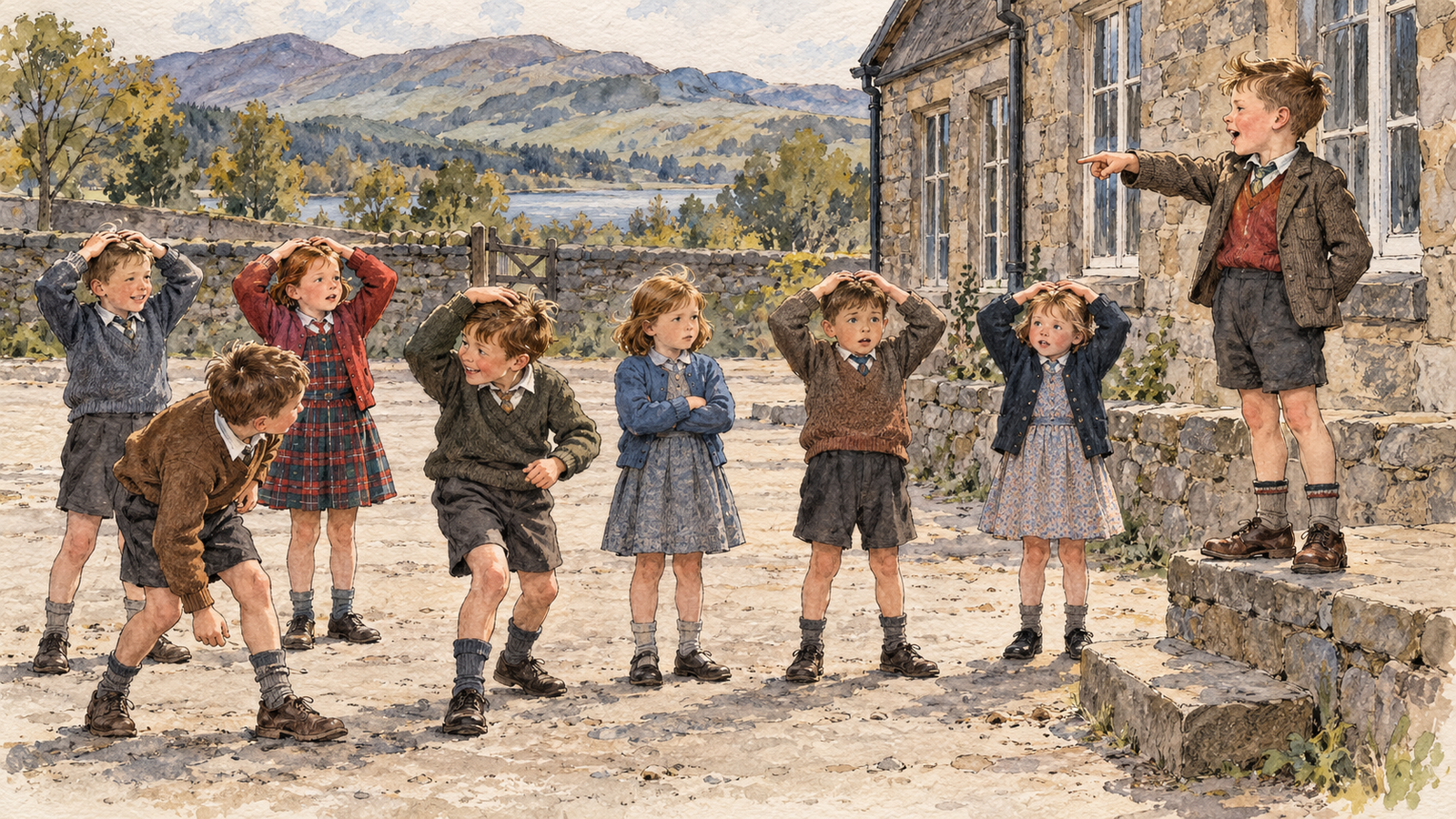
Simon Says was a peculiar game, when you think about it. One child stood on a step and ordered the others to touch their heads, hop on one foot or turn round, and we called it entertainment. The trick was not to move unless the command began with those two magic words. Fail to notice their absence and you were out, disgraced before children who couldn’t keep their socks dry.
At our school near Drymen, in Buchanan country, there was a boy who enjoyed being Simon more than was altogether healthy. I won’t give you his name, because I’ve forgotten it and because he’d be insufferable to know he was still getting attention. He wasn’t especially gifted. He frequently forgot his gym shoes, yet could remember every mistake anyone else made. Give him a low wall and an audience, and he developed the manner of a man announcing the closure of Parliament.
“Simon says, hands on your head!” Up went the hands. “Simon says, stand on one leg!” We wobbled obediently. Then came “Turn around!” and half the playground spun about while His Majesty grinned as though he’d annexed the Highlands. I fell for it often enough, generally because I was laughing at another laddie and hadn’t noticed that my own feet were moving. There are childhood humiliations that age does nothing to improve.
Simon Finds Employment
I left Scotland for America in 1982, aged twenty-eight, and was immediately impressed by the national conviction that most things could be improved with enthusiasm, a new system and a sufficiently large motorcar. I still admire it. Americans will attempt things a Scot would inspect for twenty minutes before declaring, “Aye, that’ll never work.” Sometimes the American is right, which is irritating for everyone concerned.
What took longer to get used to was the advice. You should get up at five. You should exercise more, rest more, travel more, own less. You should have a hobby, preferably one that earns money. Christ Almighty, is a woman not allowed to knit a scarf without producing a business plan?
We have interfering neighbours in Scotland, of course. One could appraise your garden, your vehicle and your character while ostensibly discussing a dreich afternoon. At least you knew you’d been criticised. In America, the same conversation might end with somebody offering to help you reach your potential.
Retirement brings Simon out in full force. Some people fancy a quiet life; others keep a calendar that would exhaust a Cabinet minister. Either approach is perfectly respectable until its owner starts telling the rest of us how retirement ought to be done. Somewhere there’s a woman trying to finish a novel while being informed she’s approaching seventy incorrectly. I hope she keeps reading.
The Mysterious Committee Called People
The thing about Simon Says was that everyone watched everyone else. If six children raised their hands, the seventh had to work remarkably hard not to follow. We may have been playing at obedience, but we were also practising the ancient human art of not wanting to look the odd one out.
In the 1950s, psychologist Solomon Asch conducted experiments in which people sometimes agreed with a group’s plainly wrong answer about the lengths of lines. Nobody had to threaten them. The other people simply said the wrong thing first. I’ve been the one dissenting voice in a room, convinced everyone else had lost their minds. I’ve also nodded along with utter nonsense because I assumed somebody must know something I didn’t. That second experience takes a bit more explaining afterward.
And then there are People. What will people think? What will people say? What do people your age do? Who are these people? Where do they meet? Do they take minutes? I’ve heard about them since boyhood and have yet to receive an invitation to the annual general meeting. Whoever they are, they’ve been managing other people’s affairs for generations without once showing their credentials.
Knowing Your Place, Apparently
When I was young, “Because I said so” counted as an explanation. Sometimes the rule deserved respect: don’t run into traffic, don’t start a fire in the shed, don’t try sailing across Loch Lomond in an abandoned wardrobe. Other instructions seemed designed largely to remind a wee person that somebody bigger was talking.
The trouble is that the orders don’t stop when you grow older. They simply change subject. Move somewhere smaller. Stop taking risks. Keep active. Take it easy. Don’t act your age. For heaven’s sake, act your age. Try following all of that simultaneously and you’ll need two bodies and a secretary.
Often the concern is real. Families worry; friends mean well. But a person can love you dearly and still be wrong about how you ought to spend a Wednesday afternoon. I’ve handed out my own share of unwanted wisdom, usually just before remembering a spectacularly foolish choice I made at the same age. It’s humbling, though not enough to stop my opinions.
Fergus’s Last Word
The clever part of Simon Says was that winning required knowing when not to obey. We understood that at eight, despite our muddy knees and questionable judgement in sandwiches. Decades later, I remain rather fond of that rule.
“Simon can say whatever he likes. I’ve been ignoring daft instructions since I was a wee lad, and I see no reason to stop now.”

🌿 You Might Also Enjoy
Do I Really Have to Decide This Again? Some rules and expectations seem to demand our obedience long after they’ve stopped making sense. Perhaps it’s time to question who gets to make the decisions.
How to Accept Your Limits Without Disappearing. Life changes, but that doesn’t mean surrendering your right to decide what works for you. Sometimes the sensible thing is to stop following rules that no longer fit.
🌿 More Stories for the Life You’re Living
Life changes, sometimes dramatically and sometimes one bewildering little inconvenience at a time.
Join From The Fables for a monthly letter filled with timeless stories, practical wisdom, and a little humor about navigating life’s changes.
And there’s a welcome gift! You’ll receive a free copy of Best I Can Do Is a Mustache, our illustrated, irreverent look at menopause and its many surprises.