.png)
The Tool That Slipped Away
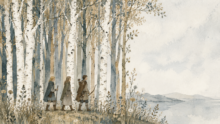
A carpenter once went into the woods to work beside a quiet stream. He carried the same axe he had carried for years, its handle worn smooth where his hand had held it, its blade nicked from honest labor. It was not beautiful, but it knew his grip. It knew the rhythm of his work. It had earned its place.
The carpenter stood near the water and began cutting timber. The morning was cool. The trees leaned softly over the bank. The stream moved with that careless confidence water has when it has never had to pay rent.
Then, with one unlucky stroke, the axe slipped from his hand.
It fell into the stream and vanished beneath the surface.
The carpenter froze.
He searched along the bank, but the water was too deep and dark. He could not reach the bottom. Without his axe, he could not work. Without work, he could not earn his bread. So he sat beside the stream, helpless and heartsick, grieving the plain tool that had been enough until the moment it was gone.
The God Beneath The Water
As he sat there, Mercury appeared and asked why he was grieving.
The carpenter told him the truth. His axe had fallen into the stream. It was not a fine axe, not a noble one, not the sort of tool anyone would write poetry about, unless the poet had very low standards and a strong interest in hardware. But it was his, and he needed it.
Mercury listened, then disappeared beneath the water.
When he rose again, he held up an axe made of gold.
“Is this yours?” he asked.
The carpenter looked at it. It shone in the morning light. It was worth more than anything he owned. With that axe, he could have changed his life in an afternoon.
But he shook his head.
“No,” he said. “That is not mine.”
Mercury went beneath the water again.
This time, he returned with an axe made of silver.
“Is this yours?” he asked.
The silver axe gleamed less fiercely than the gold, but it was still finer than anything the carpenter had ever carried. It was the kind of object that made a plain man wonder whether life had made a clerical error in his favor.
Again, the carpenter shook his head.
“No,” he said. “That is not mine either.”
The Plain Handle Returned
A third time, Mercury went beneath the water.
When he came back, he held the old axe: the wooden handle, the marked blade, the familiar weight of an ordinary life.
The carpenter stood.
“That one is mine,” he said.
Mercury, pleased by his honesty, gave him all three axes: gold, silver, and the plain one he had lost.
But the carpenter’s answer mattered before the reward ever arrived.
He had been offered something better-looking. Something more impressive. Something that would have made him appear fortunate, elevated, perhaps even chosen.
And still, he did not claim what was not his.
He knew the difference between a shining thing and a true thing.
The Stream Still Asks
This still happens.
Not always beside a stream, and usually with far fewer deities involved, which is probably for the best. It happens in the quieter moments when life offers us a version of ourselves that looks better to everyone else.
There is the gold axe: the energetic self. The one who can come to everything, stay late, answer quickly, host beautifully, remember birthdays, travel lightly, and recover overnight as though the body has a reset button hidden somewhere under the ribs.
There is the silver axe: the agreeable self. The one who says, “I’m fine,” even when she is not. The one who makes the visit work, stretches the conversation, smiles through pain, and softens every limit so no one else has to feel the edge of it.
Then there is the plain axe.
The real body. The actual capacity. The truth of today.
This one is not glamorous. It does not sparkle. It may come with pain, fatigue, pacing, food sensitivities, brain fog, early exits, quiet rooms, canceled plans, and the deeply humbling need to rest after activities that other people treat as errands.
Still, it is yours.
The Body With The Worn Handle
Living with fibromyalgia or chronic illness often means being surrounded by axes that are not yours.
People may remember an older version of you and quietly hand her back as if you misplaced her. They may offer encouragement that sounds kind but feels like pressure. They may say, “You used to be able to,” or “Maybe if you just…” or “Come on, it’ll be good for you,” as though the gold axe can be accepted if everyone smiles hard enough.
Even you may want to claim it.
You may want to say yes because you miss being easy. You may want to prove that love, faith, usefulness, friendship, and humor still live inside you. You may want to be the person who can do the thing without calculating the cost like a tired accountant in sensible shoes.
But a body with fibromyalgia is often working with a sensitized nervous system. Pain signals may be amplified. Energy may be limited. Sleep may not restore. Stress, noise, exertion, weather, emotion, and even ordinary social effort can draw from the same small account. What looks like “not much” from the outside may be a full day’s labor inside the body.
That does not mean you are weak. It means the tool in your hand is real.
The Honesty That Lets You Work
The carpenter’s wisdom was not that he rejected beauty. It was that he did not betray reality to gain it.
That is a tender kind of courage.
When you say, “I can’t do that today,” you are not refusing love. You are naming the axe you actually have.
When you say, “I need to leave early,” you are not being difficult. You are protecting tomorrow’s body from today’s overreach.
When you say, “I want to be there, but I cannot spend that much energy,” you are not making excuses. You are refusing to claim a gold axe that will not fit your hand.
There is grief in that. Of course there is.
The plain axe may not be the one you would have chosen. It may feel smaller than the life you planned. It may make you miss the old ease, the old pace, the old way of moving through the world without negotiating with your own nervous system before noon.
But honesty is not defeat.
Honesty is how you keep working with the life you actually have.
The gold axe may impress people.
The silver axe may please people.
But the plain axe is the one your hand can hold.
And sometimes healing begins there: not in becoming shinier, stronger, easier, or more acceptable, but in telling the truth without apology.
This is mine. This is what I can carry. This is enough for today.
