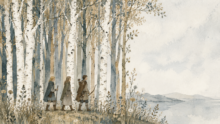

When the Sky Became the Road
Long ago, during a dry summer, a small pond began to disappear.
Day after day, the water sank lower. The reeds browned. The mud cracked beneath the afternoon sun. Fish had long since found deeper waters. Frogs vanished into the marshes. Soon only one old tortoise remained.
He looked toward the shrinking pool and knew he could not stay.
But he also knew he could not leave.
His sturdy shell had carried him faithfully through life, but it had never been quick. The nearest lake lay many miles away. By the time he reached it, the heat would likely claim him first.
Two ducks, who often rested beside the pond during their migrations, watched him quietly.
“We know another lake,” one finally said. “The water is deep, and the reeds grow thick there.”
The tortoise smiled sadly.
“I’ll never make it.”
The ducks thought together for a long while before one returned carrying a strong, straight stick.
“Hold this in your mouth,” she said. “We’ll each carry one end. We can fly you there.”
The tortoise blinked in surprise.
“It will work,” the second duck added. “But there is one condition.”
“What is it?”
“You must not open your mouth.”
The tortoise nodded solemnly.
It seemed simple enough.
Soon the ducks lifted the stick between them, and slowly the tortoise rose into the morning sky.
The View Everyone Could See
The earth drifted farther below.
Fields unfolded into neat patterns. Forests became soft green carpets. Rivers shimmered like ribbons of silver.
The tortoise had never imagined the world looked so beautiful from above.
Before long they flew over a village.
Children playing in the square looked up and shouted.
“Look!”
“A flying tortoise!”
“I’ve never seen anything so ridiculous!”
More people gathered. Fingers pointed upward. Some laughed. Others simply stared in amazement.
The tortoise heard every word.
His face grew hot.
He wanted to explain.
He wanted them to know he wasn’t foolish.
He wanted them to understand that he wasn’t flying because he wished to—but because he couldn’t survive without help.
The words swelled inside him until they became impossible to contain.
Just as he opened his mouth to answer…
He let go.
The stick fell away.
And so did he.
The ducks circled helplessly overhead.
Sometimes a single sentence costs more than silence.
The Weight No One Notices
Few of us expect help to feel so exposed. We imagine the hardest part is admitting we need it. Often, the harder part comes afterward.
Someone pushes the wheelchair. Someone carries the groceries.
Someone walks more slowly because of us. Someone waits while we search for the right word.
Someone drives because we no longer can.
None of these moments are failures. Yet they can feel strangely public.
Chronic illness changes more than what our bodies can do. It changes who gets to witness our limitations.
For many people living with fibromyalgia or disability, independence was once a quiet source of dignity. We solved our own problems. We carried our own burdens. We kept moving without asking anyone to notice.
Then one day, we needed someone else.
Not because we became lazy. Not because we stopped trying. Simply because life changed.
That can feel like flying over a crowded village while everyone looks up.
The Nervous System Hears Every Voice
There is a reason those moments feel larger than they appear.
Our nervous systems constantly scan for safety, belonging, and social acceptance. When illness makes us dependent on others, the brain often interprets visibility as risk.
Will people judge me?
Will they think I’m exaggerating?
Am I becoming a burden?
Even neutral attention can feel surprisingly intense when the nervous system is already working hard to manage pain, fatigue, dizziness, sensory overload, or cognitive fog.
Many people with chronic illness become experts at hiding symptoms—not because they are ashamed of being ill, but because invisibility often feels safer than exposure.
Ironically, receiving help sometimes asks us to surrender that invisibility.
That can feel far more vulnerable than carrying the pain itself.
Learning to Stay on the Stick
Perhaps the lesson was never that the tortoise talked too much.
Perhaps it was that he believed the people below deserved an explanation.
Not every stranger needs one. Not every curious glance requires a defense. Not every misunderstanding must be corrected.
Some people will never understand invisible illness. Some will guess wrong. Some may quietly underestimate what it takes simply to get through the day.
Their opinions may be loud. But they do not determine your worth.
Accepting help does not erase dignity. Needing assistance does not cancel adulthood. Being carried through one difficult season says nothing about the strength it took to survive long enough to reach it.
Sometimes courage looks surprisingly ordinary. It looks like accepting the ride. Holding on. Remaining quiet—not because you have nothing to say, but because you no longer need everyone watching from below to understand your story.
The Lake Beyond the Journey
The old fables rarely end where we expect.
We remember the fall. Perhaps we should remember the flight.
For a little while, the tortoise saw a world he never could have reached alone. Help has a curious way of doing that. It asks us to trust what pride would rather refuse.
It asks us to believe that needing another pair of hands does not make our own life any less meaningful.
Some roads simply cannot be walked alone.
And perhaps there is no shame in reaching the lake because someone else helped carry part of the journey.
Sometimes the bravest thing we can hold onto isn’t independence. It’s the quiet willingness to be carried until our own feet can touch the ground again.