
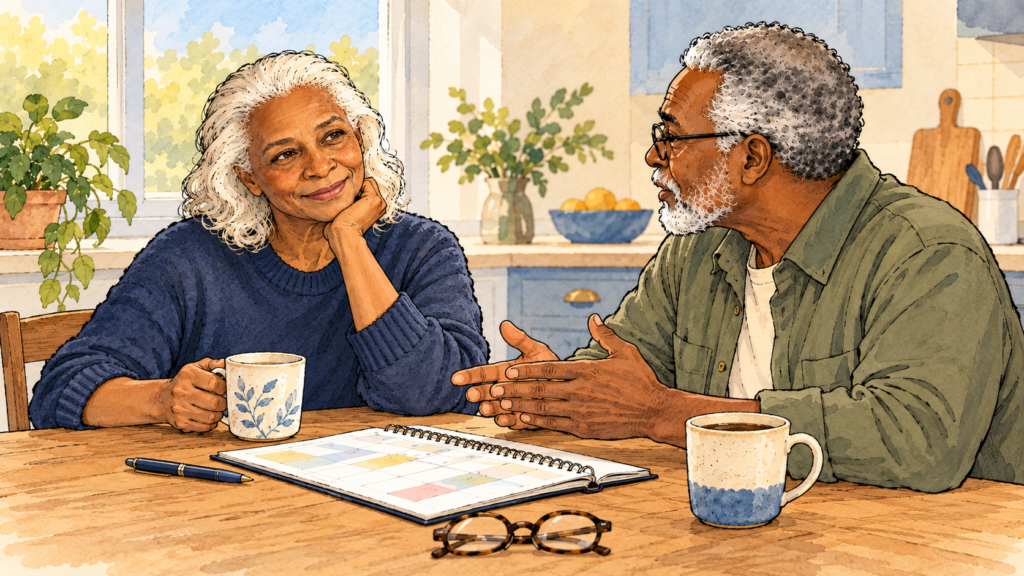
Illness, retirement, caregiving, disability, grief, or shifting capacity can quietly rearrange a long relationship. The challenge is not getting back to who you were. It is learning how to live together as the people you are now.
The Marriage May Not Be the Problem
A marriage can change without betrayal, without a dramatic fight, and without anyone deciding they want a different life. Sometimes the marriage changes because one of the people inside it changes.
A body becomes less reliable. Energy narrows. Retirement alters the rhythm of the day. Grief changes temperament. Caregiving consumes time and attention. Chronic illness makes ordinary tasks expensive in ways they were not before. Suddenly one person cannot do what she used to do, or cannot do it at the same pace, or cannot do it without paying for it later.
That sounds like an individual problem, but inside a long marriage it rarely stays individual for long.
Couples build lives out of repeated patterns. One person handles the bills. One cooks. One drives at night. One makes the social plans. One remembers appointments. One earns more. One does the yard work. One keeps everyone connected. After enough years, these arrangements can become so familiar that they stop looking like arrangements at all. They begin to feel like personality.
Then capacity changes, and the marriage discovers how much of its structure was quietly built around the old version of one person.
When the Old Arrangement Stops Working
That can be disorienting for both people.
The person who has changed may feel ashamed, defensive, guilty, frightened, or simply furious that tasks once done without thought now require planning, help, or recovery. The other partner may feel confused, overburdened, shut out, lonely, or resentful, especially if new responsibilities seem to have appeared without being discussed.
Neither person has to be cruel for tension to grow. Sometimes the old marriage is simply being asked to run on equipment it no longer has. The argument on the surface may be about dinner, errands, money, sex, travel, housework, or who forgot to call someone. Underneath it may be something much harder to say.
I don’t know who we are now. That is often the real work.
The Horse and His Rider
There is an old fable that understands this rather well.
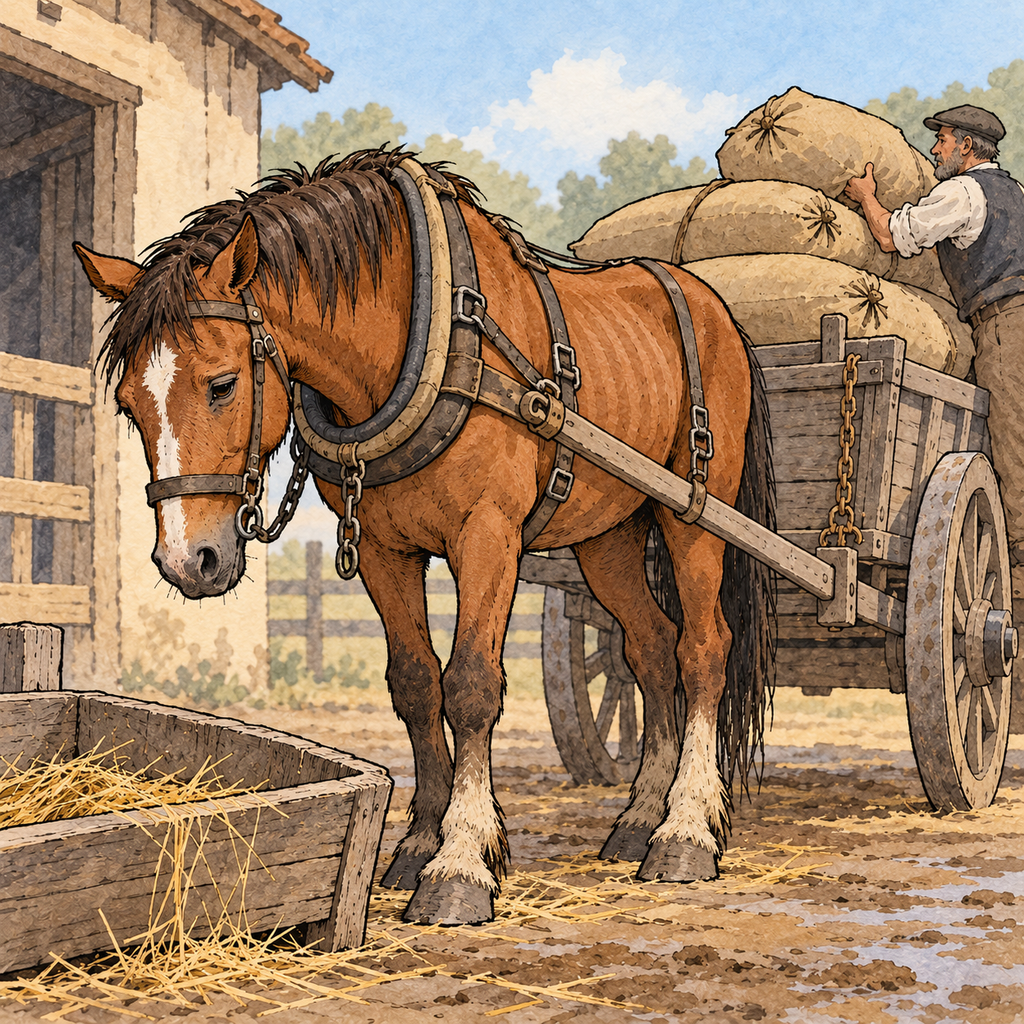
In The Horse and His Rider, a soldier takes good care of his horse while the animal is useful to him in war. The horse is fed properly and treated as a valued partner. Later, when circumstances change, the horse is given poorer food and loaded with hard labor.
Then war returns. The rider does what he has always done. He puts on his armor, saddles the horse, and expects the animal to carry him into battle again. The horse cannot. The rider remembers what the horse used to be able to do. The horse is living in the body he has now.
That small gap between memory and reality is where a great deal of marital strain can live.
One partner remembers, You used to love going out every weekend. The other is thinking, Yes, and I used to recover from it by Monday.
One remembers, You always handled the finances. The other is thinking, Yes, before concentration became exhausting.
One remembers, You never minded having everyone over for the holidays. The other is thinking, I minded less when I could stand in the kitchen for six hours.
The problem is not that the past was imaginary. The problem is that the past can become an unfair measuring stick for the present.
A Change in One Person Becomes a Change in the System
Research on long-term couples dealing with chronic illness, disability, caregiving, retirement, and other major life changes consistently shows that these events affect more than the person whose circumstances changed. Roles shift. Intimacy can shift. Social life may narrow. Responsibilities move. Communication matters more because assumptions that once worked automatically may no longer work at all.
One partner may feel increasingly dependent while the other feels increasingly responsible. One may feel watched over; the other may feel taken for granted. One may be mourning lost independence while the other is mourning the ease of the old shared life.
This is why “getting back to normal” can be the wrong goal. Sometimes normal depended on a version of life that is gone. That does not mean the marriage is gone with it. It means the marriage needs a new arrangement. he useful question is no longer, How do we make everything the way it was? It is, What is true now, and how do we build around that?
Say What Has Actually Changed
That question requires a kind of honesty couples often postpone. It means naming the change without turning the conversation into accusation.
“I can still go out in the evening, but not after a full day of errands.”
“I can cook dinner or clean up afterward, but doing both wipes me out.”
“Since retirement, we are together all day and I need more time alone than you expected.”
“I know you are trying to help me, but when you automatically take over, I feel useless.”
“I am doing more now, and I am getting tired.”
Those statements are not attacks. They are information. And information gives a couple something to redesign.
A great many marital conflicts become uglier than they need to because the real issue has never been named. One person keeps failing at an old expectation. The other keeps interpreting that failure as indifference, laziness, withdrawal, criticism, or rejection.
Sometimes the kinder thing is simply to say, “This does not work anymore.”
Renegotiate the Jobs Before Resentment Does It for You
Long relationships accumulate invisible job descriptions. Who makes appointments? Who manages the money? Who plans meals? Who drives? Who cleans? Who calls family? Who handles repairs? Who keeps the social calendar alive? Who remembers what needs replacing?
When life changes, those jobs need to become visible again. Which tasks still make sense? Which ones can be simplified? Which ones can be shared differently? Which can be dropped? Which are worth paying someone else to do if that is financially possible?
There is no prize for preserving an old division of labor after it stops making sense.
If you have always cleaned the whole house on Saturday and now that takes three days of recovery, the choice is not necessarily between doing it the old way and giving up entirely. You may clean less often, do smaller sections, trade tasks, lower the standard, or hire help.
If one partner can no longer drive comfortably at night, perhaps the other drives. Perhaps outings happen earlier. Perhaps you choose places closer to home.
If fatigue makes cooking unpredictable, the answer may be simpler meals, prepared ingredients, leftovers, or occasional takeout rather than pretending dinner still needs to look like it did twenty years ago.
That is not surrender. It is adaptation.
The Goal Is Not to Turn One Person Into the Patient
Adaptation can go wrong in the other direction too. Serious illness or disability may genuinely require caregiving, but a marriage can become painfully narrow if “patient” and “caregiver” swallow every other identity the couple once had.
A husband becomes the medication organizer. A wife becomes the appointment scheduler. Conversation becomes logistics. Days fill with symptoms, insurance, errands, limitations, and recovery. The relationship still needs places where neither of you is managing the other.
That may be a television series you watch together, coffee on the porch, a drive, breakfast out instead of dinner, music you both love, sitting outside at dusk, or one running joke that still belongs only to the two of you.
These things can sound almost embarrassingly small compared with the lives people once had.
They are not small if they preserve connection.
Both People Are Allowed to Have Needs
Couples tend to cope better when they treat a major stressor as something the relationship is facing together rather than as one person’s private failure. That does not mean the burden will always be equal.
Equal is not always possible. It means both people are allowed to tell the truth.
The person whose capacity changed is allowed to need help without becoming a child. The partner doing more is allowed to admit that doing more is tiring. The person who is ill is allowed to grieve what she lost. The healthier partner is allowed to grieve parts of the old shared life too.
Neither person has to pretend adaptation feels noble every day. Sometimes it feels irritating. Sometimes it feels unfair. Sometimes both people miss the person the other one used to be. That is a difficult truth, but it does not have to become a dangerous one.
Missing the Old Life Is Not the Same as Demanding It Back
There is a difference between grief and expectation. I miss what we used to do is different from You should still be able to do it. I miss how spontaneous we were is different from Why can’t you just push through? I miss the old rhythm of our life is different from You changed everything.
One acknowledges loss. The other assigns blame. That distinction matters enormously. A long marriage will contain more than one version of each person. That is almost the definition of a long marriage.
The young version. The working version. The parenting version. The grieving version. The retired version. The healthy version. The sick version. The independent version. The version who now needs help getting through the airport.
The task is not to freeze the relationship at whichever version felt easiest. The task is to keep recognizing one another as the versions change.
You May Need a Smaller Marriage, Not a Lesser One
There may be fewer trips now. Fewer late nights. Less entertaining. Less spontaneity. Perhaps less sex, or different sex. Perhaps fewer shared activities. Perhaps more time at home. Perhaps more planning than either of you enjoys. That can feel like loss because some of it is loss.
But smaller does not automatically mean poorer. A marriage can become quieter and still become more honest. It can become more limited and still become more tender. It can lose some of its old range and still keep companionship, humor, affection, loyalty, usefulness, and meaning.
The question is not whether the marriage still looks like it did before. The question is whether there is still a life inside it that belongs to both of you.
Carry the Load Differently
The horse in the old fable could not carry the same load simply because the rider wanted the old horse back. Human beings are no different.
Love does not restore lost stamina. Loyalty does not reverse disability. Good intentions do not erase grief. A spouse cannot be argued, encouraged, or guilted into becoming a former version of herself. But a marriage can learn to carry weight differently. That may be the deeper work of a long relationship anyway.
Not staying exactly as you were. Learning, again and again, how to live with who you have both become.
🐎 A Question To Sit With: Has your marriage been trying to preserve an old division of roles that no longer fits the people you are now?
🌿 You Might Also Enjoy
Nobody Warned Me I’d Grieve the Woman I Used to Be. When life changes who we are and what we can manage, we sometimes find ourselves missing the person we used to be. That sense of loss deserves recognition, even when nobody else notices it.
When the Life You Planned Is Gone. Sometimes the future we imagined doesn’t survive the changes life brings. Finding a way forward begins with acknowledging what we’ve lost, rather than pretending it never mattered.
🌿 More Stories for the Life You’re Living
Life changes, sometimes dramatically and sometimes one bewildering little inconvenience at a time.
Join From The Fables for a monthly letter filled with timeless stories, practical wisdom, and a little humor about navigating life’s changes.
And there’s a welcome gift! You’ll receive a free copy of Best I Can Do Is a Mustache, our illustrated, irreverent look at menopause and its many surprises.
GET MY FREE BOOK & MONTHLY LETTER