
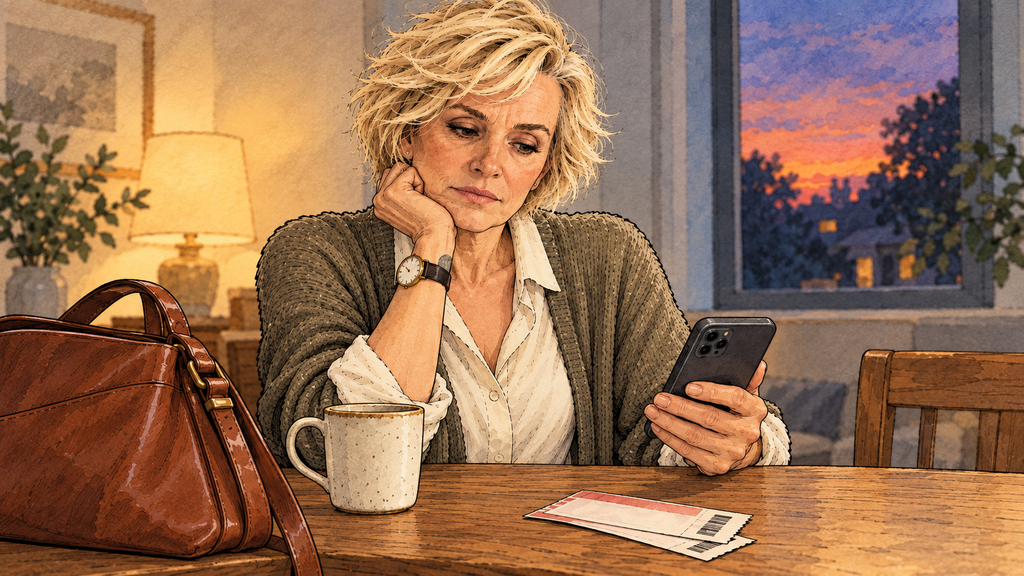
Nothing was buried. Nobody died. But somewhere between the life I expected and the life I’m living, I lost someone I knew by heart.
There are mornings when you remember the woman you used to be, and the memory catches you completely off guard.
Perhaps she was the woman who could clean the entire house on Saturday, entertain friends that evening, and still have enough enthusiasm left to make plans for Sunday. Maybe she worked, volunteered, raised children, traveled, or took care of everybody else without giving much thought to how she would manage.
She wasn’t necessarily happier. She certainly wasn’t perfect. She probably had plenty to complain about, including things you would cheerfully trade for your present troubles.
But she could do things you cannot do anymore. And sometimes you miss her terribly.
The strange part is that nobody seems to recognize this as a loss. There was no funeral for your old energy, no farewell gathering for the career you left, and no sympathy cards when the future you imagined quietly became impossible.
Life simply continued, and everyone expected you to continue with it.
The Loss Nobody Knows You’re Carrying
Some losses are easy for other people to recognize. They come with ceremonies, condolences, and an understanding that life will be different afterward. Others slip into your life so gradually that even you may not realize you’re grieving.
Perhaps you stopped accepting invitations because evenings became exhausting. You surrendered a volunteer position you loved, or discovered that traveling required more planning than pleasure. Maybe your children no longer need you in the same way, your marriage has changed, or the career that once supplied your identity is now something you describe in the past tense.
None of these changes necessarily arrives with one decisive moment of goodbye. Instead, you make another adjustment, cross another activity off the calendar, and tell yourself you’re being sensible. And you are being sensible. But being sensible doesn’t mean you aren’t sad.
There’s also a peculiar guilt attached to this kind of sorrow. You know other people have suffered terrible losses. You know there are still good things in your life. You’re grateful for them. So why do you occasionally feel like crying over something as ordinary as not being able to spend an afternoon wandering through a museum? Because it wasn’t just the museum. It was the freedom to decide what to do with your afternoon without first negotiating with your body, your finances, or your circumstances.
Sometimes the smallest losses represent something much larger.
There’s a Name for This Kind of Grief
Psychologists sometimes describe losses without a clear ending or resolution as ambiguous loss. The concept can help explain certain experiences of chronic illness, changing abilities, and relationships in which the person or life we remember is no longer available in quite the same way.
Researchers studying chronic illness have also described biographical disruption: the way illness can interrupt the familiar story people tell about their own lives. That sounds terribly academic until you recognize what it means.
You used to think of yourself as independent. Now you need help carrying groceries. You were the reliable one, the energetic one, the person everybody called when something needed doing. Now you’re the one canceling plans. The difficulty isn’t always the task itself. It’s what losing that task seems to say about who you are.
A study of women living with fibromyalgia and chronic fatigue syndrome found that illness could profoundly disrupt identity, particularly in work and social relationships. Yet those disruptions were often partial rather than total. Parts of the former identity remained, even as women worked to understand who they were becoming.
That’s an important distinction. Your life may have changed considerably without everything that made it yours disappearing. Still, knowing that intellectually doesn’t necessarily stop you from missing the woman who could do so much more.
And what happens when the person being mourned hasn’t died at all?
Even Jupiter Had Trouble With Grief
An old Aesop fable, Grief and His Due, tells of a rather awkward administrative problem on Mount Olympus.
Jupiter was distributing privileges among the gods when Grief failed to appear. By the time Grief finally arrived to claim his share, everything had already been assigned.
Jupiter was at a loss. What could he possibly give a god who had missed the entire distribution?
Eventually, he decided that Grief should receive the tears people shed for the dead.
Unfortunately, Grief proved an enthusiastic collector. The more devotion people offered him, the more generously he bestowed his own particular gifts. The fable’s traditional warning was that excessive mourning might invite further sorrow.

I’m not entirely convinced that grief operates according to such tidy accounting principles. But I do understand Jupiter’s difficulty.
Where do you put grief when nobody has died?
What portion of sorrow belongs to a lost ability, an abandoned dream, or a life that gradually became smaller than the one you expected?
The old fable reserves Grief’s share for the dead. Real life isn’t nearly so accommodating. Sometimes we mourn possibilities, identities, and familiar versions of ourselves.
Perhaps the important thing isn’t to give Grief everything he asks for, or to deny him a place altogether. Perhaps it’s to recognize that he has arrived for a reason.
Stop Measuring Yourself Against Yesterday’s Woman
One of the cruelest habits we develop during major life changes is continuing to judge ourselves by standards that belonged to entirely different circumstances. Perhaps you once prepared elaborate holiday dinners. Now the thought of shopping, cooking, cleaning, and entertaining makes you want to hide behind the refrigerator. The temptation is to conclude that you’ve become lazy, inadequate, or somehow less generous.
But capacity and character aren’t the same thing.
Instead of measuring yourself against what you once accomplished, try identifying what those activities meant to you.
Was the holiday dinner really about producing twelve side dishes, or was it about gathering people you loved around a table? Was volunteering about the hours you contributed, or the satisfaction of being useful? Was traveling about covering enormous distances, or experiencing something unfamiliar?
This distinction matters because the activity may no longer be possible in its original form, while some of its meaning remains available. A smaller dinner, an occasional telephone call to someone who needs encouragement, or a short excursion planned around your energy may preserve something valuable. They aren’t perfect replacements. They don’t have to be.
The objective isn’t to pretend nothing has been lost. It’s to stop assuming that losing one way of doing something means losing every way of being the person who loved doing it.
Give Yourself Something Useful to Work With
If you’re grieving your former self, begin with something more specific than the enormous question of how to get your old life back. Choose one thing you miss. Write down what it gave you, what now prevents you from doing it, and whether any manageable part of that experience is still possible.
Suppose you miss long walks with a friend. Was it the exercise, the companionship, the changing scenery, or the freedom to spend an hour without responsibilities? Depending on your circumstances, a shorter accessible outing, a visit in the garden, or an unhurried conversation might preserve part of what mattered.
Next, reconsider the expectations you’re carrying. If you can no longer manage a demanding afternoon, planning a shorter one isn’t failure. It’s using the information you have. When you hear yourself thinking, “I should still be able to do this,” try asking, “What would make this possible, or at least easier, with the resources I have now?”
That question moves you toward decisions you can actually make.
Research on self-compassion in chronic illness suggests that treating ourselves with less harshness is associated with lower psychological distress. It doesn’t mean pretending everything is wonderful. It means recognizing that limitations don’t require an additional layer of self-punishment.
And when there truly is no workable substitute, you don’t have to invent one. Some things are gone, and acknowledging that honestly is part of adapting.
You Can Miss Her Without Trying to Become Her Again
The grief of a changing life rarely follows a neat schedule.
You may feel perfectly reconciled to your circumstances for months, then encounter an old photograph, hear about someone’s holiday, or discover that something you managed last year has become difficult. Suddenly, there she is again. The woman you remember. That doesn’t mean you’ve failed to adjust. When life continues to change, old feelings can return in response to new losses.
You can acknowledge the sadness without surrendering your entire future to it. You can also ask for support when you need it, whether from trusted friends, people living through similar changes, or a counselor familiar with grief and chronic illness.
Most importantly, you can stop demanding that gratitude cancel sorrow.
You can appreciate your life and still wish certain parts of it were different. You can value the wisdom you’ve acquired without pretending you’d happily exchange your knees for it.
And you can be proud of the woman you’ve become while occasionally wishing you could spend one more afternoon as the woman you used to be.
The Woman Who Remains
I keep thinking about Jupiter and his unfortunate latecomer. In the old fable, Grief eventually received his share, although the storyteller worried that giving him too much attention would only encourage him. Perhaps that’s where the story still offers us something useful. Grief deserves recognition, but he doesn’t have to manage the entire household.
The woman you used to be helped make you who you are. Her friendships, experiences, humor, mistakes, talents, and stubborn determination didn’t vanish because your circumstances changed.
Some abilities may be gone. Some dreams may no longer fit. But much of what mattered about her is still here, even if it needs a different way to express itself.
You don’t have to pretend you never lost anything. You also don’t have to spend the rest of your life trying to become her again.
There’s still a woman sitting at the kitchen table, with opinions, memories, preferences, humor, and perhaps a rather impressive collection of unfinished projects. She’s worth getting to know, too. And unlike Jupiter, you don’t have to decide how many tears she’s entitled to.
😢 Now, Here’s a Thought…What is one thing about the woman you used to be that you still miss—and what part of her would you most like to carry into the life you’re living now?
🌿 You Might Also Enjoy
You Changed. The Marriage Noticed. When your life changes, your closest relationships can change with it. Even people who love each other may struggle to understand who they’re becoming and what they now need.
When the Life You Planned Is Gone. There’s a particular grief in realizing that the future you expected may never happen. Acknowledging that loss can be an important part of discovering what still lies ahead.
🌿 More Stories for the Life You’re Living
Life changes, sometimes dramatically and sometimes one bewildering little inconvenience at a time.
Join From The Fables for a monthly letter filled with timeless stories, practical wisdom, and a little humor about navigating life’s changes.
And there’s a welcome gift! You’ll receive a free copy of Best I Can Do Is a Mustache, our illustrated, irreverent look at menopause and its many surprises.
GET MY FREE BOOK & MONTHLY LETTER